

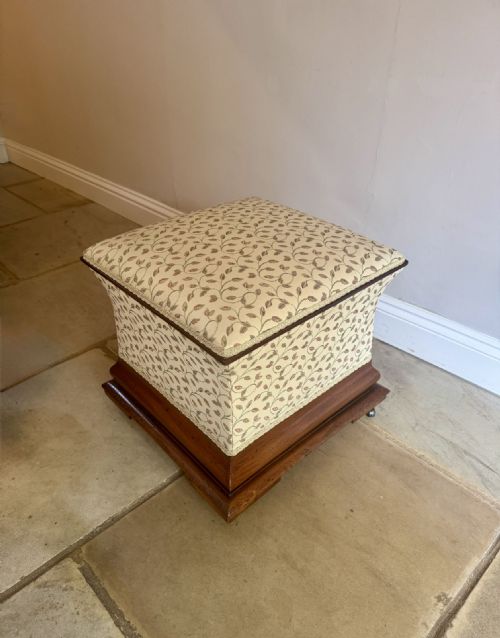
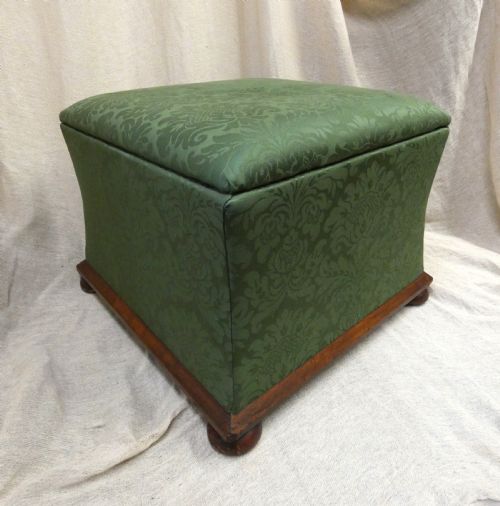


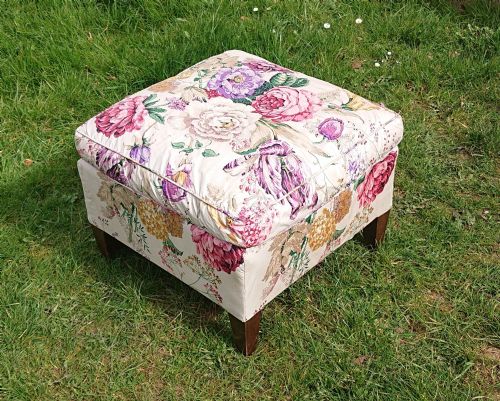


Vintage Square Ottoman
These vintage square ottoman selections bring low-profile seating and padded comfort to a room, offering versatile surfaces and traditional forms.
Vintage Square Ottoman
A vintage square ottoman functions as a low seat, a footrest, or an occasional table depending on its top. When buyers search for a vintage square ottoman, they encounter sturdy wooden frames paired with soft upholstery.
The pieces on this page span the nineteenth century through the early twentieth century, taking the form of footstools, dressing stools, and centre stools. Common historical styles include Victorian, Edwardian, and revival designs such as William and Mary and Georgian.
Wooden frames appear in mahogany, walnut, oak, and general hardwoods, frequently supported by distinct legs. Upholstery varies from needlepoint and herringbone fabric to buttoned leather and caned panels.
How they were made
Cabinetmakers constructed the foundational frames from dense timbers like mahogany, walnut, and oak, often employing robust joinery to support weight. Spiral carving and turned elements demonstrate traditional woodworking techniques applied to the legs and rails.
Upholstered surfaces relied on heavy textiles including wool, patterned herringbone fabric, and stitched leather pulled tightly over padded foundations. Details such as deep buttoning and needlepoint execution required precise manual labour by skilled artisans.
Vintage Square Ottoman Retail Price Guide 2026
Typical asking prices for vintage square ottoman among the pieces listed under this phrase on Sellingantiques today, from the lower quarter to the upper quarter. They describe what is for sale here now, not the wider market.
What varies in quality
Quality rests in the integrity of the timber frame and the precision of decorative woodwork, such as hand-carved spiral details or solid mahogany construction. Pieces that retain their original structural timber without excessive replacement parts hold greater historical integrity.
The execution of the upholstery materials, from finely worked needlepoint to tightly buttoned leather, distinguishes standard output from finer workshop productions. Maker attributions, particularly those associated with firms like Howard and Sons, elevate the standing of a piece.
Howard and Sons
The Vintage Square Ottoman Glossary
- Needlepoint
- A type of canvas work embroidery executed with yarn, often seen covering the tops of nineteenth-century footstools. This textile technique creates dense, durable geometric or floral patterns.
- Buttoned leather
- An upholstery method where leather is pulled into deep indentations secured by buttons, creating a padded and tufted surface. It appears frequently on nineteenth-century centre stools.
- Caned top
- A woven lattice made from peeled cane strips fitted into the wooden frame of a stool or table. This technique provides a lightweight, resilient surface.
- Spiral carved
- A decorative woodworking twist resembling a rope or barley sugar shape, commonly turned onto the wooden legs of walnut and mahogany furniture. It reflects seventeenth-century revival aesthetics.
Vintage Square Ottoman: Frequently Asked Questions
What is a vintage square ottoman?
A vintage square ottoman is a low, padded seat or footstool built during the nineteenth or early twentieth century. These pieces feature square wooden frames with various upholstered or caned surfaces.
They serve multiple functions in traditional interiors, acting as footrests, dressing seats, or casual centre tables. Their compact square proportions make them adaptable to different spaces.
How were nineteenth-century ottomans used?
These items functioned primarily as footstools before armchairs or as low seats near dressing tables. Larger examples served as centre stools in country house drawing rooms.
Their sturdy wooden frames and padded tops provided comfortable support for resting feet or sitting. Some variations also doubled as informal table surfaces when topped with trays.
What materials make up these stools?
Frames utilise hardwoods such as mahogany, walnut, and oak, sometimes accented with brass fittings. Structural stability depended on dense timber construction.
Upholstery materials include leather, wool, herringbone fabric, and needlepoint. Caned panels also appear on specific table-stool hybrids from the Edwardian period.
How do I identify Victorian examples?
Victorian pieces often feature heavy buttoned leather upholstery, dark woods like mahogany or oak, and robust proportions. Construction details align with mid to late nineteenth-century cabinetmaking.
Revival styles from this era frequently borrow motifs from earlier centuries, such as William and Mary spiral turning or Georgian silhouettes.
Are Howard and Sons stools different?
Stools associated with Howard and Sons represent high-quality nineteenth-century English upholstery and frame construction. These pieces are recognised by their specific maker attribution and refined execution.
They command attention from collectors due to the firm's reputation for luxury seating during the Victorian era.