



Vintage Pink Pearls
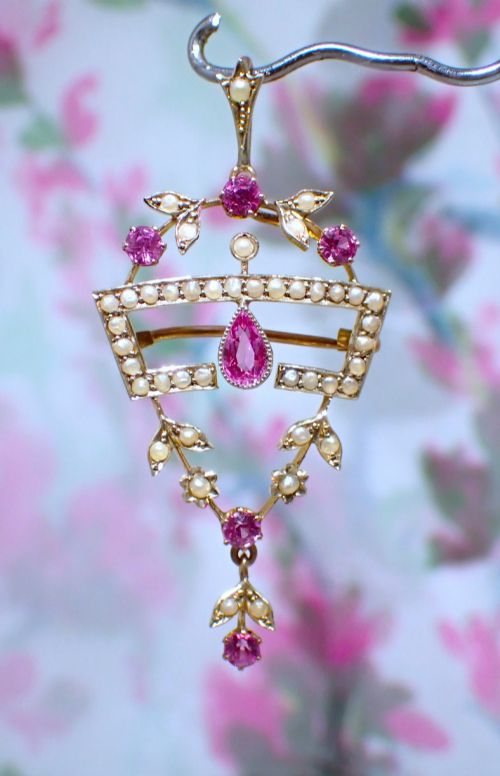
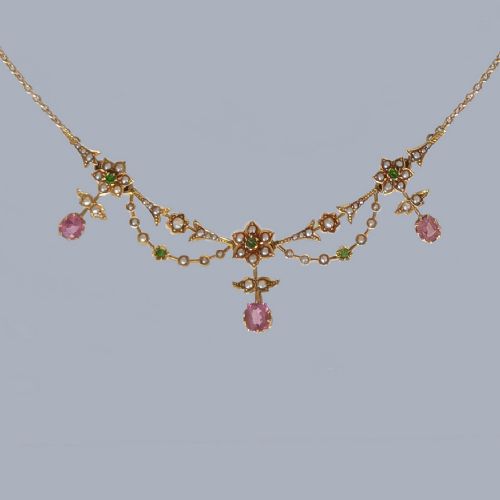
These vintage pink pearls combine soft rose tones with period gold settings, offering a subtle charm that draws collectors of early twentieth-century jewellery.
Vintage Pink Pearls
When searching for vintage pink pearls, buyers encounter delicate necklaces, pendants, and brooches dating from the Edwardian period through to the mid-twentieth century. The selection on this page centres on Edwardian pieces alongside creations from the 1900s, 1910s, 1920s, and 1950s.
The assortment relies heavily on pendants and necklaces, often paired with seed pearls, cultured pearls, and natural pearls. Alongside the pearls, pieces frequently incorporate pink tourmaline, pink sapphire, garnet, aquamarine, diamond, and rose quartz.
Stylistically, these items reflect Edwardian, Art Deco, Art Nouveau, Arts and Crafts, Belle Epoque, and vintage classic designs. Gold purity spans 9ct, 15ct, and 18ct, frequently accompanied by silver and platinum.
How they were made
Goldsmiths of the early twentieth century constructed these mounts using 15ct gold, 18ct gold, and 9ct gold, often combining platinum and silver for detailed stone settings. Fine wirework supported seed pearls and delicate fringe elements.
Pendants and brooches integrate pearls with pink tourmalines, pink sapphires, and enamel work such as plique-à-jour. Master workshops employed casting and hand-assembly to secure small gemstones alongside organic pearls.
Vintage Pink Pearls Retail Price Guide 2026
Typical asking prices for vintage pink pearls among the pieces listed under this phrase on Sellingantiques today, from the lower quarter to the upper quarter. They describe what is for sale here now, not the wider market.
Some Edwardian makers hid tiny seed pearls inside intricate gold wire fringes that swayed with every step.
What varies in quality
The standard of design depends on the complexity of the metalwork, distinguishing simple commercial mounts from intricate Art Nouveau or Arts and Crafts compositions. Hand-formed settings and balanced stone arrangements elevate a piece above standard production.
Material selection divides the range, particularly the inclusion of natural pearls, pink sapphires, and pink tourmalines against lesser seed pearls and paste stones. Maker attribution also plays a role, as signed works from established houses demonstrate superior execution.
Eduard Loss·Liberty and Co
The Vintage Pink Pearls Glossary
- Seed pearl
- A very small natural pearl, often pierced and strung in quantity, typical of Edwardian cluster work and fringe necklaces.
- Plique-à-jour
- An enamelling technique where enamel is applied to open cells without a backing, letting light shine through like stained glass.
- Lavalier
- A pendant featuring a swinging drop stone suspended from a necklace chain, popular during the Edwardian era.
- Belle Epoque
- A period of ornate, light jewellery design spanning the late nineteenth century up to the First World War.
- Fringe necklace
- A necklace featuring hanging drops or tassels suspended along the lower edge of the chain.
Vintage Pink Pearls: Frequently Asked Questions
What periods do these pieces come from?
The listings span the Edwardian era, the 1900s, the 1910s, the 1920s, and the 1950s.
Early pieces frequently display the intricate wirework and precious stones typical of the Belle Epoque and Arts and Crafts movements.
What metals are used in these settings?
Makers utilised 9ct, 15ct, and 18ct gold, alongside silver and platinum.
Higher karat golds and platinum often appear in combination with diamonds and natural pearls.
How were these items worn originally?
Pendants and lavaliers hung from fine gold chains around the neck, while brooches fastened securely to lapels and bodices.
Fringe necklaces draped across the collarbone for evening wear during the early twentieth century.
What stones accompany the pearls?
Pink tourmalines, pink sapphires, garnets, aquamarines, diamonds, and rose quartz frequently accompany the pearls.
Enamel work and paste stones also feature in selected period designs.