

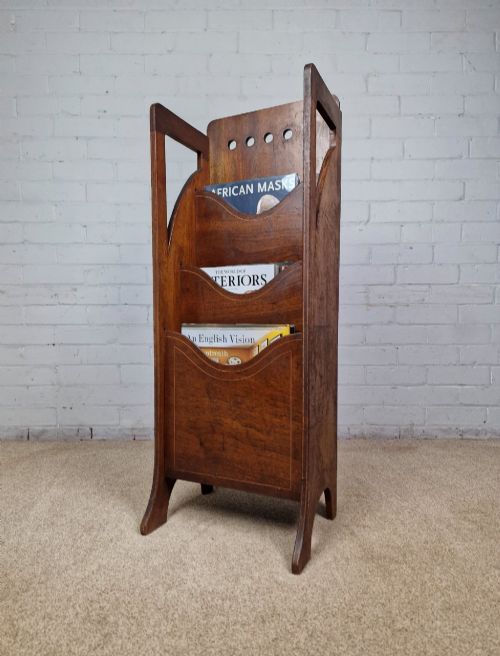


Vintage Periodical
These vintage periodical items are practical pieces of furniture designed to hold journals and papers, offering a glimpse into past reading habits.
Vintage Periodical
When you search for vintage periodical, you are looking at functional items created to organise reading material within the home, ranging from revolving stands to traditional canterburys. The selection spans the Georgian, Victorian, Edwardian, and early twentieth-century periods, showing how households managed their daily newspapers and monthly journals over the decades. You are most likely to encounter freestanding wooden racks and revolving brass and mahogany stands on this page.
The forms vary from simple oak standing racks to refined rosewood and mahogany canterburys featuring carved details and boxwood inlay. Some pieces incorporate brass elements, tubular frames, or rotating actions to allow easy access to books and magazines from any angle. Alongside these stands, you will also find bound volumes of historical magazines dating back to the late eighteenth century.
How they were made
Surface decoration relies on traditional techniques including boxwood inlay, fine carved motifs such as the Prince of Wales feathers, and rich gilt ink lettering found on bound periodical volumes. These methods reflect the prevailing styles of each era, from Regency and Arts and Crafts to Victorian and Edwardian design.
Vintage Periodical Retail Price Guide 2026
Typical asking prices for vintage periodical among the pieces listed under this phrase on Sellingantiques today, from the lower quarter to the upper quarter. They describe what is for sale here now, not the wider market.
Listings feature items spanning the Georgian, Victorian, Edwardian, and 1930s periods, made from mahogany, oak, rosewood, and brass.
What varies in quality
The standard of a piece rests on the choice of timber and the precision of the joinery, with finely grained rosewood and well-figured mahogany representing superior craftsmanship. Metal components also differentiate the pieces, as solid brass fittings and smooth-running revolving mechanisms indicate a higher grade of manufacture than basic plated hardware.
Decorative refinement further separates standard utility items from more ambitious examples, seen in crisp carved details and careful boxwood inlay work. The integration of materials, such as combining polished wood with sturdy brass stands, dictates the overall elegance and durability of the piece.
Finnigans
The Vintage Periodical Glossary
- Canterbury
- A low freestanding rack with slatted partitions, originally designed for holding sheet music or loose periodicals. It typically includes a carrying handle and small legs.
- Revolving bookcase
- A rotating stand mounted on a sturdy base, allowing users to browse a collection of books or magazines from a seated position. It often combines timber shelves with brass hardware.
- Boxwood inlay
- A decorative technique where small pieces of contrasting pale boxwood are set into the surface of a darker timber to create geometric patterns or borders.
- Prince of Wales feathers
- A carved ornamental motif depicting three ostrich feathers emerging from a coronet, frequently used as a decorative flourish on nineteenth-century furniture.
Vintage Periodical: Frequently Asked Questions
What is a canterbury?
A canterbury is a low compartmentalised stand used historically to hold sheet music, books, or periodicals near a chair or table.
Most examples feature slatted wooden divisions and small feet, sometimes incorporating a drawer beneath the main section.
How were revolving stands used?
Revolving stands were placed beside desks or seating areas to keep reference books, newspapers, and magazines within arm's reach.
The rotating mechanism allowed users to access different titles without needing to reposition the entire piece of furniture.
How do I date a piece?
Dating relies on identifying the prevailing wood types, decorative styles, and construction methods associated with specific periods like the Victorian or Edwardian eras.
Details such as boxwood inlay, tubular brass frames, and specific carved motifs offer clear clues to a piece's age.
Are these items suitable for modern homes?
These items integrate easily into contemporary rooms as practical storage for current magazines, art books, or daily newspapers.
Their compact footprints and traditional materials complement both modern and period interiors alike.