

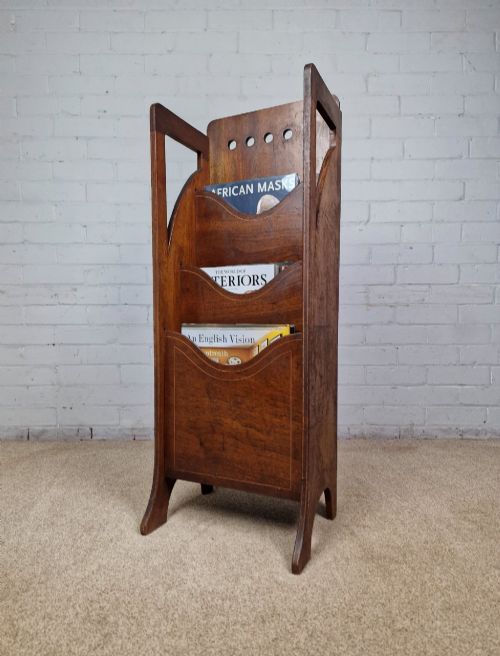


Vintage Periodical Rack
A vintage periodical rack sorts your journals and papers with timber and brass built to last.
Vintage Periodical Rack
A vintage periodical rack brings order to daily papers, weekly journals and monthly magazines through structured timber divisions or revolving metal frames. When you search for a vintage periodical rack, you encounter formats ranging from low floor-standing models to rotating bookstands and compartmented canterburys.
The pieces on this page span the nineteenth century, the Edwardian era, the nineteen-tens and the nineteen-thirties. You meet traditional English canterburys alongside revolving brass and wood stands and upright oak holders.
Makers such as Finnigans produced specific Arts and Crafts interpretations during the early twentieth century. These furnishings combine utilitarian storage with the decorative cabinet-making traits of their respective decades.
How they were made
Cabinet-makers built these racks using solid hardwoods including mahogany, oak, rosewood and satinwood, frequently enhanced by boxwood inlay. Timber sections received careful polishing to show the natural grain of the wood.
Metal components involved tubular brass and metal wire to construct revolving stands, carrying handles and structural dividers. Carved details such as Prince of Wales feathers appeared on specific nineteenth-century pieces.
Vintage Periodical Rack Retail Price Guide 2026
Typical asking prices for vintage periodical rack among the pieces listed under this phrase on Sellingantiques today, from the lower quarter to the upper quarter. They describe what is for sale here now, not the wider market.
One revolving stand lets you spin your morning papers in a full circle before breakfast.
What varies in quality
Quality rests in the selection of timber and the execution of structural joinery rather than mere age. Pieces featuring figured rosewood, satinwood inlay or substantial brass mechanisms demonstrate superior workshop standards.
The refinement of decorative carving and the stability of revolving actions distinguish finer examples from standard utility items.
Finnigans
The Vintage Periodical Rack Glossary
- Canterbury
- A low stand with partitions designed for holding sheet music, books or periodicals. Originating in the late eighteenth century, it often includes a drawer below.
- Boxwood Inlay
- Contrasting light wood inserted into recesses within a darker timber surface to form geometric or floral patterns. This decorative technique appears frequently on Edwardian pieces.
- Revolving Stand
- A central vertical axis supporting a book or magazine holder that turns freely. It allows access to multiple compartments from a single seated position.
- Arts and Crafts
- A design movement valuing honest construction and simple materials over industrial ornament. Pieces from this tradition emphasise plain oak and functional form.
Vintage Periodical Rack: Frequently Asked Questions
What is a canterbury?
A canterbury is a low compartmentalized stand originally built for sheet music and books. These pieces evolved to hold newspapers and magazines.
They often feature carrying handles and small wheels or castors for moving across the floor.
How do revolving racks work?
Revolving racks sit on a central pivot and a heavy metal or wooden base. This mechanism lets you spin the entire holder to reach different compartments.
Such designs save space beside armchairs and desks.
Where should I place a rack?
These stands fit beside armchairs, sofas or desks where reading materials accumulate. Chairside models keep daily newspapers within arm's reach.
Floor-standing versions suit corners or study spaces.
How do I date a rack?
Dating depends on the materials, timber types and decorative styles present. Edwardian pieces often display inlaid boxwood on mahogany, while Arts and Crafts examples use plain oak.
Nineteenth-century models frequently feature heavier rosewood or carved details.