





Vintage Horse Cart Art
These vintage horse cart art pieces capture rural work and rural transport through paintings, watercolours and scale models.
Vintage Horse Cart Art
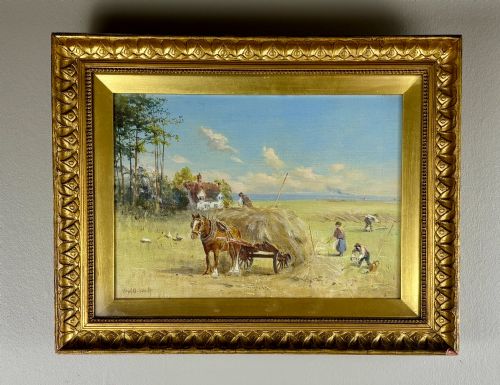
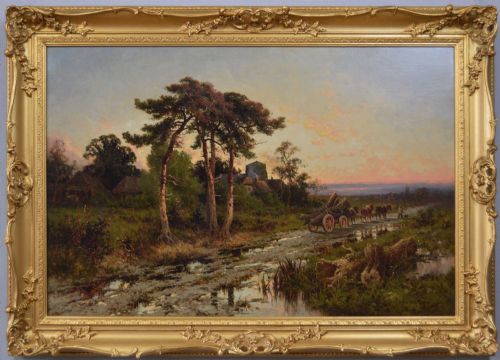
Vintage horse cart art encompasses framed watercolours, oil paintings on canvas, chalk drawings, and wooden scale models depicting working horses and their carts. These works record rural scenes such as hay harvesting, seaweed hauling, logging, and market journeys from the Georgian era through to the 1930s. Buyers look to these pieces for genuine depictions of historical agricultural life.
The selections on this page lean heavily towards British and French watercolours and oil paintings from the Victorian, Edwardian, and early twentieth-century periods. Artists worked in styles ranging from British Realism and British Impressionism to Victorian Pastoral and nineteenth-century French Realism. Alongside paintings, hand-made wooden scale models represent eighteen-century farm carts.
Subjects often focus on specific working tasks like the hay harvest or timber transport, set against regional backdrops including Whitby, Cornwall, and Arundel Castle. The scale models offer a three-dimensional record of agrarian transport, constructed from wood and glass. Together, these paintings and models form a cohesive record of traditional horse-drawn transport.
Materials and technique
Artists utilised traditional media including oil paint on canvas, watercolour pigment on paper, chalk, and gouache. Supports range from stretched canvas and paper to walnut frames and glass glazing for protection. These materials dictated the speed and application of the paint or pigment.
Makers of the scale models used wood to construct detailed representations of farm carts. These physical models relied on precise carpentry and hand-made components to replicate full-size agricultural vehicles. The combination of paper, canvas, watercolour, and wood defines the physical nature of these works.
Vintage Horse Cart Art Retail Price Guide 2026
Typical asking prices for vintage horse cart art among the pieces listed under this phrase on Sellingantiques today, from the lower quarter to the upper quarter. They describe what is for sale here now, not the wider market.
Some horses on this page clearly know they are posing for posterity.
Distinguishing quality
Quality rests upon the artist's handling of light, atmosphere, and the anatomy of the working horses. Stronger pieces display confident brushwork or pigment control that brings movement to a harvest scene or a ford crossing. Weaker examples rely on stiff repetition and lack atmospheric depth.
The integrity of the framing and the preservation of the paper or canvas matter greatly. Works that retain their original walnut frames or early twentieth-century glazing present a more complete historical object. Condition issues such as fading or foxing on watercolour paper directly influence the visual strength of the piece.
Cecil Charles Windsor Aldin·James William Booth·Léon Joseph Voirin·John Augustus Atkinson·George Hamilton Constantine·Herbert Royle·Frederick William Jackson·Walter Duncan·Snaffles·George Turner·Frank Saltfleet·Henry H Parker·William Kay Blacklock·Alfred George Stevens·Fred Lawson·John Baragwanath King·Reginald Mills·Robert Thorne Waite·JE Hood·Lois Wilton
The Vintage Horse Cart Art Glossary
- Watercolour pigment
- A colourant suspended in a water-soluble vehicle, applied to paper to create transparent washes of tone. This medium allows for rapid sketching of outdoor rural scenes.
- Gouache
- An opaque water-based paint that includes a white pigment to create denser, heavier colour applications. Artists utilised gouache for stronger highlights in landscape works.
- Scale model
- A physical representation of an object maintained in accurate proportion to its original size. These hand-made wooden pieces record agricultural cart design.
- British Impressionism
- A painting style focusing on light and everyday subjects, practiced by British artists during the late nineteenth and early twentieth centuries. This approach informed many rural harvest depictions.
- Chalk drawing
- An artwork created using dry pigment pressed into sticks, often worked on tinted paper. Cecil Charles Windsor Aldin utilised this medium for lightweight cart depictions.
Vintage Horse Cart Art: Frequently Asked Questions
What periods do these artworks cover?
The pieces span from the Georgian period in eighteen-hundred through the Victorian and Edwardian eras, extending into the nineteen-thirties. Artists recorded rural life across these changing decades using contemporary artistic styles.
Earlier pieces often reflect romanticised agrarian scenes, while twentieth-century works capture a changing British countryside.
Where do the landscape settings come from?
The landscapes depicted are specific regional locations across Britain and France, including Whitby in Yorkshire, Cornwall, and Arundel Castle. Artists travelled to these working rural environments to paint harvests, coastal scenes, and logging carts in situ.
This direct observation provides a dependable record of regional topography and farming practices.
How should I care for a watercolour painting?
Watercolour pigments on paper require protection from direct sunlight to prevent fading of the delicate washes. Framing under glass with acid-free mounts safeguards the paper from environmental moisture and atmospheric pollution.
Displaying these works in stable indoor conditions preserves the integrity of the original paper support.