
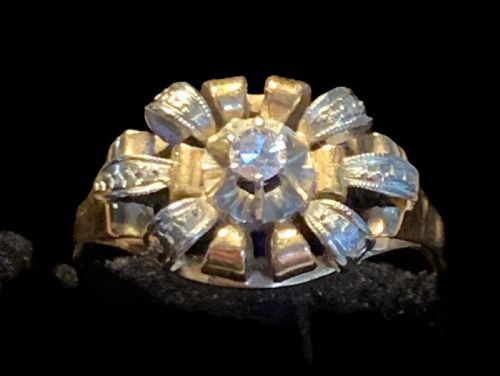
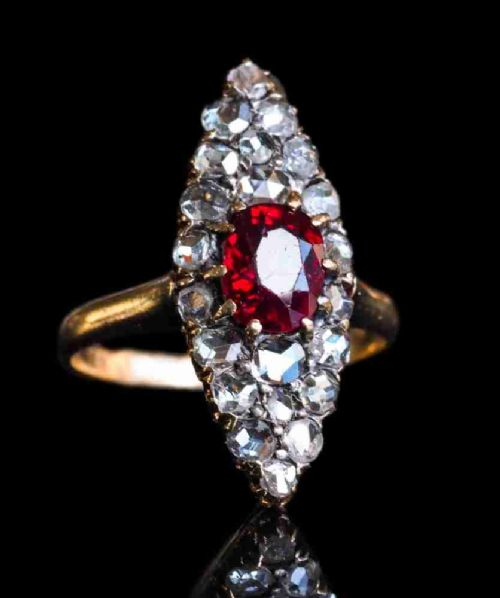


Vintage French Dress Ring
A vintage french dress ring brings together the distinctive weight of continental workshop design and a focus on statement gemstones.
Vintage French Dress Ring
A vintage french dress ring represents a category of finger ornaments designed primarily for visual impact rather than betrothal. The examples gathered here span from the delicate curves of the Edwardian era through the sharp geometry of Art Deco and into the bolder volumes of mid-century production.
Buyers will find that the forms vary considerably, encompassing elongated navette shapes, geometric cluster rings, and substantial tank profiles. Platinum and yellow or white gold serve as the primary structural foundations for these varied silhouettes.
The stones mounted within these settings define much of their character, ranging from untreated sapphires and emeralds to old-cut diamonds and cultured pearls. Each piece carries the distinct stylistic markers of its specific decade of manufacture.
Construction and materials
The materials recorded in these listings rely heavily on a combination of platinum and eighteen-carat gold, often utilised in white or yellow variants to contrast with the stones. Platinum provides the strength required for intricate pierced work and pavé settings without adding excessive bulk.
Gemstone integration relies on traditional techniques such as claw settings for solitaires and flush or pavé arrangements for smaller melee diamonds and calibré-cut rubies or sapphires. Goldsmiths matched the metal colour to the prevailing aesthetic of the period, favouring platinum for crisp white finishes and gold for warmer tones.
Current listings feature pieces spanning from the Victorian era through the 1960s, constructed in platinum, gold, and various gemstones.
Assessing the range of execution
Quality in these pieces is dictated by the precision of the metalwork and the integration of the components. Superior examples display seamless transitions between platinum settings and gold shanks, with hand-finished piercing that remains crisp and symmetrical.
The selection of the central gemstones heavily influences the standing of a ring, particularly regarding the natural origin and saturation of sapphires, rubies, and emeralds. Higher tiers of manufacture maintain strict alignment in pavé-set stones, where every element sits flush and secure within its channel.
Boucheron
The Vintage French Dress Ring Glossary
- Navette
- A boat-shaped ring setting that tapers to points at either end. This silhouette extends visually along the finger.
- Tank ring
- A bold, chunky ring style developed during the mid-twentieth century. It draws inspiration from military vehicle tracks with stepped, voluminous metal shoulders.
- Calibré cut
- Gemstones specifically shaped to fit a precise geometric space within a setting. This technique is common in Art Deco geometric patterns.
- Pavé
- A method of setting multiple small stones close together. Tiny beads of metal hold the gems in place, creating a continuous surface of sparkle.
- Transitional cut
- A diamond cutting style used during the period when old European cuts evolved into modern brilliant cuts. It bridges nineteenth-century facet arrangements with twentieth-century symmetry.
Vintage French Dress Ring: Frequently Asked Questions
What defines a vintage french dress ring?
These pieces are decorative finger ornaments originating from French workshops across the late nineteenth and twentieth centuries. They prioritise bold designs, prominent gemstones, and stylistic movements such as Art Deco and Edwardian.
Buyers select them for their distinct continental character and varied use of precious metals like platinum and eighteen-carat gold.
How do I wear a cocktail ring daily?
Cocktail rings and large dress rings work well as standalone pieces on the hand to avoid gemstone abrasion. Pairing them with simpler bands lets the central cluster or navette shape remain the visual focal point.
Consider removing them during manual tasks to protect delicate claws and softer stones like pearls or emeralds.
How can I tell an Art Deco ring apart?
Art Deco pieces rely on strict symmetry, linear geometry, and the widespread adoption of white metals like platinum. They frequently incorporate calibré-cut rubies or sapphires alongside transitional-cut diamonds.
This aesthetic contrasts sharply with the flowing, organic lines of earlier Edwardian or nineteenth-century designs.
What is a tank ring?
Tank rings emerged around the mid-twentieth century, featuring heavy, volumetric gold or platinum construction. Their stepped shoulders and blocky profiles reflect the industrial aesthetic of the period.
They often house channel-set diamonds or synthetic rubies within their substantial metal architecture.