

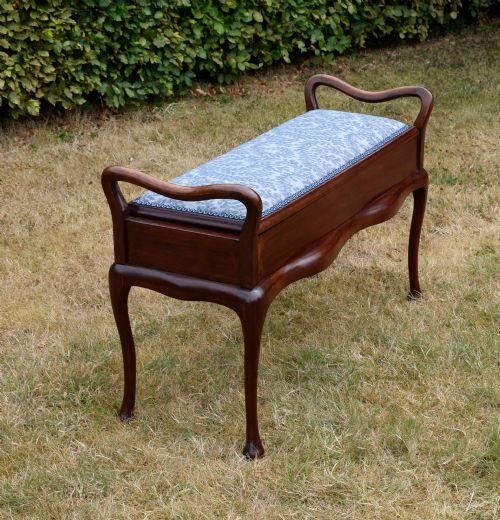


Vintage Duet Stool
A vintage duet stool gives two players room at the keyboard, combining period timber frames with upholstered seats.
Vintage Duet Stool
A vintage duet stool is a wider seat designed for two people to sit together at a piano or instrument, though these benches also serve as window seats. Buyers searching for a vintage duet stool will find pieces originating from the Edwardian period, 1890, 1900, 1920, and 1860.
The most common examples on this page are Edwardian mahogany piano stools, often featuring inlaid woodwork. Other forms include Art Deco music stools, Georgian Revival window seats, and French gilt or provincial stools.
Makers and craftsmen built these long benches to accommodate dual seating while matching the formal furniture styles of their respective eras, such as Queen Anne Revival or Louis XVI.
How they were made
Seats incorporate various upholstery materials including fabric, velvet, leather, and tapestry. Hardware components like brass add functional and decorative touches to the joints and feet.
Vintage Duet Stool Retail Price Guide 2026
Typical asking prices for vintage duet stool among the pieces listed under this phrase on Sellingantiques today, from the lower quarter to the upper quarter. They describe what is for sale here now, not the wider market.
Materials across these seats combine mahogany, walnut, and giltwood with fabric, velvet, leather, and tapestry upholstery.
What varies in quality
Quality rests in the crispness of the timber carving and the precision of any wood inlay. Superior pieces display refined joinery in the mahogany or walnut frame rather than simple box construction.
The choice of covering material and the durability of the underlying upholstery frame separate standard workshop output from finer examples. Giltwood and detailed French styling also shift a piece into a different decorative tier.
The Vintage Duet Stool Glossary
- Duet stool
- A wide bench built to seat two musicians side by side at a piano. These pieces often feature hinged lids for sheet music storage.
- Inlay
- A decorative technique where contrasting strips of wood are set flush into the primary mahogany or walnut surface.
- Giltwood
- Timber treated with gold leaf or gold paint to create a rich, reflective surface finish.
- Edwardian
- A stylistic period spanning the early twentieth century, known for lighter proportions and revivals of earlier furniture designs.
Vintage Duet Stool: Frequently Asked Questions
What is a duet stool used for?
A duet stool provides extended seating for two people sharing a piano bench during practice or performance. They function equally well as window seats or hallway benches in traditional interiors.
Their elongated proportions give them a distinct footprint compared to standard single piano seats.
How do I identify an Edwardian piano stool?
Edwardian piano stools typically feature mahogany frames with delicate inlaid decoration and tapered legs. They date from the early twentieth century and often incorporate upholstered fabric or velvet seats.
Look for light timber tones and refined proportions characteristic of the period.
Are all duet stools meant for pianos?
While many were built specifically as music stools with internal storage, others function simply as window seats or benches. Examples styled after French provincial or Georgian Revival designs served general living spaces.
The upholstery and frame depth often indicate whether a piece belonged in a music room or a drawing room.
What woods were used for these stools?
Mahogany and walnut form the primary structural timbers for these period benches. Giltwood also appears on French-influenced decorative pieces from the mid-nineteenth century.
Craftsmen selected these hardwoods for their strength and suitability for fine turning and inlay.