



Vintage Coaching Scene
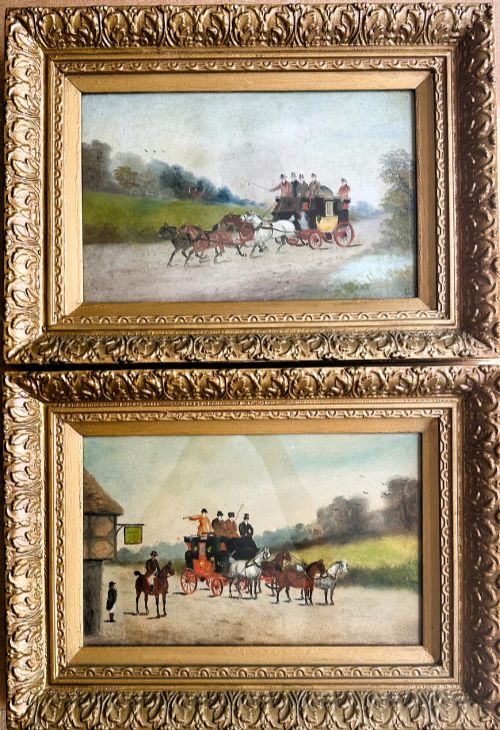
These vintage coaching scene works capture traditional British travel and sporting life through oil paintings, watercolours, prints, and copper mirrors.
Vintage Coaching Scene
A vintage coaching scene depicts stagecoaches, mail coaches, horses, and hounds across various periods including the nineteenth century, Victorian era, and Edwardian times. These pieces record historic British transport and rural travel through traditional artistic mediums such as oil paints, watercolours, and colour lithographs.
The items found on this page range from framed equestrian sporting paintings and watercolours to decorative copper wall mirrors and hand-painted tole ware tobacco boxes. Buyers primarily encounter traditional British sporting artwork depicting road travel, hunts, and coaching inns.
Originating largely from the nineteenth and early twentieth centuries, these works reflect the enduring appeal of equine subjects and historical transport themes. Artists utilised canvas, paper, wood, and glass to portray horses, riders, and coaches in winter scenes, rural settings, and famous stops.
Materials and methods
The works rely upon oil paint on canvas or board, alongside delicate watercolours on paper and printed colour lithographs. Artists utilised traditional British sporting techniques to capture fine details of horses, harnesses, and carriages.
Decorative pieces incorporate embossed copper framed in wood or giltwood, alongside hand-painted tole ware. These materials showcase the craftsmanship of the Arts and Crafts and Victorian periods through metalwork and painted surfaces.
Vintage Coaching Scene Retail Price Guide 2026
Typical asking prices for vintage coaching scene among the pieces listed under this phrase on Sellingantiques today, from the lower quarter to the upper quarter. They describe what is for sale here now, not the wider market.
A painted tole ware tobacco box sits quietly alongside monumental oil paintings of galloping stagecoaches.
Evaluating quality and execution
Quality rests in the precision of the brushwork and the anatomical accuracy of the horses, hounds, and figures depicted by the artist. Master painters capture motion and lighting effectively, whereas lesser examples lack anatomical definition and spatial depth.
The standard of framing and the preservation of the original medium, whether oil on canvas or copper repoussé, influence the overall presentation. Signed works by recognised sporting painters demonstrate superior artistic execution compared to anonymous output.
Philip Rideout·George Wright·Philip Henry Rideout·Samuel Henry Alken·John Richard Worsdale·Frank Dadd·John Atkinson
The Vintage Coaching Scene Glossary
- Lithograph
- A print made from a flat stone or metal plate on which an image is applied using an oil-based substance. This technique allowed for the mass production of detailed colour prints during the Victorian period.
- Tole ware
- Metalware painted and lacquered, often with hand-applied decoration, used for household items such as boxes and trays. It reflects traditional decorative craft methods.
- Oil painting
- A work created using pigments bound with a drying oil, typically applied to canvas or wood panels. This medium allows for rich colour depth and fine detail in equestrian scenes.
- Watercolour
- A painting method where paint is made of pigments suspended in a water-based solution, typically applied to paper. It yields transparent, luminous washes often seen in preparatory sketches and finished pastoral views.
Vintage Coaching Scene: Frequently Asked Questions
What periods do these pieces date from?
The pieces span from the nineteenth century through the Edwardian era up to the nineteen-thirties. They reflect traditional British sporting and rural subjects popular across those decades.
Craftsmanship and artistic styles shift from Victorian realism to Arts and Crafts metalwork and early twentieth-century watercolour traditions.
How were coaching scenes used originally?
Paintings and framed prints hung in country houses, inns, and clubs to celebrate equestrian sports and historical travel. Copper mirrors and painted boxes served decorative and utilitarian functions in period interiors.
These objects celebrated the culture of stagecoaches, mail coaches, and fox hunting before the widespread adoption of rail travel.
How do I identify a Victorian painting?
Victorian paintings often feature detailed brushwork, narrative compositions, and subjects related to horses, hounds, and rural coaching inns. The framing and canvas materials typically conform to nineteenth-century workshop practices.
Signatures from established sporting artists of the period provide definitive attribution for many works.
Where do copper wall mirrors fit in?
Copper wall mirrors from the Arts and Crafts movement feature hand-hammered frames and decorative motifs. They complement coaching scenes by bringing period metalwork and tactile surfaces into the same room.
These pieces emphasise handcrafted textures rather than mass-produced factory decoration.