

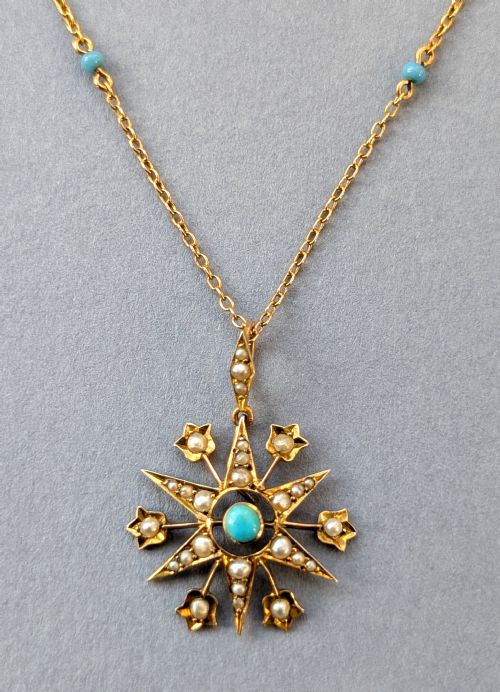


Victorian Star Necklace
A victorian star necklace captures the celestial fascination of the nineteenth century through cluster-set diamonds, seed pearls, and turquoise.
Victorian Star Necklace
A victorian star necklace brings together celestial motifs and nineteenth-century craftsmanship, capturing the period's obsession with the night sky. When searching for a victorian star necklace, buyers encounter varied interpretations of astral symbolism, from diamond-set starbursts to seed pearl clusters.
The pieces listed on this page span the Victorian era, Edwardian period, and around nineteen hundred. Surviving examples take the form of pendants, necklaces, and versatile pendant brooches that transition easily from daywear to evening attire.
How they were made
Goldsmiths worked primarily in nine-carat and fifteen-carat yellow gold, shaping metal to support intricate stone settings. Central motifs were fashioned with multi-pronged or closed-back settings that held small old-cut diamonds.
Gemstones such as turquoise, seed pearls, garnet, and red rock crystal were meticulously arranged around central stellar points. Many items doubled as pendants and brooches, requiring robust hinges and pin mechanisms integrated safely into the reverse of the gold framework.
Victorian Star Necklace Retail Price Guide 2026
Typical asking prices for victorian star necklace among the pieces listed under this phrase on Sellingantiques today, from the lower quarter to the upper quarter. They describe what is for sale here now, not the wider market.
Nineteenth-century star necklaces let you wear your own personal night sky, minus the chilly walk home.
What varies in quality
The integrity of the conversion mechanisms, such as detachable bails and secure pin fittings, also distinguishes finer pieces. Artistry shines in the delicate symmetry of the star points and the substantial weight of the underlying gold.
The Victorian Star Necklace Glossary
- Starburst
- A decorative motif radiating outward from a central point to mimic a shining star. These designs frequently incorporate diamonds or pearls to enhance the luminous effect.
- Seed Pearl
- Very small, naturally occurring pearls often drilled and strung or threaded onto fine silk. They appear closely clustered to form floral or celestial patterns in nineteenth-century jewellery.
- Old Cut
- A diamond cutting style prevalent before modern brilliant facets were standardised. These stones feature high crowns and small tables that catch candlelight warmly.
- Cabochon
- A gemstone shaped and polished with a smooth, rounded surface rather than faceted edges. This style is often utilised for turquoise, garnet, and opal settings.
- Pendant Brooch
- A versatile item fitted with both a suspension loop for a chain and a pin mechanism for garments. This dual functionality allowed Victorian wearers to pin the piece to a bodice or hang it from a necklace.
Victorian Star Necklace: Frequently Asked Questions
How do I wear a convertible star pendant?
These versatile pieces often feature a hidden or folding loop alongside a secure pin on the reverse. You can thread them onto a fine gold chain for daily wear or attach them directly to heavy fabric as a brooch.
When converting the piece, check that the pin clasp fastens tightly to prevent loss during movement.
What periods do these star necklaces cover?
The pieces originate primarily from the Victorian era, extending slightly into the Edwardian period and around nineteen hundred. Victorian examples often lean heavily into celestial themes with heavy yellow gold settings.
Later Edwardian items frequently combine pearls and turquoise with lighter, airier metalwork while retaining the popular starburst shape.
How are seed pearls secured in place?
Seed pearls are traditionally threaded onto fine silk or fine wire and secured individually within tiny individual cups or prongs. Goldsmiths arranged them densely to create textured surfaces that mimic celestial bodies.
Keeping these delicate pearls dry helps preserve their natural lustre and prevents the underlying thread from weakening over time.
What gold carats should I expect?
Nineteenth-century items commonly utilise nine-carat and fifteen-carat yellow gold for structural durability and rich colour. Higher carat gold offers a deeper hue that contrasts effectively against white diamonds and pale pearls.
The metalwork weight varies depending on whether the piece was designed as a lightweight daytime pendant or a substantial evening brooch.