


Victorian Slate Table Clock
A victorian slate table clock brings solid weight and architectural presence to a room, offering dependable timekeeping encased in dark stone.
Victorian Slate Table Clock
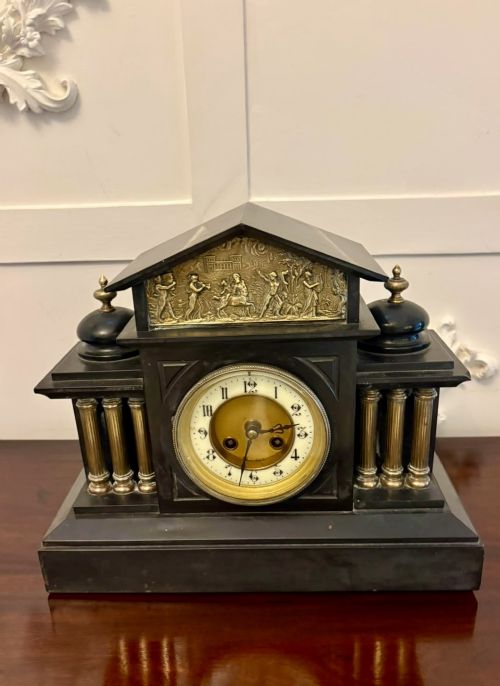
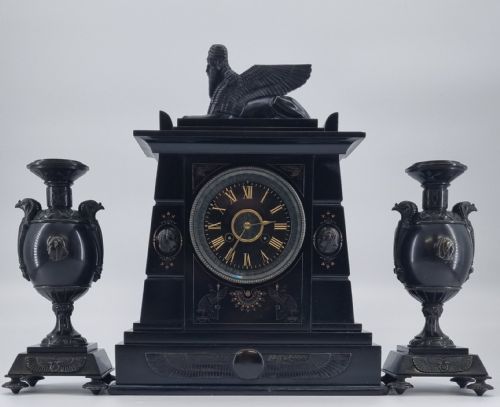
When you search for a victorian slate table clock, you encounter heavy stone timepieces built during the nineteenth century. These objects typically take the form of mantel clocks, desk compendiums, or larger garniture sets accompanied by side pieces.
The versions you meet most frequently on this page date from the 1860s through to the 1890s, often drawing on classical architectural motifs or Egyptian Revival styles. They stand solidly on flat surfaces, designed to command attention through sheer mass and austere geometry.
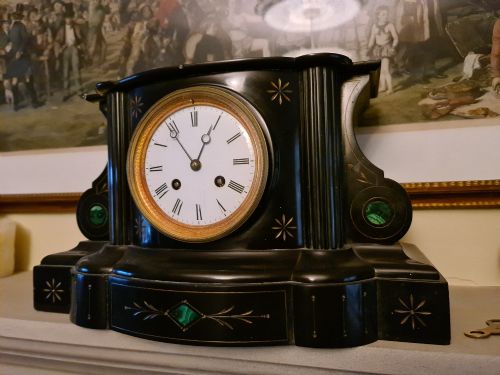
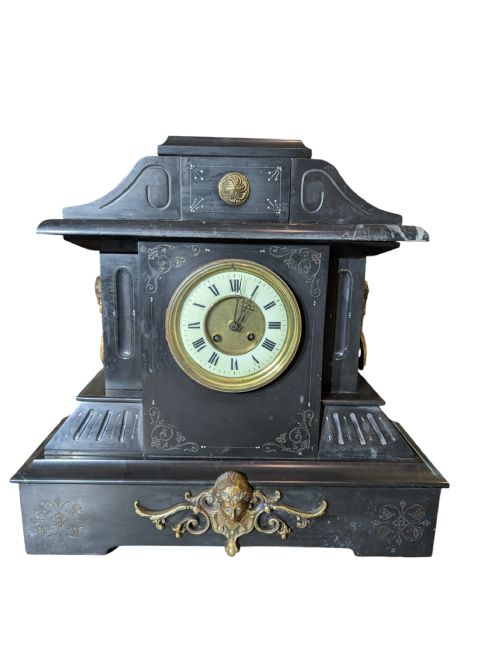
Many examples incorporate contrasting marble inlays, gilt brass mounts, or bronze details alongside the primary black stone body. Dial configurations range from standard white enamel faces to specialised perpetual calendars and moon phase displays.
Materials and construction
Makers shaped heavy blocks of black slate and marble into architectural cases, frequently utilising faux finishes or contrasting green and red marble inserts. These dense stone bodies were polished to a smooth finish and occasionally inlaid with coloured stone segments or geometric patterns.
Metal components such as brass, bronze, and gilt mounts were cast and fitted to the stone cases, framing the enamel dials and glass bezels. Movements typically featured eight-day mechanisms, including chain fusee systems or pendulum regulations housed securely behind the stone housing.
Judging quality and execution
Superior examples distinguish themselves through the precision of the stone cutting, the crispness of architectural details, and the integration of high-grade movements by notable makers. The depth and execution of marble inlays and bronze ornamentation separate standard production pieces from exceptional works.
The complexity of the internal mechanism plays a significant role, with perpetual calendars, equation of time complications, and penny moon dials elevating the standing of the piece. Well-balanced proportions and harmonious use of contrasting auxiliary garnitures complete the upper tier of the range.
Philippes Paris·Baby and Jannings·D Munsey of Cambridge·Barraud and Lund London·Brocot
The Victorian Slate Table Clock Glossary
- Garniture
- A set consisting of a central clock flanked by matching decorative side pieces such as urns or obelisks. These matched groups were designed to sit harmoniously on a mantelpiece.
- Fusee
- A conical pulley used in clock movements to maintain an even pull on the gear train as the mainspring unwinds. This mechanism improves the timekeeping accuracy of the clock.
- Enamel
- A glassy substance fused to a metal dial face under high heat to create a smooth, durable surface for painted numerals. White enamel dials provide high contrast for reading the time.
- Egyptian Revival
- A nineteenth-century decorative style inspired by ancient Egyptian motifs such as sphinxes, obelisks, and hieroglyphic patterns. This aesthetic heavily influenced architectural clock cases.
- Perpetual Calendar
- A clock mechanism that automatically adjusts for the differing lengths of months and leap years. Such complications represent advanced horological skill.
Victorian Slate Table Clock: Frequently Asked Questions
How do I wind a victorian slate table clock?
Most of these clocks use an eight-day movement that requires winding via a key inserted into the dial holes. Turn the key gently until you feel firm resistance, taking care not to over-wind the mainspring.
Ensure you handle the pendulum and internal components with care during any movement, and consult a professional horologist if the mechanism resists or fails to hold power.
Where should I place a heavy slate clock?
Due to their substantial weight, these clocks require a sturdy, level surface such as a strong mantelpiece, heavy sideboard, or dedicated desk. Placing them on an unstable shelf risks damage to both the furniture and the stone case.
Keep the clock away from direct sunlight, damp environments, and extreme temperature fluctuations to protect the internal metal parts and the exterior marble finishes.
What is an architectural mantel clock?
Architectural mantel clocks are designed to mimic classical buildings, temples, or monuments using stone columns, pediments, and plinths. Makers used the dark surface of slate to create miniature facades reminiscent of ancient structures.
These pieces often feature heavy cornices and stepped bases that emphasise their solid, sculptural presence within a room.
How do I identify an Egyptian Revival clock?
Egyptian Revival clocks display specific decorative motifs drawn from pharaonic art, including winged sun disks, lotus columns, sphinx figures, and bronze or gilt highlights. These elements are integrated directly into the slate or marble housing.
Such designs became particularly popular during the mid-nineteenth century, reflecting broader European fascination with archaeological discoveries in Egypt.