



Victorian Overlay Glass
These brilliant pieces of victorian overlay glass combine layered hues and precise cutting to catch the light from every angle.
Victorian Overlay Glass
When you search for victorian overlay glass, you encounter objects formed by fusing a layer of coloured glass over a base of clear, crystal, or contrasting hue. The selection spans the nineteenth century, with origins centred primarily in English, French, and Bohemian workshops.
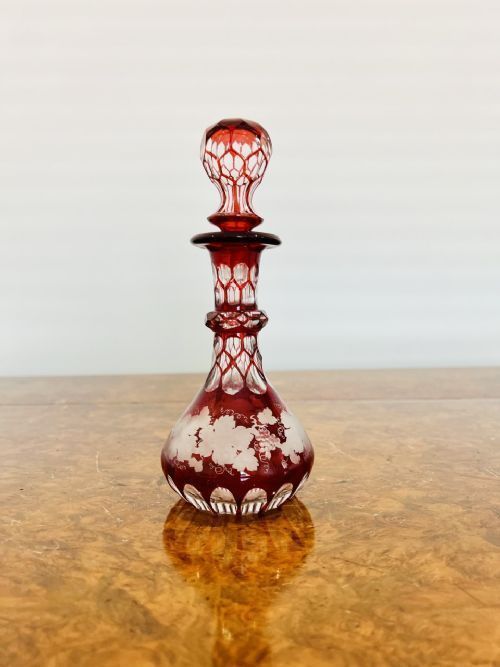
The most common forms on this page include scent bottles, decanters, vases, and champagne coupes. Scent bottles frequently incorporate silver mountings or chatelaines, while larger display items such as lustres and garniture sets showcase deep wheel-cutting through the outer coloured layer.
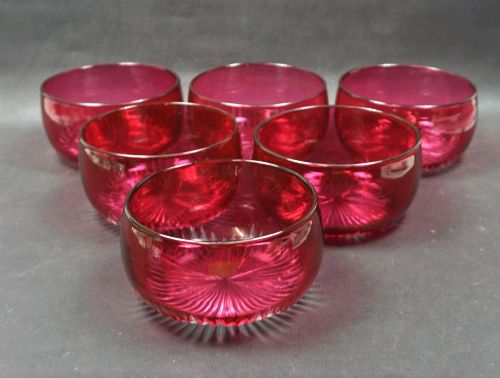
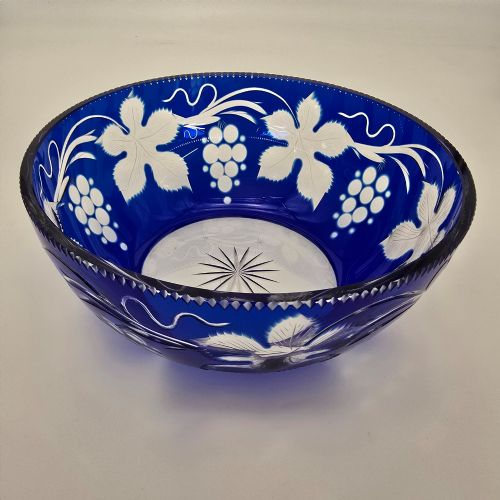
Bohemian and English pieces dominate the selection, often rendered in rich tones of cranberry, green, ruby, and cobalt blue. These items range from compact miniature scent flasks to tall hock decanters and pairs of matching goblets.
Materials and technique
The method relies on gathering a primary parison of clear lead crystal or glass and dipping it into a crucible of molten coloured glass before blowing the vessel to shape. Once annealed, artisans utilise wheels and abrasive stones to cut through the exterior coloured stratum down to the base layer, creating stark contrasts in pattern.
Further ornamentation frequently involves hand gilding with gold leaf, enamel application, and detailed copper-wheel engraving depicting vines, birds, or floral motifs. Metal mounts in silver, sterling silver, or gilt brass are then fitted to functional items like perfume bottles and claret jugs.
Victorian Overlay Glass Retail Price Guide 2026
Typical asking prices for victorian overlay glass among the pieces listed under this phrase on Sellingantiques today, from the lower quarter to the upper quarter. They describe what is for sale here now, not the wider market.
Materials documented in current stock include lead crystal, sterling silver, gold leaf, and vibrant glass colours such as cranberry, ruby, emerald, and cobalt.
Assessing the range
Distinctions in quality rest upon the depth of the colour saturation and the precision of the wheel-cut facets. Superior examples display crisp borders between the layered colours where the cutting reveals the underlying crystal without jagged edges or bleed.
The finesse of the supplementary decoration dictates the upper tier of the market, where meticulous hand-engraving and intact fire-gilding elevate standard vessels into notable decorative works. Weight and the acoustic resonance of the lead crystal also signal superior composition in larger forms like decanters and goblets.
Jean Gille·Baccarat
The Victorian Overlay Glass Glossary
- Overlay glass
- A vessel comprising two or more distinct layers of glass fused together during manufacture, allowing artisans to cut away portions of the outer layer for decorative contrast.
- Cased glass
- A term often interchangeable with overlay, denoting glass blown in multiple concentric layers of differing colours.
- Cut to clear
- A decorative technique where the thick outer casing of coloured glass is deeply ground away to expose the clear or crystal layer underneath in specific patterns.
- Lustre
- A mantelpiece ornament featuring a bowl with a scalloped rim hung with prismatic glass pendants, designed to refract candle or daylight.
- Champagne coupe
- A shallow, broad-bowled stemware piece utilised in the nineteenth century for sparkling wines, frequently rendered in coloured overlay glass with engraved botanical motifs.
Victorian Overlay Glass: Frequently Asked Questions
What is victorian overlay glass?
These objects consist of a core glass vessel covered by one or more outer layers of contrasting colour. Artisans then cut through the outer skin to reveal the base material beneath.
Production flourished across nineteenth-century Europe, particularly in England, Bohemia, and France. Makers utilised this multi-layered technique on items ranging from small perfume bottles to large table decanters.
How do I date these pieces?
Dating relies on stylistic markers, manufacturing methods, and associated metal mounts. Pieces from the middle to late nineteenth century often feature specific Victorian proportions and hand-cut facets.
Silver mounts, hallmarks, and specific shades of cranberry or cobalt blue also help narrow the production era. Most examples recorded here sit firmly within the eighteen-fifties to eighteen-nineties.
How were decanters and scent bottles used?
Perfume bottles served as personal accessories, sometimes fitted with chatelaines or intricate silver caps to hold aromatic oils on a dressing table or belt. Decanters and hock glasses functioned as formal tableware for serving wine during nineteenth-century dining.
Display items such as vases and lustres were positioned on mantelpieces or sideboards to catch daylight and candlelight through their cut facets.
How do I care for overlay glass?
Gentle hand washing in lukewarm water with mild soap preserves both the glass surface and any delicate gold leaf or enamel details. Harsh chemical cleaners and abrasive cloths should be avoided to protect the fire-polished finish.
When handling items with metal mounts or stoppers, support the base rather than the decorative neck or handles to prevent strain on the joined materials.