
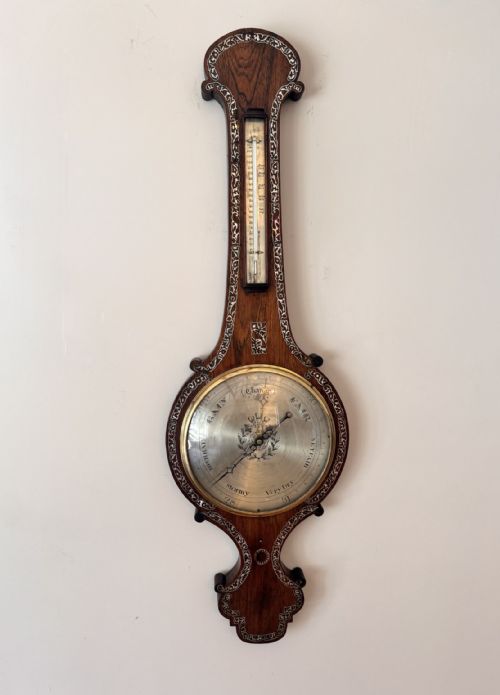


Victorian Mahogany Thermometer
These Victorian mahogany thermometer pieces combine period utility with rich timber, giving any room a steady anchor of nineteenth-century science.
Victorian Mahogany Thermometer
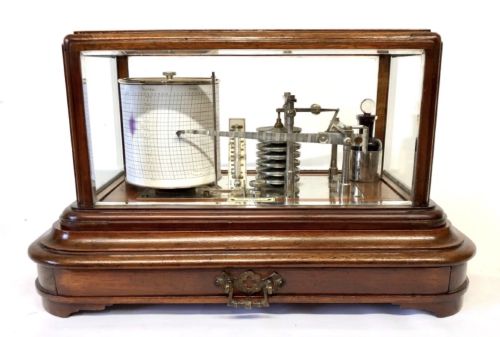
When you search for a Victorian mahogany thermometer, you are looking at nineteenth-century scientific instruments housed in rich timber cases. The selection spans straightforward wall instruments alongside complex barographs and comprehensive banjo barometers that incorporate thermometer scales.
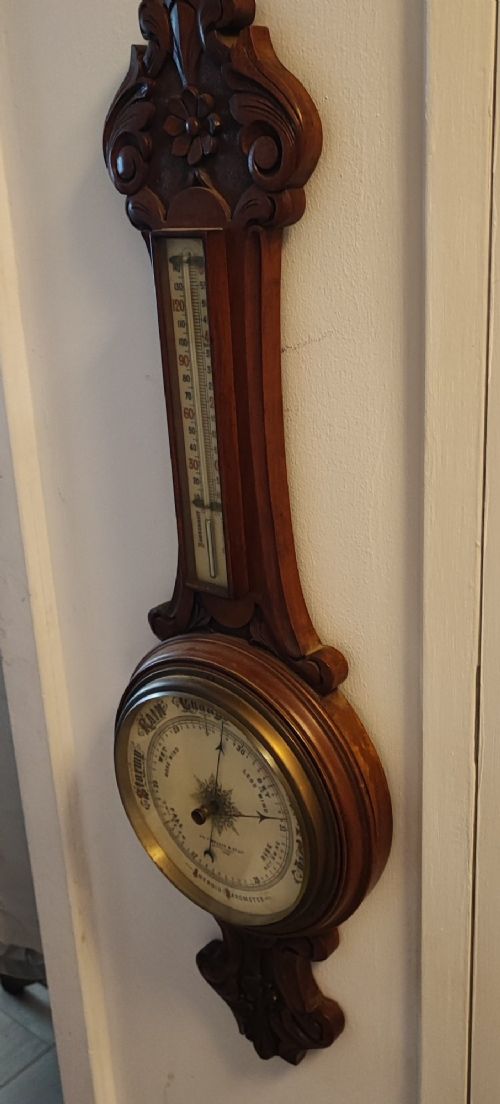
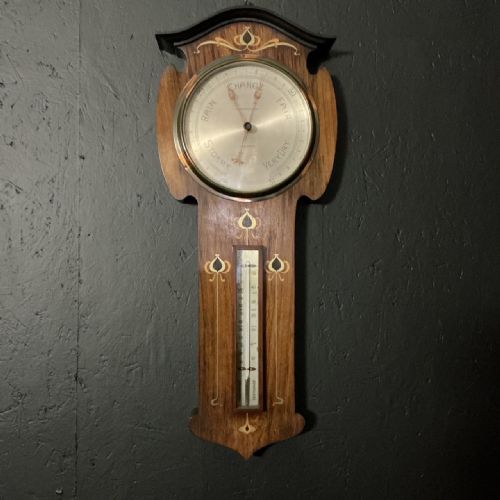
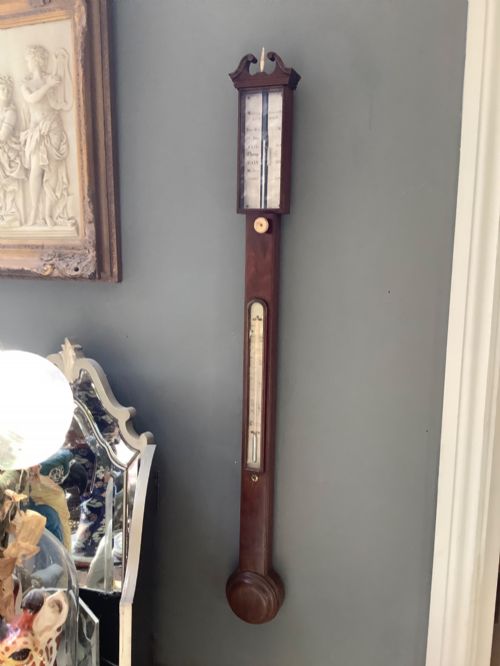
You are most likely to meet banjo barometers and stick barometers from the Victorian era on this page, often featuring architectural onion top cases or delicate string inlay. These domestic weather glasses served an essential household role before digital forecasting, recording temperature alongside atmospheric pressure.
The origins stretch from provincial makers in Swindon, Cambridge and York to notable London workshops and distant colonial outposts like Hong Kong and Singapore. Each piece reflects the nineteenth-century obsession with meteorological observation executed in dense, dark wood.
How they were made
Cabinetmakers constructed the housings primarily from solid and veneered mahogany, frequently selecting stock with deep grain patterns. Workshops enhanced these timber cases with brass dials, intricate wood inlay, and occasional mother-of-pearl accents.
Makers integrated delicate glass tubes filled with mercury alongside engraved bone or ivory scales to register temperature and pressure shifts. Steel and brass mechanical components inside barographs and aneroid systems provided the internal movement required for accurate recording.
Some nineteenth-century travellers needed barographs shipped all the way to Hong Kong just to keep track of distant weather.
What varies in quality
The distinction between standard utility instruments and superior examples lies in the ambition of the casework and the reputation of the maker. Master instrument makers residing in London or university towns fitted movements into cases finished with marquetry, architectural pediments, and fine brasswork.
Simpler provincial instruments rely on clean timber proportions without elaborate embellishment, whereas top-tier pieces incorporate complex barograph mechanisms or multi-dial banjo layouts signed by established firms.
Gaupp and Co·Patrick Adie·Negretti and Zambra·James H Kelly·W E Pain·J Groce
The Victorian Mahogany Thermometer Glossary
- Banjo barometer
- A domestic weather glass housed in a distinctive curved wooden case resembling a banjo. This form typically displays a large circular dial at the base with a thermometer tube mounted along the upright stem.
- Barograph
- A self-recording meteorological instrument that draws a continuous line of atmospheric pressure onto a revolving drum. These mechanical devices often include an attached thermometer to record temperature fluctuations simultaneously.
- Marquetry
- The art of applying decorative veneer pieces in various woods to form geometric or pictorial patterns on the case front. This technique elevates a plain timber surface into a considered decorative statement.
- Onion top
- A rounded architectural pediment topping the wooden case of a wall barometer or thermometer. This specific profile gives the instrument a distinct silhouette characteristic of nineteenth-century domestic joinery.
Victorian Mahogany Thermometer: Frequently Asked Questions
How do I read a mercury barometer?
Mercury barometers measure atmospheric pressure by balancing the weight of mercury in a glass tube against the pressure of the surrounding air. When the column rises, pressure increases; when it drops, stormy weather approaches.
Most instruments feature a sliding metal pointer called a vernier that allows you to note the exact position of the mercury column compared to the previous reading.
Where should I hang a wall thermometer?
These instruments function best on interior walls away from direct sunlight, radiators, and drafty doorways to ensure steady temperature readings. Placing them at eye level in a principal room allows for easy daily observation.
Secure the mahogany case firmly to a wall stud using appropriate fixings, as nineteenth-century hardwood and glass instruments carry significant weight.
How do I date a Victorian thermometer?
Dating relies on examining the style of the mahogany case, the typography on the engraved bone or paper scale, and any signature engraved on the brass plate. Mid-nineteenth-century examples often display simpler architectural lines, while later Victorian pieces embrace eclectic revival styles or Arts and Crafts simplicity.
Makers frequently signed the brass dial plates, allowing researchers to trace active working dates through historical trade directories.
What is the difference between an aneroid and a mercury barometer?
A mercury barometer uses liquid metal in an open-ended glass tube to register pressure changes directly from the atmosphere. An aneroid barometer uses a sealed flexible metal box that expands and contracts with pressure shifts, driving mechanical levers connected to a dial face.
Victorian homes utilised both types, though aneroid models offered greater portability and eliminated the need for an open column of liquid metal.