

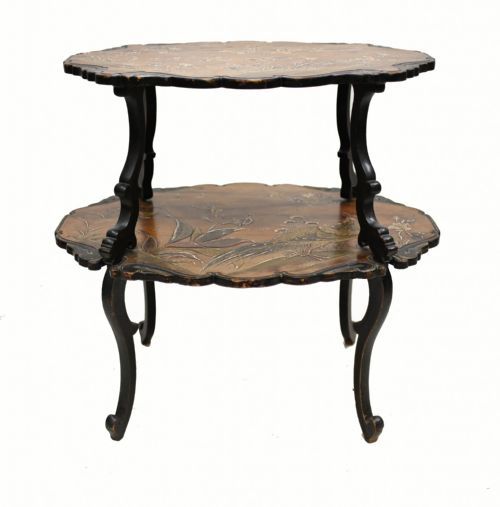


Victorian Ebonised Etagere
These Victorian ebonised etagere pieces offer tiered display space in dark finishes, bringing practical elegance and period character to any interior.
Victorian Ebonised Etagere
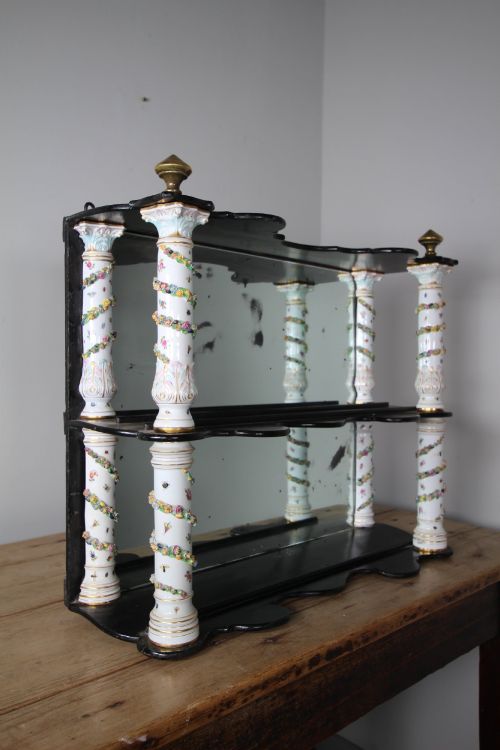
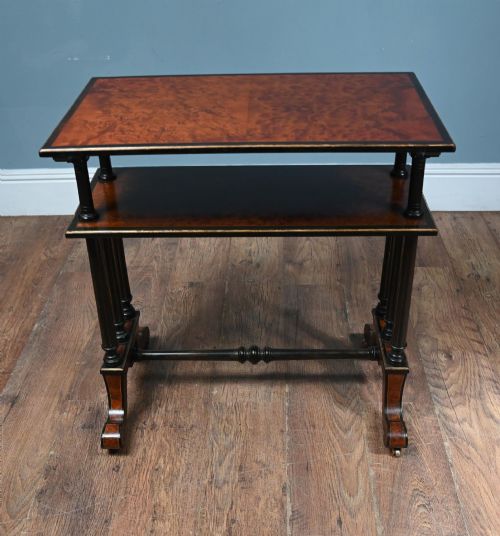
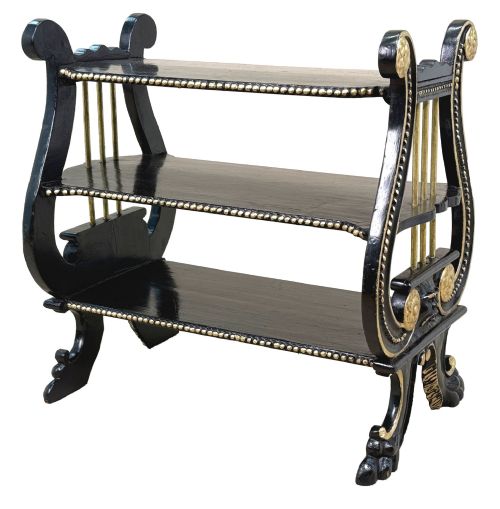
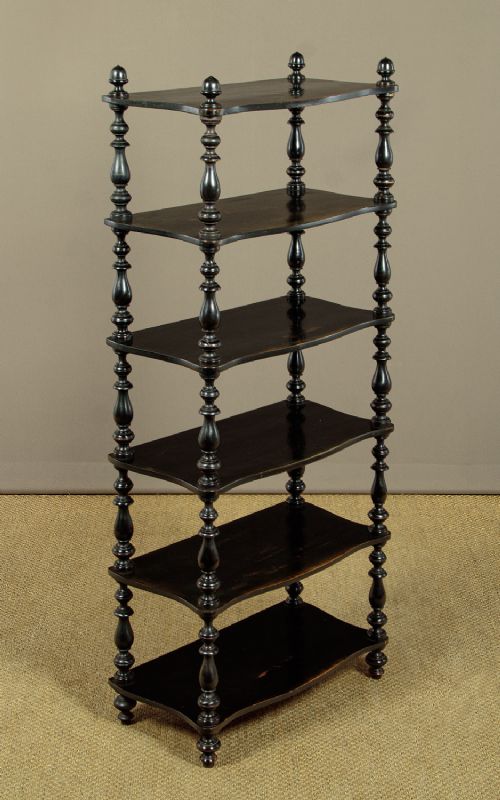
A victorian ebonised etagere is a tiered shelving unit designed for displaying decorative objects, typically finished in a dark, simulated ebony coating. Buyers looking at this selection find multiple tiers supported by slender uprights, intended for drawing rooms and parlours.
The pieces on this page appear in various forms, including corner units, wall hanging shelves, and freestanding dumb waiter bookcases. These items date primarily from the mid-to-late nineteenth century, spanning decades such as the eighteen-fifties through to eighteen-ninety.
Makers of the period utilised stylistic influences ranging from standard Victorian aesthetics to Japonisme and Chinoiserie. Some examples incorporate contrasting timbers like amboyna and walnut alongside the dominant dark ebonised surfaces.
Materials and construction methods
Cabinet makers of the era built these tiered stands using hardwoods such as cherry and mahogany, which were then ebonised to achieve a uniform, dark surface mimicking costly ebony. Parcel gilding and intricate inlay work frequently embellished the framework to catch the light.
Surfaces often featured japanning or lacquer techniques, alongside glass panels and brass fittings. Structural elements relied on traditional joinery to support multiple tiers without heavy frames.
Victorian Ebonised Etagere Retail Price Guide 2026
Typical asking prices for victorian ebonised etagere among the pieces listed under this phrase on Sellingantiques today, from the lower quarter to the upper quarter. They describe what is for sale here now, not the wider market.
Materials recorded across current items include brass, glass, amboyna, gilt wood, lacquer, and hardwood alongside standard ebonised timber.
Distinguishing quality in tiered stands
Quality in a victorian ebonised etagere rests on the precision of its surface finish and the integrity of its secondary timbers. Superior examples display crisp parcel gilding, well-preserved japanning, and tightly fitted joints across multiple shelves.
The choice of contrasting woods, such as amboyna or burr walnut panels, distinguishes finer workshops from standard production pieces. Complexity in tier arrangement, from corner brackets to six-tier dumb waiters, also indicates higher ambition in design.
The Victorian Ebonised Etagere Glossary
- Ebonised
- Wood treated with a dark stain or paint finish to imitate true ebony. This technique gained immense popularity during the nineteenth century for formal furniture.
- Etagere
- A piece of furniture consisting of a set of open shelves for displaying small objects or ornaments. The form originated in France before becoming a staple of Victorian interiors.
- Japanning
- A type of European finish that emulates East Asian lacquerware. It involves layers of varnish heated and polished to create a hard, glossy surface.
- Dumb Waiter
- A tiered stand or shelving unit historically used for holding books, dishes, or decorative items. In Victorian contexts, these often feature multiple graduated platforms.
Victorian Ebonised Etagere: Frequently Asked Questions
What is an etagere used for?
An etagere is primarily designed for the display of ornaments, small collections, and decorative objects. The tiered structure allows multiple items to be shown clearly without cluttering surface space.
Historically placed in drawing rooms and parlours, these pieces served both a decorative and a practical function in Victorian homes.
Where should I place an etagere at home?
Tiered stands and corner shelves suit living rooms, hallways, and studies where vertical display space is needed. Corner units utilise awkward angles effectively, while freestanding etagere tables anchor larger walls.
Placement should avoid direct sunlight to protect the ebonised finish and any delicate inlay work from fading.
Are these stands sturdy enough for heavy books?
Most etageres and tiered stands were built for ornaments, ceramics, and light volumes rather than heavy reference books. The slender uprights and multiple shelves distribute weight across the structure rather than supporting heavy loads on a single tier.
Heavier items are better suited to dedicated bookcases or lower side tables.