


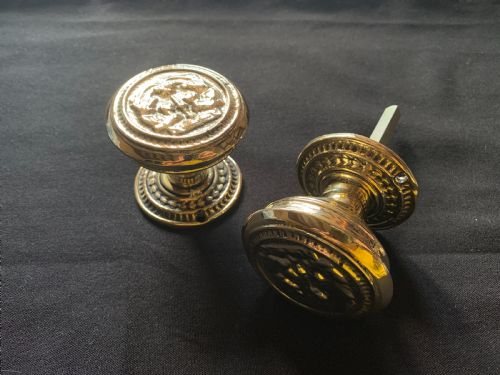


Victorian Door Knobs
These Victorian door knobs bring solid nineteenth-century weight and turning to your doors, combining practical function with distinct period character.
Victorian Door Knobs
When you search for victorian door knobs, you encounter robust hardware spanning the Victorian, Regency, Arts and Crafts, and Art Nouveau styles. The majority of pieces appearing here belong to the Victorian era, offering substantial brass, bronze, and iron fixtures designed for daily use.
You will find these items presented as single centre door knobs, pairs for rim locks, and complete sets that include matching finger plates and door locks. Forms range from simple turned profiles to ornate cast designs.
Materials extend beyond standard metals to incorporate timber such as oak and ebony, alongside glass elements like amber and clear varieties. Each style reflects the manufacturing capabilities and aesthetic preferences of nineteenth-century makers.
Distinctions in quality
The distinction between standard utility hardware and finer examples rests in the heft of the metal and the crispness of the casting. Heavier brass and bronze castings demonstrate superior material density and more precise turning on patterns like the beehive.
Attention to detail in matching sets, where door plates and knobs share coordinated ornamentation, separates mass-produced utility items from more thoughtful nineteenth-century production. The integration of contrasting materials, such as wood and glass secured firmly within metal mounts, indicates careful assembly.
Listings feature items spanning the Victorian, Regency, Arts and Crafts, and Art Nouveau styles, dating from the nineteenth century into 1900.
The Victorian Door Knobs Glossary
- Centre door knob
- A single large pull mounted to the middle of a door rather than operating a latch mechanism. These prominent pieces often feature elaborate octagonal or beehive turnings.
- Rim lock
- A lock mechanism surface-mounted to the face of a door rather than mortised inside the edge. The accompanying knobs operate the internal latch from both sides.
- Beehive
- A turned pattern featuring concentric ridged rings tapering towards the centre. This profile offers both decorative appeal and a secure grip.
- Finger plate
- A flat metal plate fitted behind the door knob to protect the timber surface from hand marks. They frequently match the design and material of the knobs.
Victorian Door Knobs: Frequently Asked Questions
What is a centre door knob?
A centre door knob is a stationary pull fixed to the middle of a primary entrance door. It serves as a handle for pulling the door closed rather than operating a latch.
These pieces are typically larger than standard operating knobs and often feature distinct decorative forms like octagons or beehive turnings.
How do rim lock knobs differ?
Rim lock knobs are designed to operate surface-mounted locks fixed directly to the interior face of a door. They connect via a spindle that passes through the door stile directly into the mechanism.
Such pairs are commonly found in brass, bronze, or glass variants suited for interior doors.
What materials were used?
Nineteenth-century hardware utilised a range of durable metals including solid brass, bronze, iron, and steel. These were frequently combined with timber grips like oak and ebony.
Glass was also cast into clear or amber forms, providing decorative alternatives to traditional metal fittings.
How do I identify a Victorian style?
Victorian door hardware encompasses several distinct stylistic movements including Arts and Crafts and Art Nouveau alongside traditional classical revivals. Look for characteristic shapes like faceted octagons and concentric beehive rings.
The weight of the brass or bronze and the method of casting offer clear indicators of nineteenth-century production.