
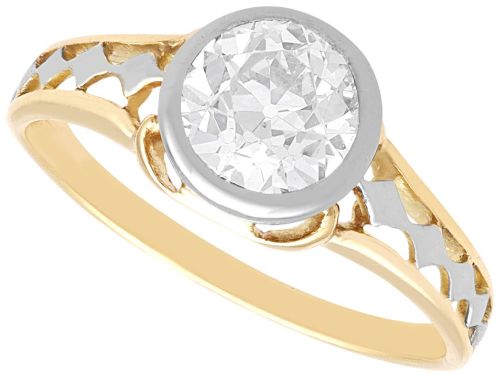
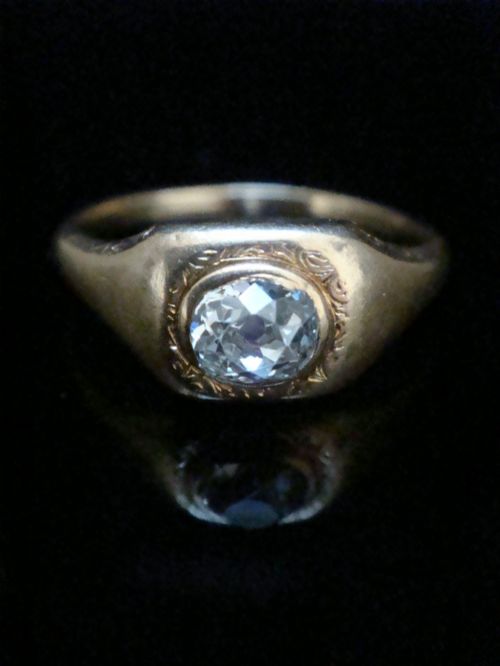
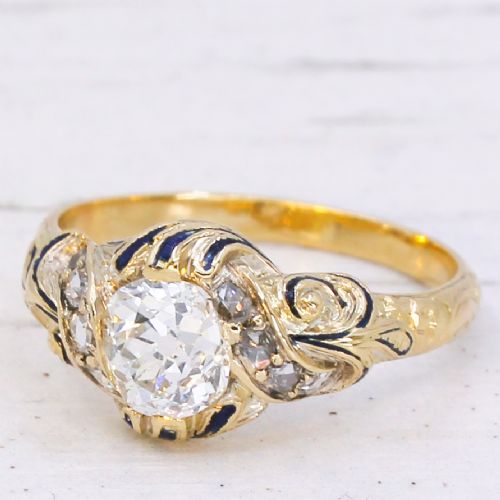


Victorian Diamond Solitaire
Victorian diamond solitaire rings and jewellery capture the singular charm of hand-cut stones set in yellow gold.
Victorian Diamond Solitaire
A Victorian diamond solitaire centres on a single diamond mounted in a ring, pin, brooch, or earring originating primarily from the nineteenth century. The phrase encompasses high-mount engagement rings alongside gypsy-set bands and delicate stickpins.
The pieces on this page lean heavily toward nineteenth-century origins, featuring yellow gold mountings ranging from nine to eighteen carats, alongside platinum and silver accents. Rings dominate the selection, though earrings and brooches appear regularly.
Craftsmanship from this era relies on hand-forged settings designed around individual stones rather than standardised commercial castings. Every mounting accommodates the specific irregularities of old-cut diamonds.
How they were made
Goldsmiths worked primarily with yellow gold in various purities, supplemented by platinum and silver in later Edwardian crossovers. Metals were shaped by hand to create sturdy collets, star-burst engravings, and flush gypsy settings.
Stones were cut by hand, yielding characteristic facets that produce broader flashes of light under candlelight rather than modern brilliant scintillation. Diamond cutters preserved as much original weight as possible, resulting in deep pavilions and rounded table facets.
Diamond weights range from modest accent stones upward to substantial multi-carat old European and rose cut centerpieces.
What varies in quality
The integrity of the setting dictates much of the piece's durability, particularly where thin gold claws or flush star settings secure the stone. Superior examples show minimal wear to the surrounding metal and retain crisp hand-engraved details.
Diamond quality depends on the symmetry of the hand-cut facets and the natural colour or clarity of the stone. Stones with pleasing old-cut proportions and lively light return elevate the overall character of the mounting.
The Victorian Diamond Solitaire Glossary
- Old cut
- A hand-faceted diamond cut before modern machine-standardised proportions were established. These stones typically feature smaller tables and higher crowns.
- Gypsy setting
- A mounting style where the diamond is flush-set directly into the thick metal band. The surrounding gold is often embellished with star-burst engravings.
- Rose cut
- An early diamond cut featuring a flat base and a domed crown composed of triangular facets. It resembles an unopened rosebud.
- Collet
- The collar or metal rim that directly holds the gemstone in place. It forms the primary basket of a ring or brooch setting.
- Belcher setting
- A specific ring design where the metal prongs holding the stone are pulled upward from the shoulders in a continuous, rounded sweep.
Victorian Diamond Solitaire: Frequently Asked Questions
How do I wear a gypsy ring safely?
Gypsy rings sit flush with the band, making them remarkably resilient for daily wear. Their smooth profile prevents the stone from catching on fabrics.
However, the surrounding gold band requires occasional inspection by a jeweller to ensure the flush setting remains tight around the diamond.
Can I resize an antique gold ring?
Most gold and platinum rings from the nineteenth century can be adjusted by a skilled bench jeweller. The process depends on the thickness of the band and the presence of intricate shoulder engravings.
Take the piece to a specialist experienced in antique jewellery to preserve hallmarks and structural integrity.
How should I clean antique diamond jewellery?
Clean these pieces gently using warm water, mild soap, and a soft-bristled brush to remove everyday oils. Avoid harsh ultrasonic cleaners, which can dislodge fragile stones or damage softer antique metals.
Pat the jewellery completely dry with a lint-free cloth before storing it in a lined box.