




Victorian Diamond Dangle Earrings
Victorian diamond dangle earrings catch the light with every turn of the head, bringing genuine nineteenth-century movement and sparkle to the ear.
Victorian Diamond Dangle Earrings
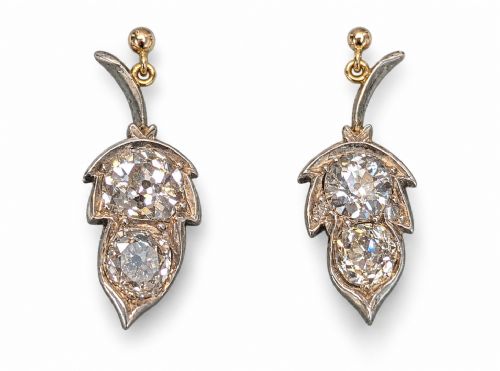
Victorian diamond dangle earrings combine nineteenth-century goldsmithing with lively articulated drops that sway gently when worn. You will find pieces spanning from the mid-nineteenth century through to the early decades of the twentieth, reflecting both strict Victorian designs and later Edwardian lightness.
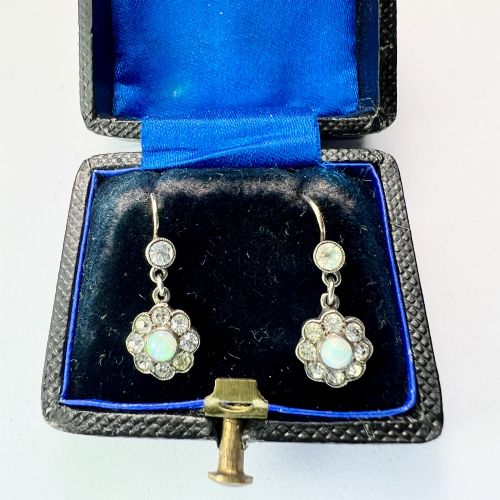
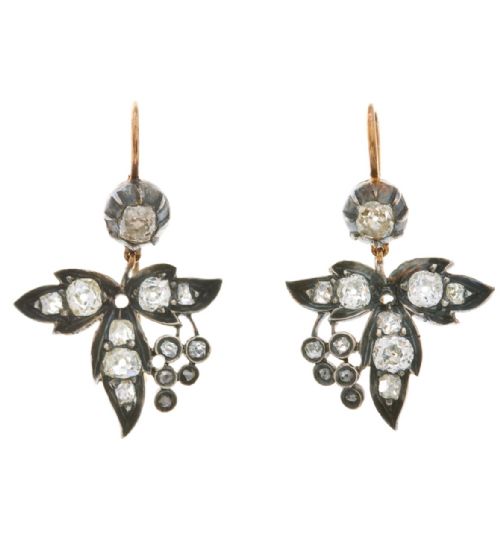
The most common forms on this page pair warm yellow gold or silver-topped gold with old-cut diamonds, natural pearls, and occasional opal or paste accents. Drop earrings and teardrop configurations dominate the selection, often incorporating foliate mounts, bows, or marquise frames.
While many examples originate directly from the Victorian era, the inventory also accommodates related Georgian, Edwardian, and vintage interpretations that share the same articulated drop format. These pieces range from simple diamond studs with suspended drops to elaborate multi-stone clusters set in fifteen or eighteen carat gold.
Materials and Construction
Goldsmiths of the period frequently combined silver and gold, mounting diamonds in silver to heighten their brightness against the darker metal while using gold for the reverse and hooks to prevent tarnish against the skin. This dual-metal technique is characteristic of nineteenth-century jewellery production.
Stones are typically set by hand with old-cut, old European, or rose-cut diamonds that possess irregular facets yielding a softer, more candlelit shimmer than modern brilliant cuts. Settings incorporate delicate closed backs, foil linings in specific instances, and intricate wirework or pierced foliate mounts.
The listings span from the Georgian era through to the nineteen-fifties, employing gold, silver, natural pearl, opal, and paste alongside diamonds.
Quality and Craftsmanship
The distinction between standard production and the finest work lies in the articulation and security of the joints, where superior pieces maintain fluid movement without looseness in the hinges or drops. Master makers ensured that the transition between fixed ear wires and suspended elements remained seamless.
Stone matching and mount integrity further define the tier of a pair, as top-range examples display uniform diamond matching and robust bezel or collet settings that hold each gem securely. The finesse of hand-engraved details on the gold or the precision of silver foliate work separates everyday workshop output from exceptional examples.
Knoll and Pregizer
The Victorian Diamond Dangle Earrings Glossary
- Old cut
- A diamond facet arrangement predating the modern brilliant cut, typically featuring a smaller table and higher crown that produces a broad flash of light.
- Rose cut
- A stone style characterised by a flat base and a domed crown covered in triangular facets, resembling an unopened rosebud.
- Natural pearl
- An organic gem formed entirely by mollusc secretion without human intervention, frequently suspended as drops in nineteenth-century cluster earrings.
- Paste
- Hand-cut lead glass used historically as a high-quality gemstone substitute, valued for its clarity and weight in antique mounts.
- Collet setting
- A low collar of metal that encircles the girdle of a gemstone, holding it securely flush against the backing plate.
Victorian Diamond Dangle Earrings: Frequently Asked Questions
How do I care for antique diamond earrings?
Clean these pieces gently with a soft brush and warm soapy water, avoiding harsh ultrasonic cleaners that can loosen foil-backed stones or natural pearls.
Store each earring in a separate fabric pouch to prevent the old-cut diamonds from scratching the surrounding gold and silver mounts.
Are these earrings comfortable for daily wear?
The articulated drops are designed to move freely, distributing weight well when secured with reliable hook or lever-back fastenings suited to nineteenth-century designs.
Due to their length and dangling format, many owners reserve them for evening events or special occasions rather than active daily use.
How can I tell Victorian from Edwardian styles?
Victorian pieces tend to feature heavier gold weights, warmer yellow tones, and substantial collet or silver-topped settings around old-cut diamonds.
Edwardian designs shift towards lighter platinum or silver foliate mounts, incorporating natural pearls and brighter, airier openwork clusters.
What does silver-topped gold mean?
Goldsmiths soldered a thin layer of silver to the front of a gold mount so that the white metal would enhance the whiteness and fire of the set diamonds.
The gold backing provided the necessary structural strength and protected the wearer's clothing and skin from silver tarnish.