

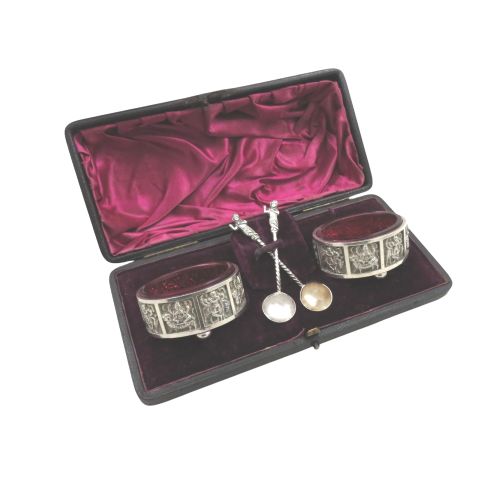


Victorian Cased Silver Salts
Victorian cased silver salts are fitted sets of small table vessels presented in velvet or silk-lined boxes, prized for their decorative craftsmanship.
Victorian Cased Silver Salts
Victorian cased silver salts are matching pairs or sets of small open bowls and matching spoons housed in fitted presentation boxes. These small table vessels are most commonly encountered as pairs from the late nineteenth century, often complete with their original spoons and lined storage cases.
The selections span the Victorian and Edwardian periods, with dates cluster around the eighteen-eighties and eighteen-nineties. Alongside standard salt cellars, the form occasionally overlaps with cased scent bottles and small dishes within the wider groupings.
How they were made
The primary components are fashioned from sterling silver, frequently paired with removable glass liners that protect the metal from corrosive salt. Silversmiths utilised traditional techniques of shaping, repoussé decoration, and chasing to ornament the small bowls with motifs such as Hindu deities or bird designs.
The protective cases are constructed from rigid outer coverings of leather or card, and internally lined with tactile materials including silk, satin, and velvet to cradle the silver vessels securely.
Victorian Cased Silver Salts Retail Price Guide 2026
Typical asking prices for victorian cased silver salts among the pieces listed under this phrase on Sellingantiques today, from the lower quarter to the upper quarter. They describe what is for sale here now, not the wider market.
Listings for victorian cased silver salts incorporate sterling silver, glass liners, and protective cases lined with velvet, silk, satin, or leather.
What varies in quality
Quality in victorian cased silver salts depends upon the crispness of the chased or embossed ornamentation on the silver body and the completeness of the original fitted set. Pieces featuring specific aesthetic movement designs or distinct motifs demonstrate greater artistic ambition than plain utilitarian bowls.
The condition and survival rate of the internal satin and velvet linings, alongside the structural integrity of the outer leather case, strongly influence the overall integrity of the surviving ensemble.
Horton & Allday·Spurrier & Co
The Victorian Cased Silver Salts Glossary
- Salt Cellar
- An open vessel used to hold salt at the dining table before the invention of the spring-loaded salt shaker. These small bowls often require removable glass liners.
- Sterling Silver
- An alloy of silver containing ninety-two point five percent pure silver and seven point five percent other metals, usually copper. This standard composition is typical for British table silver.
- Assay Office
- A body charged with testing the purity of precious metals and stamping them with hallmark symbols. Birmingham, Chester, and London offices appear frequently on these pieces.
- Repoussé
- A metalworking technique where the smith hammers the design from the reverse side to create a raised relief on the front. This method creates the textured decoration seen on many period salts.
- Aesthetic Movement
- A late nineteenth-century design style that emphasised visual beauty over narrative or moral content. Pieces in this style often display stylised natural or exotic motifs.
Victorian Cased Silver Salts: Frequently Asked Questions
How were salt cellars used on the Victorian table?
Victorian diners used small silver salt cellars to hold pinches of salt at individual places or shared between guests. Diners lifted the salt using tiny matched spoons rather than shaking it from a container.
These open bowls sat directly upon the dining cloth or on small dishes, accompanied by removable glass liners to prevent the salt from tarnishing the silver.
What periods do these cased sets come from?
The pieces originate primarily from the Victorian era, spanning the late nineteenth century with dates clustered around the eighteen-eighties and eighteen-nineties. A small number extend into the Edwardian period.
Date letters and town marks stamped into the silver provide precise years of assay, confirming the exact period of manufacture.
Why do some salts have glass liners?
Glass liners were inserted into open silver salt cellars to protect the metal from the corrosive properties of salt. Direct contact with salt causes pitting and tarnishing on sterling silver over time.
These removable inserts allowed the silver bowls to remain clean and undamaged while in daily use on the dining table.
How do I care for cased silver salts?
Care involves keeping the silver dry and occasionally polishing the metal with a non-abrasive cloth to remove natural tarnish. The velvet and silk linings inside the presentation cases should be kept away from damp environments.
Strooring the silver inside its original fitted case helps protect the pieces from dust and accidental surface scratches when not on display.