

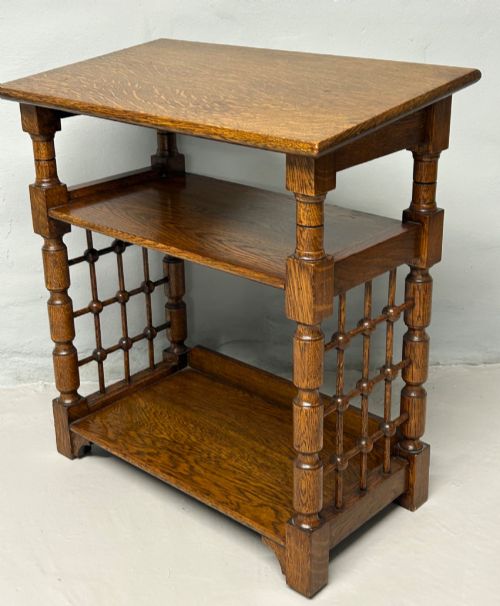
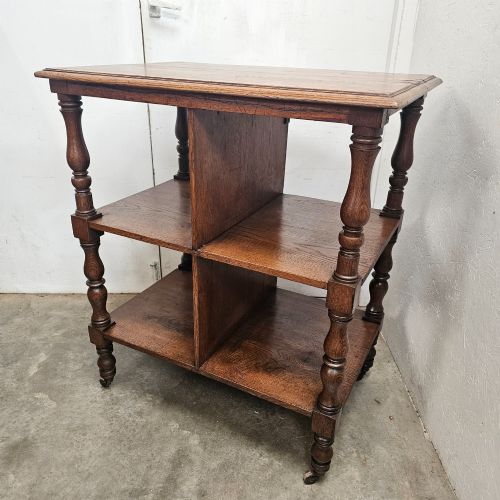


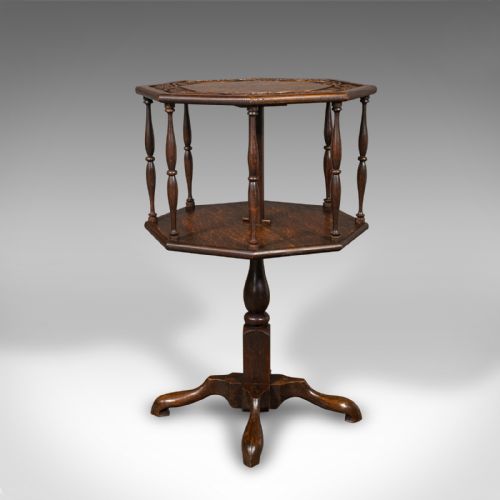

Turning Book Table
A turning book table brings rotating utility and compact storage to any corner, holding a library within arm's reach.
Turning Book Table
A turning book table offers accessible tiers and rotating shelves designed to hold volumes close to a chair or desk. When you search for a turning book table, you find pieces built to keep reference books or novels upright and within immediate reach.
The examples gathered here span the nineteenth century, including Regency, Victorian, and Edwardian periods, alongside Arts and Crafts designs. These pieces often take the form of revolving bookcases, two-tier reading tables, and occasional tables fitted with book storage.
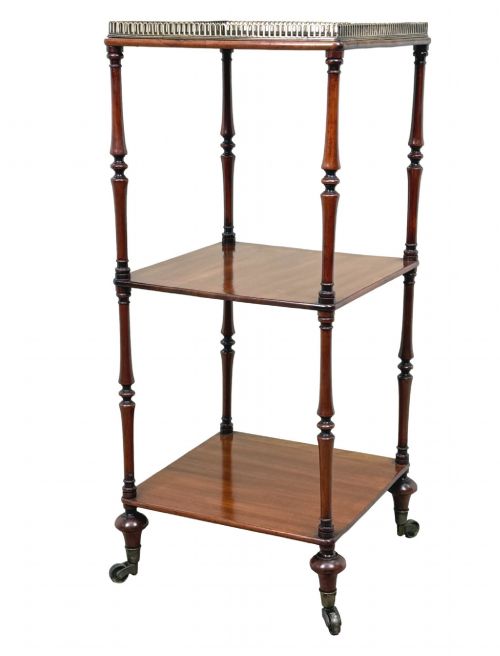
Mahogany and oak dominate the selection, complemented by walnut, birdseye maple, brass, and ceramic elements. Forms range from small revolving book stands to multi-tiered whatnot étagères and library carts.
Materials and construction
Makers utilised solid timbers and veneers, predominantly mahogany and oak, building robust frames to support stacked tiers of books. Figured woods like birdseye maple and walnut appear on surfaces to add visual depth.
Revolving mechanisms incorporate brass and iron components to ensure smooth rotation under the weight of books. Inlaid timber and ceramic details further distinguish the construction of these reading and occasional tables.
Turning Book Table Retail Price Guide 2026
Typical asking prices for turning book table among the pieces listed under this phrase on Sellingantiques today, from the lower quarter to the upper quarter. They describe what is for sale here now, not the wider market.
One clever piece doubles as a food trolley and a book shelf, proving that Victorian makers believed reading and dining belonged together.
Quality and craftsmanship
Quality rests in the precision of the rotating mechanism and the stability of the tiered structure under load. Superior pieces maintain smooth movement without wobble, even when fully laden with heavy volumes.
The selection of timber, from plain oak to finely figured mahogany and birdseye maple, defines the visual grade of the piece. Crispness in turned supports and well-fitted joinery separate standard utility items from finer workshop productions.
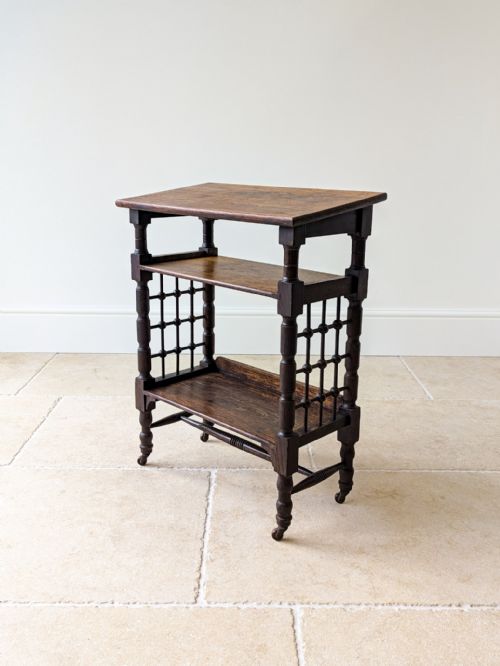
Leonard Wyburd For Liberty & Co
The Turning Book Table Glossary
- Étagère
- A set of open shelves for displaying small objects or books. It provides tiered storage across multiple levels.
- Whatnot
- A piece of furniture with shelves for books or ornaments. These pieces typically feature three or more tiers supported by slender uprights.
- Birdseye maple
- Timber featuring small, circular markings resembling bird eyes. This decorative grain results from indented growth rings within the tree.
- Regency
- An English design period spanning the early nineteenth century. Furniture from this era often exhibits classical restraint and refined proportions.
- Edwardian
- A stylistic period covering the early twentieth century. Pieces from this time frequently draw inspiration from earlier Georgian and Victorian forms.
Turning Book Table: Frequently Asked Questions
How do revolving mechanisms work?
The revolving action relies on internal wooden or metal pivots that allow the upper tiers to spin freely. This lets a reader access different stacks of books from a stationary seat.
Over time, these pivots settle into smooth rotation if the central shaft remains properly aligned and lubricated.
Where were these tables used?
These tables served primarily in libraries, studies, and drawing rooms where reference books needed to be close at hand. Their compact footprint suited spaces beside armchairs or reading desks.
They also functioned as occasional tables for holding daily reading material rather than permanent library collections.
How do I care for mahogany surfaces?
Mahogany benefits from occasional waxing using traditional beeswax to nourish the timber and maintain its natural lustre. Avoid placing the wood in direct sunlight or near heat sources to prevent warping.
Dusting with a soft, dry cloth preserves the finish without wearing down the patina built over decades of use.
How do I identify an Edwardian piece?
Edwardian furniture, dating from the early twentieth century, often reflects lighter construction and simpler Arts and Crafts influences. Oak and walnut appear frequently in these domestic utility pieces.
Proportions tend to be practical and straightforward, showing less heavy ornamentation than high Victorian examples.