



Tufted Daybed Settee
These tufted daybed settees combine deep buttoning with sprawling nineteenth-century comfort, offering both a statement piece and a genuine place to lie down.
Tufted Daybed Settee
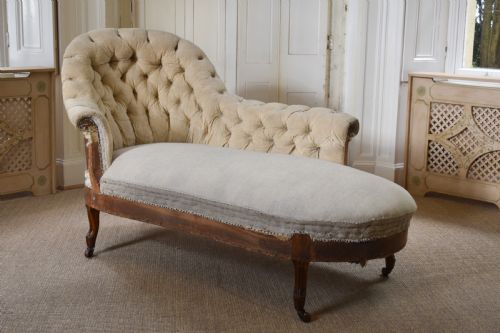
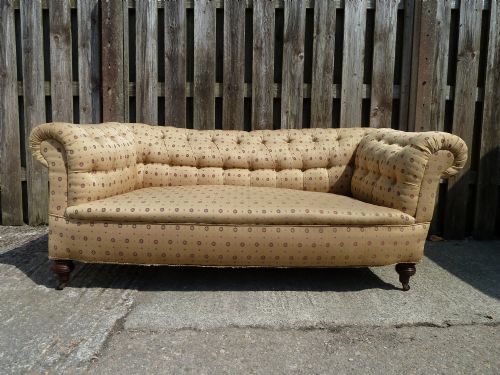
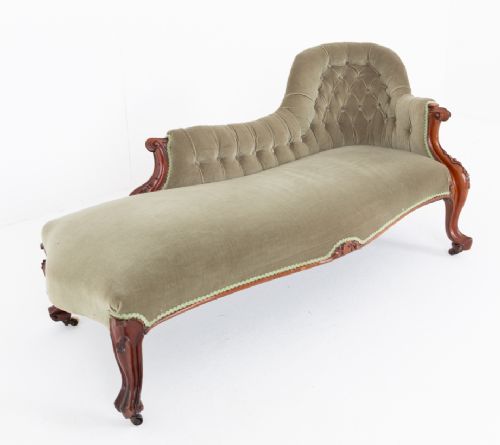
A tufted daybed settee is a nineteenth-century hybrid seating form, bringing together the backrest of a settee with the extended lounge surface of a daybed or chaise longue. You are most likely to encounter Victorian examples on this page, shaped as scroll end settees, open arm sofas, or deep-buttoned Chesterfield chaises.
These pieces primarily date from the middle to late decades of the nineteenth century, reflecting the Victorian taste for upholstered comfort in the parlour or drawing room. Makers constructed them in distinct forms, from rosewood frames with carved details to robust leather or fabric-upholstered Chesterfields.
The layout of these pieces varies from traditional single-ended scroll designs to expansive open arm sofas intended for reclining in a semi-recumbent posture. Their presence defines a room through assertive woodwork and plush textile coverings.
How they were made
Makers built the structural frames of these pieces using dense hardwoods such as mahogany, rosewood, and walnut, often shaping them with carved ornament and scroll ends. These timbers provided the rigid skeleton necessary to support heavy upholstery and active daily use.
The defining characteristic is the tufted upholstery, which secured the interior stuffing through deep buttoning across fabric, velvet, or leather surfaces. Artisans layered traditional stuffings within these coverings to achieve the characteristic firm yet yielding contours of the period.
Tufted Daybed Settee Retail Price Guide 2026
Typical asking prices for tufted daybed settee among the pieces listed under this phrase on Sellingantiques today, from the lower quarter to the upper quarter. They describe what is for sale here now, not the wider market.
Some nineteenth-century occupants demanded daybeds specifically engineered for afternoon poetry reading without mussing their starch.
What varies in quality
Quality separates pieces by the crispness of the timber carving on the exposed rosewood, mahogany, or walnut frames and the integrity of the structural joinery. Finer examples maintain rigid stability in their scroll ends and legs without looseness in the joints.
The execution of the tufting and the selection of the upholstery material dictate the visual and tactile success of the piece. Superior examples display precise symmetry in the buttoning and employ durable leathers or rich textiles that suit the nineteenth-century scale.
H. Goodall & Sons·Holland & Sons·Jas Shoolbred
The Tufted Daybed Settee Glossary
- Chesterfield sofa
- A traditional nineteenth-century upholstered seating form characterised by arms and back of the same height and deep button tufting. It remains a standard for heavy domestic seating.
- Chaise longue
- An elongated upholstered chair designed for reclining, featuring one raised end acting as a headrest. It combines the functions of a chair and a daybed.
- Scroll end
- A woodwork detail where the arm or frame terminal curls outward in a tight or sweeping spiral curve. This shape defines many Regency and Victorian seating designs.
- Open arm sofa
- A settee design featuring exposed wooden arm structures that are open beneath the armrest rather than solid-upholstered. It lightens the visual weight of the timber frame.
- Rosewood
- A dense, heavily figured dark timber utilised by nineteenth-century cabinet makers for high-status furniture. It accepts a high polish and shows distinct grain patterns.
Tufted Daybed Settee: Frequently Asked Questions
What is a tufted daybed settee?
A tufted daybed settee is a nineteenth-century seating form that merges a settee back with an extended daybed or chaise longue base. These pieces feature deep buttoning and prominent wooden frames from the Victorian era.
They were designed for reclining and formal lounging in period drawing rooms. Today, they serve as focal points for living spaces that accommodate both sitting and lying down.
How do I date a Victorian settee?
Dating relies on observing the timber species, the carved ornamentation, and the overall structural silhouette. Rosewood and heavy walnut frames often point toward the middle decades of the nineteenth century.
Later Victorian pieces from the end of the century frequently adopt Chesterfield proportions and distinct leather or heavy fabric upholstery. Comparing the frame style with known cabinet maker outputs helps narrow the timeframe.
Where should I place a chaise longue?
These pieces require floor space that allows their length and scroll ends to be viewed without obstruction. They sit well against a primary wall or floating in a large room where the back and arm details remain visible.
Because they combine seating and reclining functions, position them away from tight corridors to maintain the intended circulation around the room.
How do I care for antique leather upholstery?
Antique leather requires maintenance that prevents the surface from drying out or cracking over time. Regular gentle dusting and appropriate conditioning keep the hide supple.
Keep these pieces away from direct sunlight and strong heat sources to protect both the leather hide and the underlying nineteenth-century wood frame.