
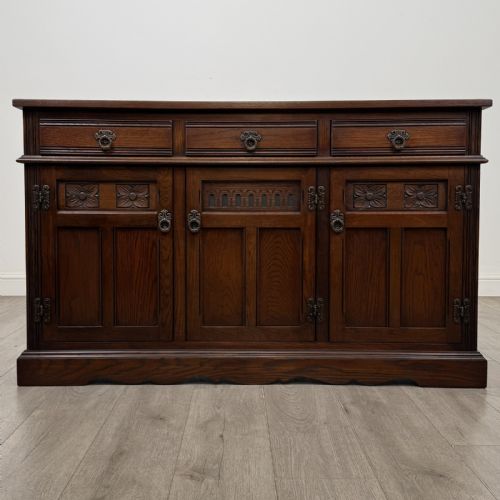
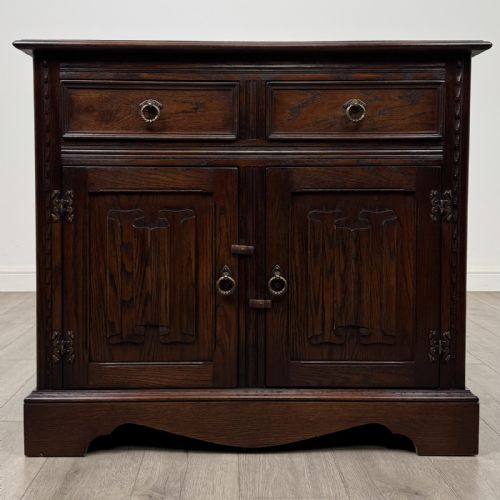
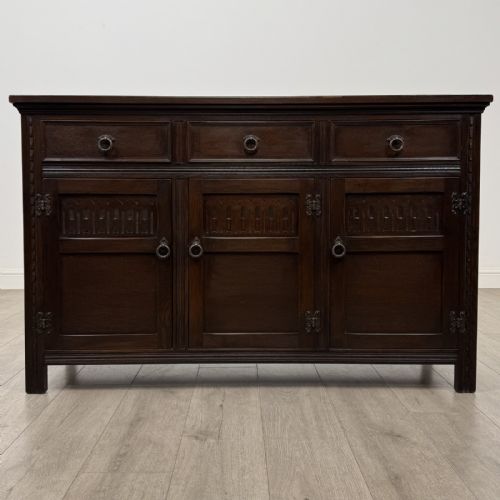
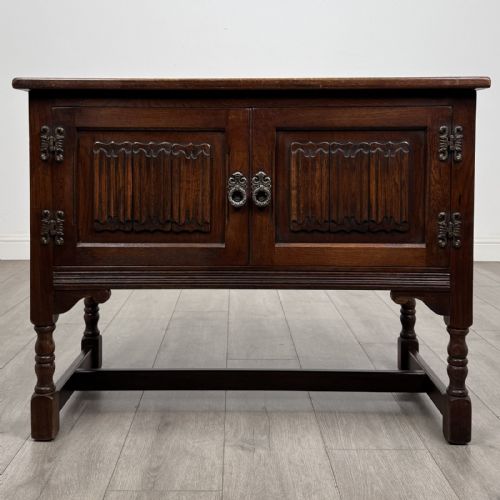




Tudor Revival Sideboard
These pieces known as a tudor revival sideboard bring heavy historic character and solid timber storage to a room, driven by late nineteenth and early twentieth century craftsmanship.
Tudor Revival Sideboard
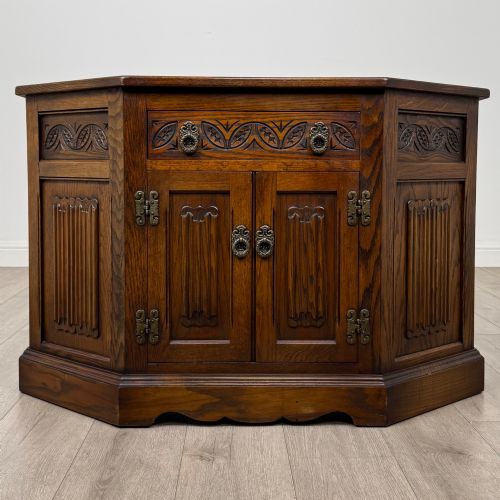
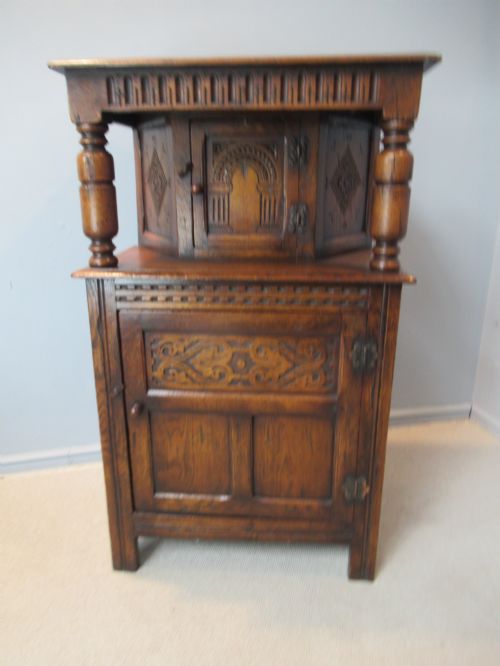
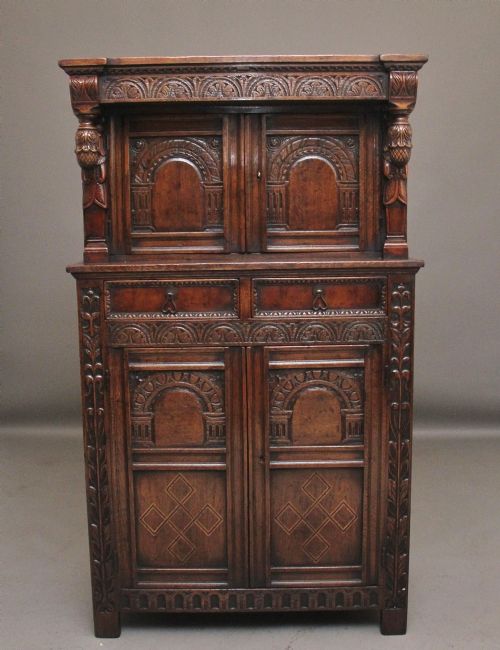
A tudor revival sideboard typically takes the form of a court cupboard or a carved linenfold cabinet, drawing directly on early domestic storage furniture. These pieces combine enclosed lower cupboards with recessed upper tiers or lift tops, echoing the architecture of much older centuries.
The versions most commonly met span from the Edwardian period through to the nineteen-twenties, alongside occasional nineteenth century examples. Makers leaned heavily on Jacobean and Tudor styling, creating imposing furniture intended for grand dining rooms and halls.
How they were made
Construction relies heavily on solid oak, selected for its dense grain and durability. Joinery often incorporates traditional framing methods to support heavy carved sections.
Detailing relies on hand carving, featuring linenfold panels and carved canopies. Iron and brass hardware such as hinges and handles are used to secure and accent the heavy timber doors.
The listings span the Edwardian period, eighteen-eighty, eighteen-fifty, and nineteen-twenty, featuring solid oak construction with iron and brass hardware.
What varies in quality
The depth and crispness of the carved ornamentation separate standard production from finer cabinet work. Deeply undercut relief and well-defined linenfold panels show a higher degree of hand labour.
Proportion and scale also dictate quality, ranging from small compact cupboards to large golden oak court cupboards. The selection of timber grain and the integrity of the original joints determine the overall substance of the piece.
The Tudor Revival Sideboard Glossary
- Court cupboard
- A traditional English two-stage sideboard or cabinet featuring a recessed upper section supported by pillars. These pieces evolved to display plate and store food in the dining hall.
- Linenfold
- A style of wood carving that imitates folded fabric or linen cloth. It appears frequently on the panels of cupboards from this tradition.
- Jacobean
- A design style spanning the early seventeenth century characterised by heavy proportions and geometric ornamentation. Revival pieces replicate these characteristics using later machinery and hand tools.
- Canopy
- The projecting upper section of a court cupboard supported by carved posts. It creates architectural depth above the recessed upper cabinet doors.
Tudor Revival Sideboard: Frequently Asked Questions
What is a court cupboard?
A court cupboard is a traditional form of storage furniture featuring an upper and lower section, often with a recessed upper cabinet. These items were built to hold household provisions and display plate.
In revival pieces, this traditional form is scaled for later domestic interiors while retaining heavy decorative carving and substantial timber construction.
How do I date a revival sideboard?
Dating relies on examining the timber preparation, tool marks, and overall construction methods. Pieces from the Edwardian era and the nineteen-twenties often combine machine-cut elements with hand finishing.
Earlier nineteenth century examples display different oxidation on the oak and distinct structural wear patterns compared to later twentieth century interpretations.
Where should I place this furniture?
These sideboards suit dining rooms, large hallways, and living spaces with sufficient room to accommodate heavy timber proportions. Their substantial presence anchors a room effectively.
Ensure the floor space can support a heavy oak cabinet and allow enough clearance for doors and lift tops to open fully.
What is linenfold panelling?
Linenfold panelling is a carved decorative motif designed to resemble stiff fabric folded in vertical pleats. It is commonly found on the doors of oak cupboards.
This technique gives flat wooden surfaces texture and shadow, originating from medieval textile arts translated into woodwork.