
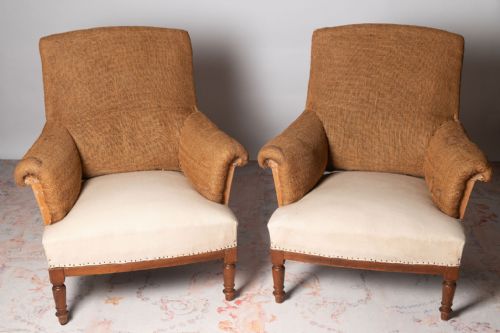


Traditional French Club Chairs
Traditional french club chairs offer deep, enveloping comfort built around sturdy frames and supple hides.
Traditional French Club Chairs
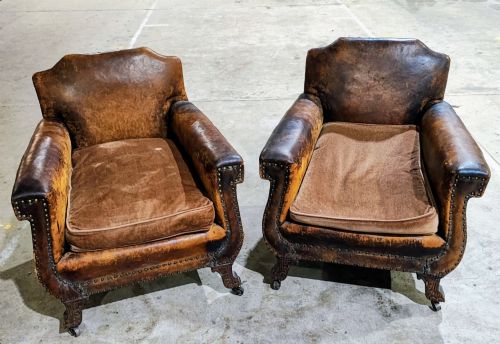
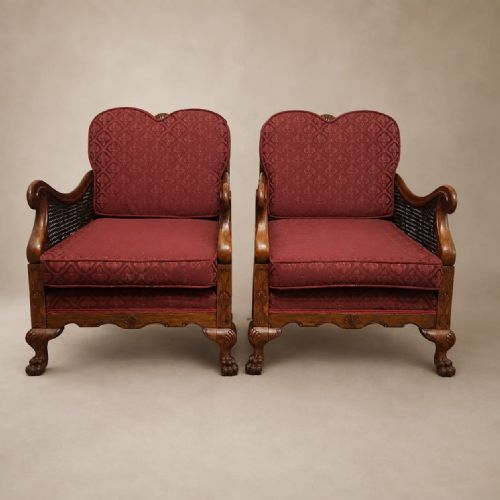
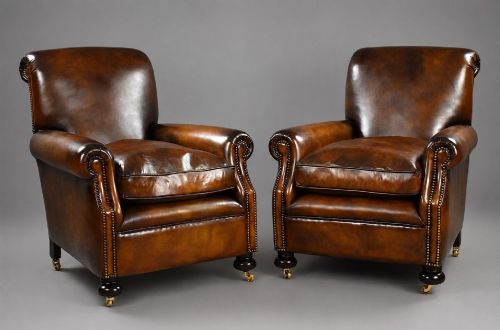
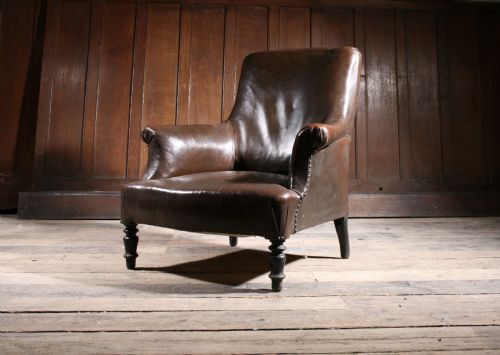
Traditional french club chairs combine deep-seated comfort with robust construction, appearing across multiple eras including the nineteenth century and the Art Deco period. These substantial armchairs emerge in forms ranging from plain leather library seating to ornate French provincial designs with ebonised legs or walnut frames. Buyers searching for traditional french club chairs encounter pairs and single items upholstered in leather, sheep's hide, calico, velvet, and linen.
The materials and styles span Victorian and Edwardian aesthetics alongside French chateau and country traditions. Pieces include buttoned library armchairs and split cane bergere easy chairs alongside simpler nineteenth-century frames. Most listings feature generous proportions intended for relaxed seating rather than formal drawing-room display.
How they were made
Makers constructed traditional french club chairs using timber frameworks of beech and walnut to support heavy upholstery. Traditional artisans stretched leather and sheep's hide tightly over deep springing, securing the edges with brass studs where appropriate.
Wood framing provided the foundational structure for open armchairs and closed club forms, whilst secondary materials like cane added texture to specific nineteenth-century and 1920s variations. Finishing details involved ebonising wooden legs and shaping arch tops to define the silhouette.
Materials appearing across these armchair listings include leather, sheep's hide, brass, wood, beech, walnut, velvet, calico, and linen.
What varies in quality
The quality of traditional french club chairs rests primarily on the condition of the hide and the integrity of the underlying wooden frame. Finer examples retain supple leather with an honest patina, whereas lesser pieces show heavy surface degradation or compromised internal support.
Execution of detail separates standard commercial production from superior craftsmanship. The tightness of the upholstery work, the stability of walnut or beech frames, and the preservation of original elements dictate the standing of each armchair.
The Traditional French Club Chairs Glossary
- Club chair
- A deep-seated, upholstered armchair designed for relaxation, typically finished in leather. These pieces originated in twentieth-century clubs and salons.
- Bergere
- An enclosed or open-framed upholstered armchair with a cane or wicker back and sides. This French style frequently incorporates wooden frames like walnut.
- Art Deco
- A design style from the early twentieth century characterised by sleek geometric shapes and streamlined forms. Art Deco club chairs often feature smooth leather and simplified silhouettes.
- Ebonised
- Wood treated with a dark stain or finish to resemble ebony. This technique appears on the legs of nineteenth-century armchairs.
Traditional French Club Chairs: Frequently Asked Questions
What defines traditional french club chairs?
Traditional french club chairs are deep, low-slung armchairs traditionally upholstered in leather or sheep's hide over a robust wooden frame. They prioritise heavy comfort and substantial proportions.
These armchairs emerged in various styles, spanning nineteenth-century interpretations through to Art Deco designs, often featuring broad armrests and generous seating.
How do I care for leather club chairs?
Leather upholstery requires regular conditioning to maintain suppleness and prevent the hide from drying out over time. Keep chairs away from direct sunlight and heat sources.
Gentle cleaning with appropriate leather balms helps preserve the natural grain and patina developed over decades of use.
Are these chairs comfortable for daily use?
Traditional french club chairs were specifically designed for relaxed, prolonged seating with deep sprung bases and supportive backs. Their generous dimensions accommodate comfortable lounging.
The supportive internal construction makes them well-suited as everyday reading or library chairs.
How do I distinguish 1920s styles from 19th-century chairs?
Nineteenth-century examples often display more ornate framing, buttoned upholstery, and traditional wood finishes like ebonised legs. They lean towards classic library aesthetics.
Art Deco and 1920s versions favour cleaner lines, smoother sheep's hide, and streamlined shapes that reflect the modern design movements of the period.