


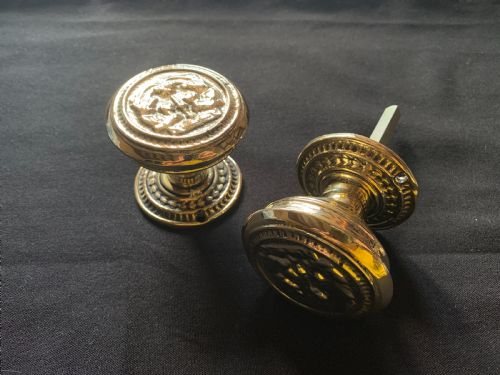


Traditional Door Knobs
Traditional door knobs deliver authentic period weight and proportion to an interior, bringing tactile history to everyday passage doors.
Traditional Door Knobs
Traditional door knobs encompass heavy architectural hardware designed for period homes, spanning Georgian, Regency, Victorian, and Edwardian eras. When searching for traditional door knobs, buyers encounter distinct forms ranging from centre door pulls to pairs intended for latch and lock sets. These pieces ground a restoration project in historical accuracy through period-correct geometry and proportion.
How they were made
Metalworking dominates the production of these items, with heavy use of cast and turned brass, alongside bronze and iron components. Workshops utilised durable alloys to withstand daily operation, often pairing metal bases with wooden elements to create tactile contrast on Victorian examples.
Surface finishing and turning defined the manufacture, from the concentric ridges of beehive patterns to the smooth curves of ovular Georgian designs. Individual pieces display the hand of the turner or founder through subtle irregularities in casting and assembly.
Listings span six distinct periods, from Georgian and Regency through Victorian, 1860, Arts and Crafts, Edwardian, and 1900.
What varies in quality
Quality rests in the substantial weight of the metal and the crispness of the turning or casting. Superior examples exhibit deep, clean definition in decorative profiles like the beehive pattern, whereas lesser pieces show smoothed or softened details from worn tooling.
The integrity of composite construction also dictates merit, particularly where brass meets wood in mixed-material pairings. Fine craftsmanship ensures secure permanent joints that withstand the rotational torque of daily use without loosening.
The Traditional Door Knobs Glossary
- Centre door knob
- A stationary pull mounted centrally on a front door rather than operating a latch. These larger knobs often feature decorative backplates and heavier castings than standard passage hardware.
- Beehive
- A turned decorative pattern featuring a series of concentric stepped rings resembling a traditional skep. This profile provides exceptional grip and defines many mid-period Victorian designs.
- Arts and Crafts
- A design movement prioritising honest materials and simple, unpretentious construction over excessive ornamentation. Hardware from this aesthetic emphasises the natural texture of the metal.
- Art Nouveau
- A style characterised by flowing, organic lines and asymmetrical botanical motifs. Pieces from this period break away from rigid historical revivals in favour of sinuous contours.
Traditional Door Knobs: Frequently Asked Questions
Are these door knobs suitable for modern doors?
Many traditional door knobs fit standard modern latches and spindles with minor adjustments. Buyers should check spindle diameters and backset measurements before installation.
Period hardware adds substantial character to contemporary joinery, bridging old and new interiors effectively.
How do I tell a centre door knob apart from a passage pair?
Centre door knobs are typically sold individually as single heavy pulls designed to be gripped when drawing a heavy front door closed. They often lack spindle mechanisms for operating internal latches.
Passage knobs come in pairs connected by a spindle to turn and retract a door mechanism from either side.
What is the difference between Victorian and Georgian door knobs?
Georgian door knobs favour clean, classical proportions with smooth ovular or spherical profiles. They rely on simple symmetry rather than heavy surface texture.
Victorian pieces introduce greater variety, including decorative beehive turnings, octagonal shapes, and mixed materials like wood and brass combined.
How should I clean antique brass door furniture?
Gentle washing with warm soapy water and a soft cloth preserves the historic patina accumulated over decades. Avoid harsh chemical polishes that strip away the aged surface character.
Regular handling naturally maintains the finish on unlacquered metal surfaces in daily use.