



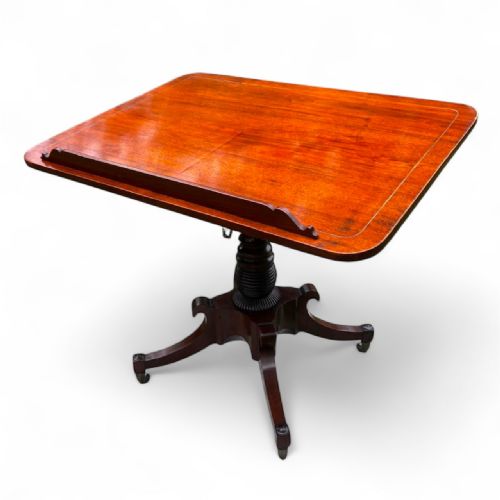


Tilting Reading Table
These tilting reading table designs bring ingenious mechanism and warm timber together, offering a practical surface that adjusts to your exact needs.
Tilting Reading Table
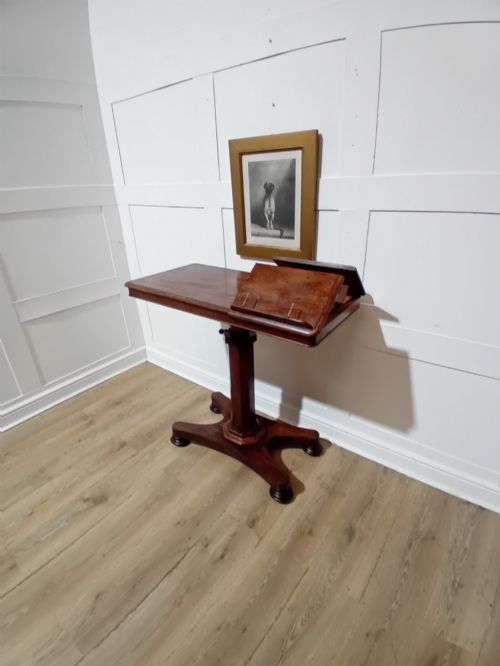
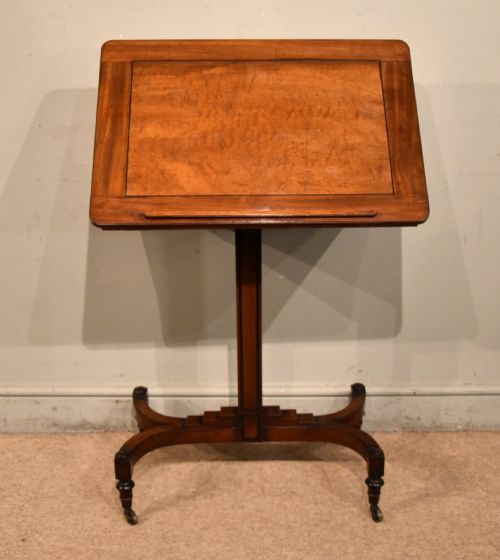
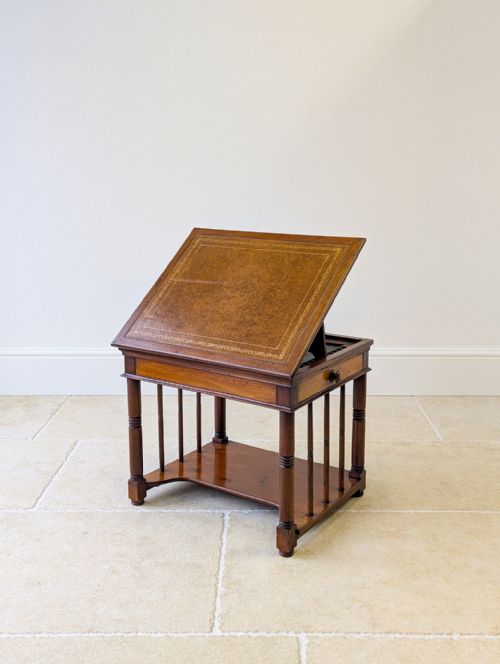
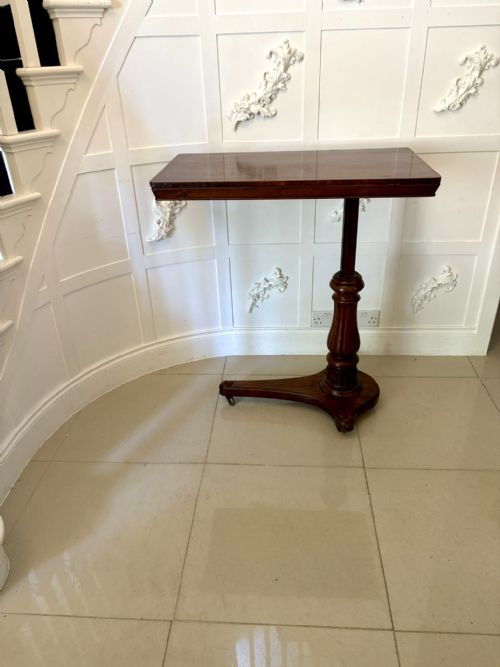
A tilting reading table gives you a flexible surface designed for books, music, or writing, moving easily between flat and angled positions. When you search for a tilting reading table, you encounter various forms including library chairsides, adjustable music stands, and double-sided lecterns.
The pieces appearing on this page span the Georgian, Regency, Victorian, and Edwardian eras, alongside examples from the early twentieth century. You will frequently find variants described as reading stands, artist's desks, and mobility aids alongside traditional occasional tables.
Mahogany forms the dominant timber across these examples, paired occasionally with pine or supported by sturdy iron and cast iron bases. Brass inlay and adjustable mechanisms appear regularly, marking these items as functional furniture built for studies, libraries, and parlours.
Materials and construction methods
Cabinet makers relied primarily on mahogany for its rich grain and structural stability, shaping tops that could withstand frequent adjustment and daily use in the library or studio. Pine and mixed woods also appear in specific utilitarian or later pieces.
Tilting Reading Table Retail Price Guide 2026
Typical asking prices for tilting reading table among the pieces listed under this phrase on Sellingantiques today, from the lower quarter to the upper quarter. They describe what is for sale here now, not the wider market.
Some Victorian examples doubled as mobility aids with heavy cast iron frames, proving that historical ergonomics solved bedroom reading struggles with industrial strength.
Markers of quality and execution
Finer examples distinguish themselves through the precision of their adjustable brass ratchets and the smoothness of their mechanical action, allowing effortless transition between angles. The choice of solid mahogany and the refinement of turned columns or inlay further separate standard production from superior pieces.
Proportion and structural integrity dictate the standing of a piece, with well-balanced bases preventing tipping when the top is fully angled. Quality manifests in the seamless integration of folding ledges, book supports, and double-sided surfaces.
The Tilting Reading Table Glossary
- Lectern
- A stand with a sloping top designed to hold a book or manuscript at a comfortable reading angle. These pieces often feature adjustable heights for standing or seated use.
- Regency
- A style period spanning the early nineteenth century defined by classical restraint and polished mahogany surfaces. Pieces from this era often incorporate delicate brass inlay.
- Cast Iron
- A robust metal alloy poured into moulds to create heavy, stable bases and frames. It frequently supports industrial or medical variants such as mobility aids.
- Double Sided
- A configuration allowing access from two opposing positions, common in shared library or music room tables. This design maximises utility in larger spaces.
Tilting Reading Table: Frequently Asked Questions
What is a tilting reading table?
A tilting reading table is a piece of furniture featuring an adjustable top designed to hold books, music, or writing materials at various angles. They were traditionally used in libraries, music rooms, and studies for comfortable reading.
Today, these tables serve equally well as versatile side tables or dedicated desks in modern homes, retaining their mechanical charm.
How do I adjust the reading angle?
Adjustment typically relies on a brass ratchet mechanism, a notched support arm, or a central screw column beneath the top. These devices allow the surface to lock securely into multiple sloping positions.
Operating the mechanism requires lifting or sliding the support gently to engage the desired notch or tighten the collar.
What periods do these tables come from?
The available pieces span the eighteenth century through the Edwardian era and early twentieth century. Common periods represented include Georgian, Regency, and Victorian.
Each period brings distinct design characteristics, from George II mahogany stands to later cast iron mobility aids.
Where were these tables used originally?
Libraries, studies, and music rooms formed the primary locations for these tables, serving readers, musicians, and architects. Specialised variants also functioned as bedside mobility aids.
Their adjustable nature made them essential for tasks requiring close inspection of texts, scores, or architectural drawings.