

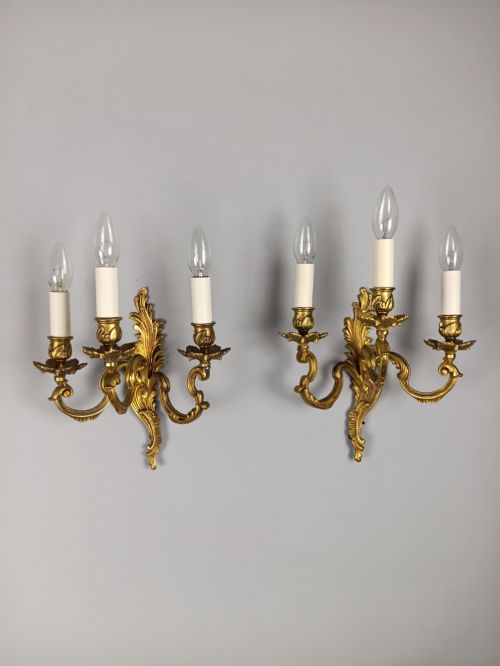


Three Light Brass Holder
A three light brass holder brings three distinct flames to a mantel, table or wall, offering the warm, layered illumination that collectors prize.
Three Light Brass Holder
When searching for a three light brass holder, collectors encounter candelabra, wall lights and sconces, and candlesticks configured with three branches or arms. These pieces emerge predominantly in brass, ormolu, and gilded bronze, frequently paired with materials like marble and glass to create substantial table and wall lighting.
The selections span the nineteenth century through the Edwardian era, encompassing distinct historical revivals such as French Rococo, Louis XVI, Regency, and Gothic styles. French workshops and English makers dominate the forms, yielding everything from monumental altar candelabra to adjustable arm empire designs.
Buyers most frequently meet pairs of three branch candelabra dating from the nineteenth century, often exhibiting heavy cast construction and patinated metal surfaces. These pieces serve both functional illumination and decorative symmetry within traditional interiors.
How they were made
Maker's workshops cast brass, ormolu, and gilded bronze in sections using traditional foundry methods before hand-chasing the metal surfaces to sharpen botanical, scroll, or figural details. Ormolu and gilt finishes required the application of gold leaf or mercury gilding to achieve a deep, lasting lustre on the bronze base.
Candelabra incorporating marble or glass components utilised precision cutting and turning to mount the stone bases and glass drops securely into the metal framework. Structural joints were often threaded or pinned to support the weight of three distinct branches without instability.
Three Light Brass Holder Retail Price Guide 2026
Typical asking prices for three light brass holder among the pieces listed under this phrase on Sellingantiques today, from the lower quarter to the upper quarter. They describe what is for sale here now, not the wider market.
Some nineteenth-century makers engineered adjustable arms so users could swing their candelabra wide or tuck them tight at whim.
What varies in quality
The distinction between ordinary production and superior craftsmanship lies in the crispness of the metal chasing and the weight of the cast brass or bronze. Finer examples retain deep, sharp relief in their ornamentation, whereas lesser pieces display softened, smoothed casting details from worn moulds.
Materials also dictate the tier of the piece, with genuine mercury-gilded ormolu and heavy statuary marble commanding greater distinction than thin gilt metal or plain timber bases. The structural integrity of the branching arms and the symmetry of the composition separate workshop masterworks from standard commercial production.
Wm. Tonks & Sons
The Three Light Brass Holder Glossary
- Ormolu
- Gilded bronze, where a finely ground gold-mercury amalgam is applied to a bronze base and heated to drive off the mercury. This technique produces a rich, durable golden surface seen on high-end French and English decorative metalwork.
- Candelabra
- A branched candlestick designed to hold multiple candles simultaneously. These fixtures often feature a central shaft dividing into three or more distinct arms for lighting.
- Regency
- An English decorative style spanning the early nineteenth century, characterised by classical restraint, archaeological revival motifs, and the combination of dark bronze with bright ormolu mounts.
- Gilt Bronze
- Bronze metal that has been coated with a thin layer of gold leaf or gold paint to simulate solid gold. It provides the luxurious appearance of ormolu through slightly different manufacturing processes.
- Rococo Revival
- A nineteenth-century design movement mimicking the asymmetrical scrolls, shell motifs, and naturalistic curves of the eighteenth-century French Rococo movement. It appears frequently on ornate candelabra and wall sconces.
Three Light Brass Holder: Frequently Asked Questions
How do I clean an antique brass candelabra?
Dust the piece gently with a soft, dry cloth to remove surface particles without disturbing the underlying metal patination. Avoid harsh chemical polishes that strip historical finishes and diminish the character of nineteenth-century brass.
For stubborn grime, use a damp cloth with mild soap, drying the metal immediately to prevent spotting. Preserving the natural age of the brass maintains the authenticity and visual depth of the object.
Were these originally wired for electricity?
Most antique three branch candelabra were manufactured exclusively for wax candles during the nineteenth and early twentieth centuries. Conversion to electricity often occurred decades later to accommodate modern domestic lighting preferences.
When evaluating electrified examples, check whether the wiring can be removed or updated safely without altering the original metal structure. Preserving the candle cups allows collectors the option of returning the piece to its original state.
How do I distinguish Regency from Victorian styles?
Regency metalwork relies on crisp classical restraint, military motifs, and striking contrasts between dark patinated bronze and bright ormolu. The lines are generally cleaner and reflect archaeological discoveries from Greece and Rome.
Victorian pieces, by contrast, lean towards heavier ornamentation, floral exuberance, and elaborate revival styles such as Rococo and Gothic. Examining the cast details and overall silhouette usually reveals the shift from early nineteenth-century neoclassical discipline to mid-century abundance.
Where should I place a three branch candelabra?
These pieces suit mantelpieces, sideboards, and large dining tables where their height and three-light spread create balanced symmetry. Wall-mounted versions require secure fixing into solid masonry or studs to support the substantial weight of brass and marble.
Ensure the placement keeps the open flames away from foot traffic, drapes, and overhanging shelves. Using appropriate candle sizes prevents wax from dripping onto the metal arms or supporting surfaces.