
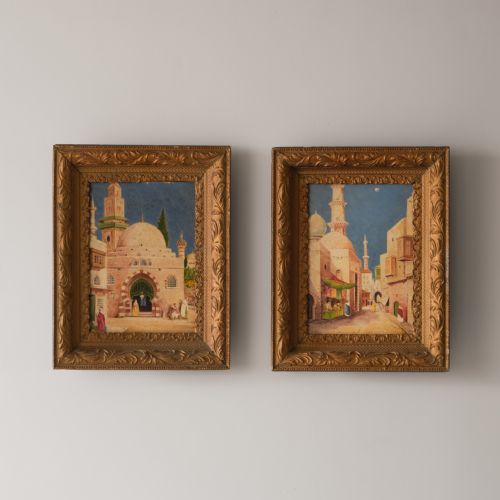


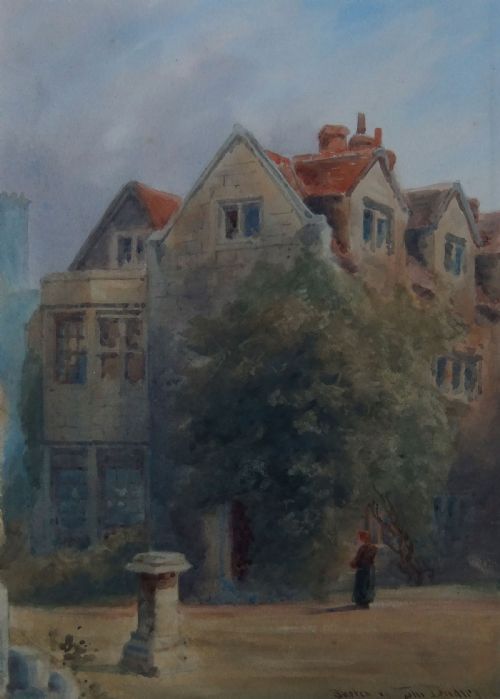

Terracotta Architectural Watercolour
These terracotta architectural watercolour pieces capture historic stonework, facades and foreign views, offering collectors a direct window into past buildings.
Terracotta Architectural Watercolour
When you search for terracotta architectural watercolour, you are looking at works on paper that record buildings, stonework and street scenes. The pieces on this page span the nineteenth and twentieth centuries, taking in British village scenes, Dutch architecture and Grand Tour views of classical sites. You will find both precise architectural drawings and looser topographical watercolours.
The subjects range from English medieval structures and Dutch Renaissance facades to Italian classical ruins and London bridges. These watercolours appear in framed formats, often accompanied by pen, ink or paint details on paper. They serve as historical records of buildings as they stood in earlier eras.
How they were made
Artists created these works using watercolour paint applied to paper, frequently supported by ink and pen work to define architectural lines and stonework details. The application ranges from fine, meticulous draughtsmanship to broader washes.
Framing materials include wood, gilt wood and glass to protect the delicate works on paper. The mounting preserves the watercolour pigments and ink from environmental damage over the centuries.
One detailed architectural drawing records a Dutch building constructed in sixteen hundred and three.
What varies in quality
The distinction between ordinary and exceptional works lies in the precision of the draughtsmanship and the artist's ability to render complex architectural perspective. Pieces that capture intricate stonework and fine structural details demand greater technical skill from the painter.
Condition and medium complexity also set works apart, particularly where artists combine ink, paint and watercolour to build depth. The strength of provenance and the specific historical interest of the depicted building influence the desirability of each piece.
Jack Merriott·David Law·Peter Toft·Tom Dudley·John Thirttle
The Terracotta Architectural Watercolour Glossary
- Watercolour
- A paint consisting of a pigment suspended in a water-soluble vehicle, used on paper to create translucent washes of colour.
- Topographical
- Representing a particular place or locality with realistic detail, often focusing on buildings and landscapes.
- Grand Tour
- A traditional trip of Europe undertaken by upper-class European young men of sufficient means, resulting in the acquisition of art and views.
- Gilt wood
- Wood that has been treated with gold leaf or a gold-coloured finish, commonly used for traditional picture frames.
- Draughtsmanship
- The art or technique of making detailed drawings, essential for accurate architectural depiction.
Terracotta Architectural Watercolour: Frequently Asked Questions
What subjects do these watercolours show?
These watercolours depict architectural subjects, including historic English villages, Dutch Renaissance buildings, Italian ruins and London bridges.
The works record real structures, facades and street scenes from the nineteenth and twentieth centuries.
How should I frame and display them?
Display these works on paper away from direct sunlight to prevent the watercolour pigments and paper from fading over time.
Ensure they remain protected behind glass within their wooden or gilt wood frames to maintain their condition.
How do I identify the age of a piece?
Dating relies on the artist's active period, stylistic clues, costume details and the specific architectural history of the buildings shown.
Signatures, inscriptions and framing methods also provide context for the era in which the watercolour was produced.
What materials are typically used?
The primary materials are watercolour paint and ink applied to paper supports, capturing fine structural and tonal details.
Completed works are housed in wood, glass and gilt wood frames to secure and exhibit the art.