
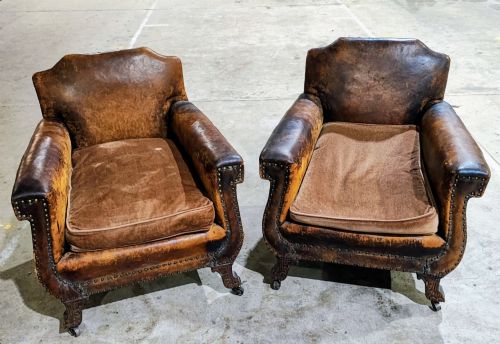
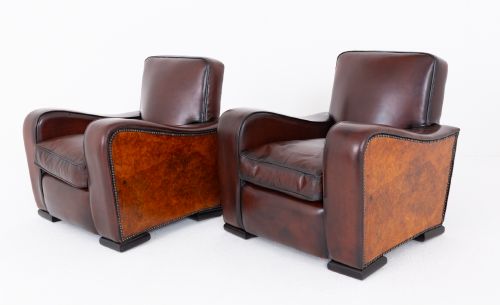
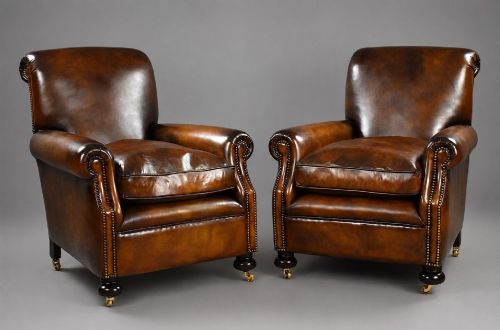
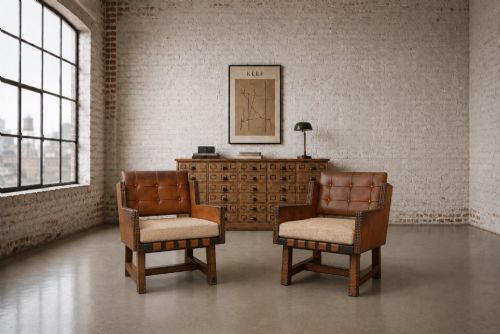
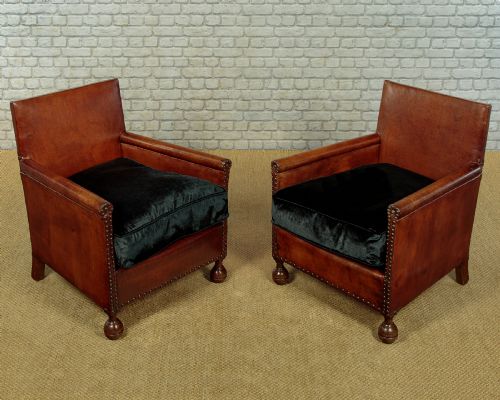


Studded Leather Lounge Chairs
Studded leather lounge chairs bring substantial seating and tactile warmth to a room, spanning Victorian, Edwardian, and Art Deco eras.
Studded Leather Lounge Chairs
Studded leather lounge chairs encompass armchairs, club chairs, wingbacks, and seating suites designed for domestic comfort. You will encounter club chairs and armchairs most frequently on this page, often presented in pairs.
The periods represented span the nineteenth century through the 1930s, taking in Victorian, Edwardian, and Art Deco designs. Pieces range from French and British club chairs to Anglo-Indian plantation chairs and Moroccan suites.
Forms vary from low lounge seats and library chairs to metamorphic designs and reclining chaises. Wood frames underpin these seats, paired with leather upholstery secured by brass studs.
Materials and construction
Makers utilised solid timbers such as oak, mahogany, walnut, teak, and rosewood to build the structural frames of these lounge chairs. These hardwoods provide the underlying strength required for heavy seating.
Upholstery relies upon leather, frequently hand-dyed or finished in tones like caramel and brown, occasionally complemented by velvet elements. Brass studs secure the leather edges to the wooden framework, providing both structural fastening and decorative outline.
Assessing quality and execution
Quality reveals itself in the selection of timber and the treatment of the leather upholstery. Dense hardwoods and supple, hand-dyed leather distinguish the more substantial examples from simpler variants.
The integration of mechanical or adjustable elements, such as metamorphic frames or reclining mechanisms, indicates higher ambition in manufacture. Refined carving on wooden elements, including turned feet or cabriole legs, further separates standard production from finer work.
The Studded Leather Lounge Chairs Glossary
- Wingback
- An armchair with high sides attached to the back, designed to shield the sitter from draughts. These often incorporate exposed wooden legs and leather upholstery.
- Plantation chair
- A deep-seated lounge chair featuring extended arms, originating in colonial settings for tropical climates. They are typically constructed from teak.
- Metamorphic chair
- A piece of furniture engineered to alter its form for different functions, such as shifting from a chair to a recliner. These incorporate adjustable mechanical elements.
- Cabriole leg
- A furniture leg that curves out and then in, resembling an animal's leg. This form appears on Victorian seating.
Studded Leather Lounge Chairs: Frequently Asked Questions
How do I clean antique leather?
Antique leather requires gentle maintenance using specialised leather conditioners to preserve the hide and prevent cracking. Avoid harsh chemical cleaners that strip the original finish and hand-dyed colour.
Regular dusting with a soft cloth keeps debris from settling into the seams and brass studding. Professional conservation is advisable for fragile or deeply distressed antique hides.
Where should I place a club chair?
Club chairs suit studies, libraries, and living rooms where deep seating creates a comfortable reading or relaxing area. Their substantial proportions anchor a room layout effectively.
Pairing two chairs together creates a natural conversation grouping. Keep them away from direct sunlight and heat sources to protect the leather from drying out.
How do I identify a Victorian chair?
Victorian chairs often feature dark hardwoods like walnut and rosewood, alongside button-back upholstery or claw and ball feet. The styling draws on historical revivals such as Jacobean influences.
Examining the construction methods and joinery underneath helps confirm the nineteenth-century origin. Turned feet and hand-dyed leather are also characteristic of this period.
What is an Anglo-Indian chair?
Anglo-Indian chairs are pieces made in India during the nineteenth century, often for British residents, utilising native timbers like teak. They typically feature deep seats and extended arms designed for warm climates.
These chairs combine British seating forms with regional woodworking traditions and materials. They stand out among standard European designs through their specific timber choice and construction.