

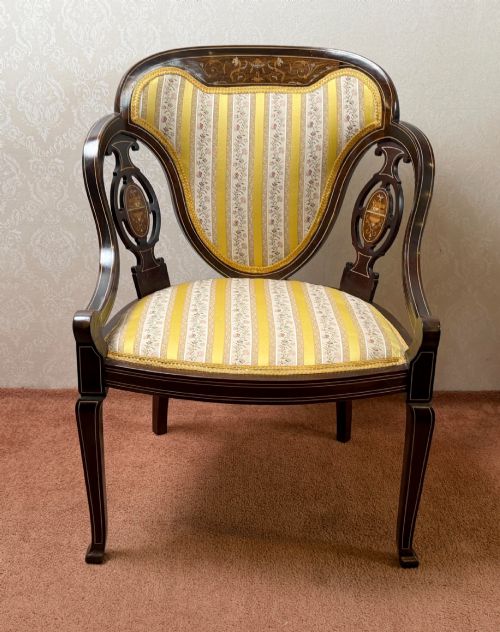


Striped Easy Chair
A striped easy chair is a seat designed for deep comfort, bringing character and colour to a room through its pattern.
Striped Easy Chair
When you search for a striped easy chair, you encounter a variety of upholstered seating designed primarily for comfort and relaxation. These pieces range across several periods, including Georgian, Victorian, Edwardian, and Regency eras, reflecting shifting tastes in domestic seating.
The versions you are most likely to meet on this page include wing armchairs and square-sided armchairs upholstered in textiles, fabrics, and velvet. Many of these chairs incorporate wooden frames made from mahogany, walnut, or rosewood, sometimes accented with inlay or carved details.
How they were made
Makers constructed these chairs using sturdy hardwoods such as mahogany, walnut, and rosewood for the exposed frames and structural supports. Cabinetmakers and upholsterers shaped these timbers with varying degrees of carving, sometimes adding bone and boxwood inlay to enrich the appearance.
The upholstery technique involved padding and covering the frames in textiles, fabrics, and velvet to ensure comfort and visual appeal. Many of these chairs have undergone re-upholstery over time to maintain their usability while retaining their period forms.
Striped Easy Chair Retail Price Guide 2026
Typical asking prices for striped easy chair among the pieces listed under this phrase on Sellingantiques today, from the lower quarter to the upper quarter. They describe what is for sale here now, not the wider market.
Listings include armchairs spanning the Georgian, Victorian, Edwardian, and Regency periods, constructed from mahogany, walnut, rosewood, and hardwood.
What varies in quality
The distinction between standard examples and finer pieces often lies in the quality of the timber selection and the precision of the frame construction. Chairs featuring detailed carving or subtle inlay demonstrate a higher level of craftsmanship from the maker.
Proportion and execution define the character of the piece, where harmonious lines and balanced upholstery shape the overall presence. Pieces that retain their original structural integrity display a superior standard of historical craftsmanship.
The Striped Easy Chair Glossary
- Wingback
- An armchair featuring protective side panels designed to shield the sitter from drafts. These panels extend from the arms up to the back of the chair.
- Inlay
- A decorative technique where contrasting materials such as bone and boxwood are inserted into recesses within the wooden frame. This adds intricate detail to the surface of the furniture.
- Upholstery
- The padded covering and fabric applied to a chair frame to provide comfort. This encompasses various textiles, fabrics, and velvet.
- Hardwood
- Dense timber derived from broad-leaved trees, used in the construction of durable chair frames. Examples include mahogany, walnut, and rosewood.
Striped Easy Chair: Frequently Asked Questions
How do I identify the period of an armchair?
Period identification relies on observing the framing style, woodwork details, and construction methods characteristic of eras such as the Georgian or Victorian periods.
Comparing the specific wood types and decorative elements like inlay helps narrow down the likely date of manufacture.
What materials were used for these chairs?
Frameworks typically consist of hardwoods such as mahogany, walnut, rosewood, and general hardwood, sometimes accented with bone and boxwood.
Coverings range across various textiles, fabrics, and velvet to provide the upholstered finish.
Are these chairs suitable for daily use?
Many of these seating options are designed for comfort and remain practical for everyday seating in modern living spaces.
Chairs that have undergone re-upholstery offer renewed padding while preserving the historical framework.
What defines a wing armchair?
A wing armchair incorporates extended side panels on the upper back designed to block draughts and retain warmth around the sitter's head.
This classic form appears across multiple periods, from Georgian designs to later revival styles.