
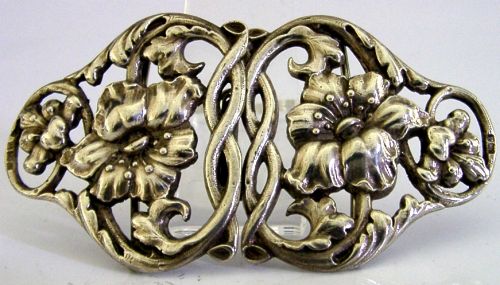


Sterling Silver Belt Buckle
A sterling silver belt buckle fastens utility with ornament, spanning Victorian scrollwork, Edwardian floral motifs and mid-century forms.
Sterling Silver Belt Buckle
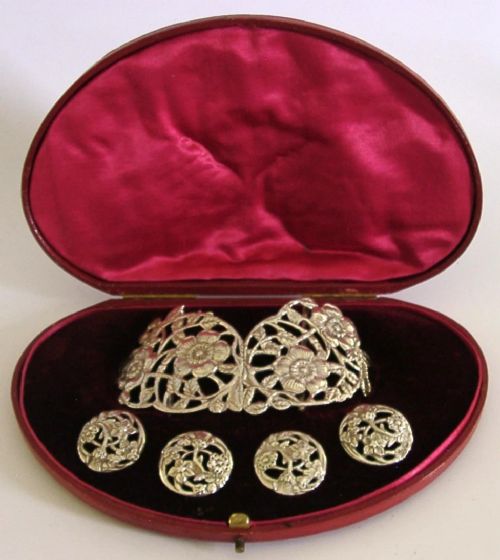
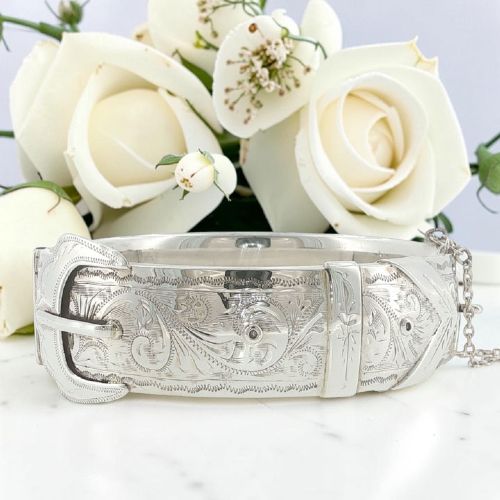
A sterling silver belt buckle comprises cast or pierced metal fasteners designed for waist wear, alongside related nurse buckles, cuff bangles and napkin rings. The examples found here span the Victorian, Edwardian and mid-century periods, capturing shifts in design from naturalistic scrollwork to linear geometry. Buyers encounter varied regional assay marks alongside fitted boxes lined in velvet or leatherette.
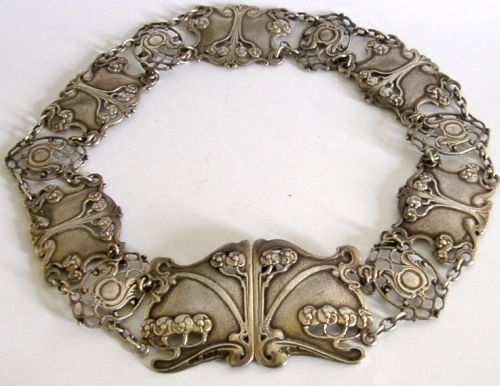
The Art Nouveau style dominates the selection alongside Arts and Crafts and Victorian aesthetics, featuring organic curves, heart shapes and figural scenes such as cherubs, dragons and the goddess Diana. Cast English pieces sit alongside enamelled work and specialised nurses' buckles made for practical uniform wear. These items bridge costume accessory and functional metalwork, often appearing with matching buttons or integrated belts.
What varies in quality
The clarity and depth of cast relief work separate standard examples from finer items, particularly where human figures, stags or floral motifs show sharp anatomical detail rather than softened edges. Heavier weight silver indicates substantial metal use rather than thin sheet construction, which affects durability during fastening.
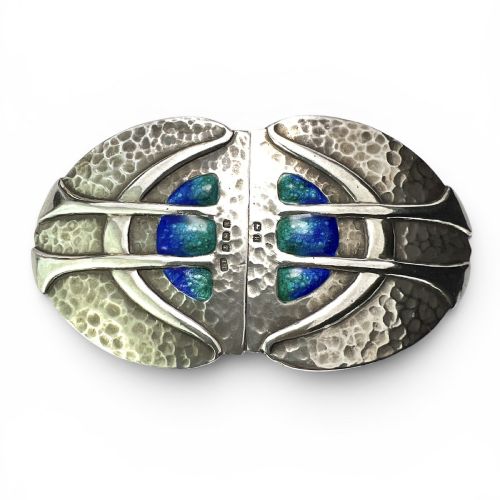
The preservation of applied vitreous or glass enamel influences value, as losses or cracking alter the intended polychromatic surface. Crispness in hand-pierced scrollwork and legible hallmarks stamped cleanly into the metal further distinguish master silversmith output from mass production.
Stag hunting scenes and galloping cherubs regularly guarded Victorian waistlines.
James Fenton·Walker & Hall·Liberty's·Henry Matthews
The Sterling Silver Belt Buckle Glossary
- Sterling silver
- A silver alloy containing 92.5 percent pure silver by mass, with the remainder composed of copper or other metals. This standard ensures structural strength for wearable items like buckles.
- Vitreous enamel
- A material made by fusing powdered glass to a substrate by firing, resulting in a smooth, durable glass coating. It provides rich colour depth on metal surfaces.
- Assay office
- A body responsible for testing the purity of precious metals and stamping them with official hallmarks. British offices use specific town marks alongside standard purity symbols.
- Pierced scroll
- A decorative technique involving the cutting away of background metal to leave intricate, openwork scrolling patterns. It lightened heavy metal components whilst adding visual complexity.
- Nurse buckle
- A specialised two-piece buckle designed to hook together over utility belts worn by healthcare staff. These often feature cast figural scenes or specialised regional motifs.
Sterling Silver Belt Buckle: Frequently Asked Questions
How do I wear an antique silver buckle?
Many of these pieces adapt well to modern cloth belts or specialised fabric bands designed to thread through the central bars. Alternatively, converted cuff bangles offer wrist wear derived from the same form.
Ensure the fastening pin and catch align securely before wearing historic silver at the waist to prevent loss during movement.
What is a nurse buckle?
Nurse buckles function as two-piece interlocking fasteners designed specifically for uniform belts worn by hospital staff during the Victorian and mid-century eras. They often feature symbolic imagery or sturdy cast construction to withstand daily institutional use.
Collectors prize them for their distinct social history and robust manufacturing standards.
How do I date a silver buckle?
British sterling silver pieces carry hallmarks that include a date letter indicating the exact year of assay, alongside the maker's mark and town symbol. Comparing these stamps against official registry records reveals the production year.
Stylistic cues such as Edwardian enamelling or Victorian scrollwork also point to specific decades.
How should I clean antique silver?
Remove dust with a soft microfibre cloth and avoid harsh chemical dips that strip away desirable age patina from recessed areas. Gentle treatment preserves the integrity of applied enamel and delicate cast details.
Store pieces in dry conditions away from direct sunlight to prevent excessive tarnishing.