



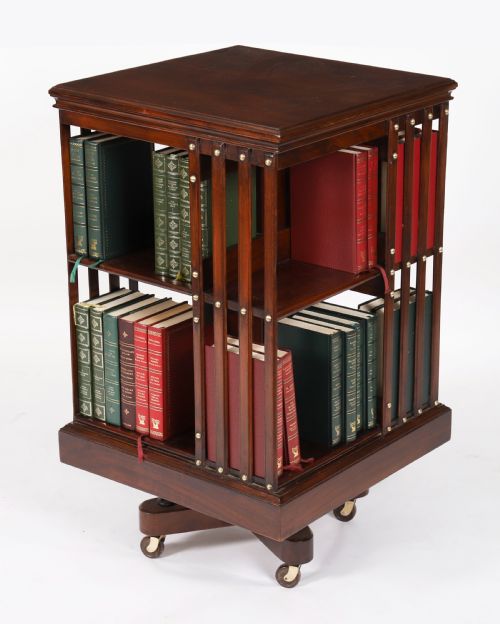


Square Revolving Book Stand
A square revolving book stand is a compact library essential that keeps volumes within arm's reach while turning smoothly on its axis.

Square Revolving Book Stand
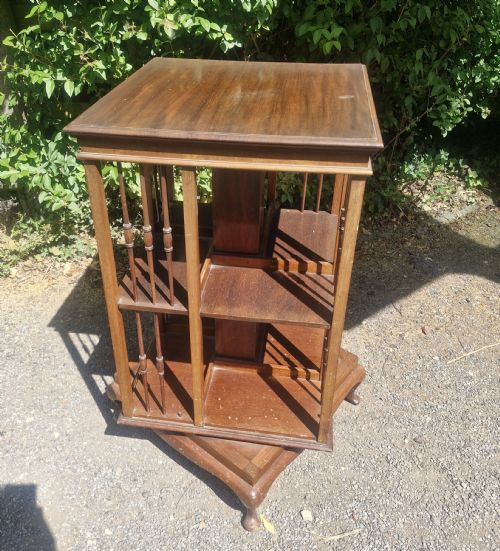
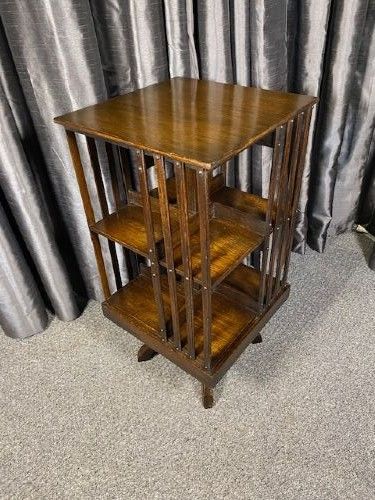
When you search for a square revolving book stand, you find pieces designed to hold reference volumes and favourite reads within easy access. The examples listed here lean heavily toward the Edwardian and Victorian periods, often taking the form of tiered shelving units that rotate on a central pivot.
Mahogany and walnut dominate the selection, frequently paired with inlaid satinwood details or built in the Chippendale style. These items served as practical desk or floor companions in studies and drawing rooms, where floor space was at a premium and books needed consultation throughout the day.
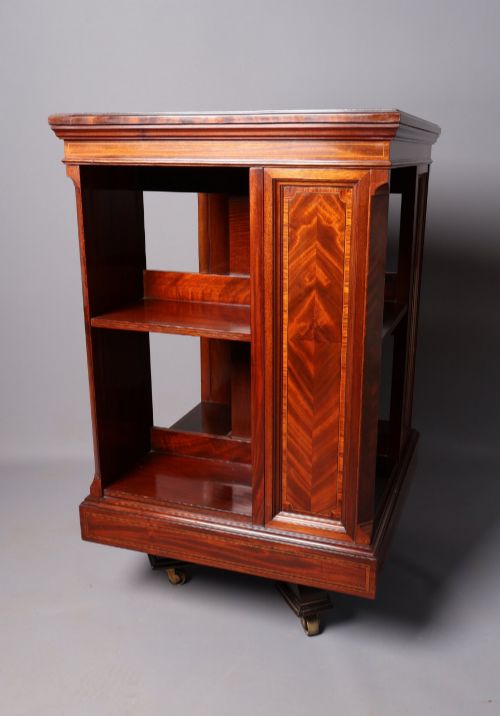
The version you are most likely to meet on this page is a mahogany Edwardian model, sometimes featuring subtle marquetry or standing as a petite French four-shelf variation. Oak also appears among the listings, alongside larger formats and walnut constructions that offer multiple tiers of storage.
How they were made
Cabinetmakers constructed these stands using solid timbers such as mahogany, walnut, and oak, often applying satinwood inlay to enrich the flat surfaces of the shelves and sides. The timber was selected for its grain and stability, ensuring the frame could support the substantial weight of stacked books without warping over time.
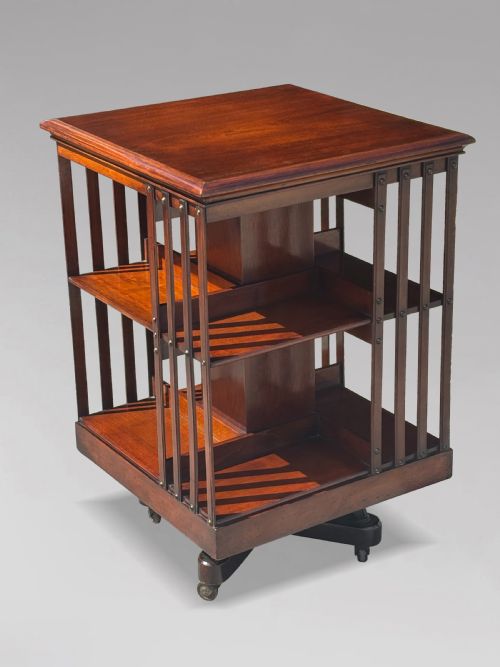
The essential mechanical feature is the revolving pivot, which frequently incorporated iron, metal, or brass components concealed beneath the base. This internal mechanism allowed the heavy wooden tiers to turn with minimal friction, a testament to the precise joinery and metalworking of the period.
Square Revolving Book Stand Retail Price Guide 2026
Typical asking prices for square revolving book stand among the pieces listed under this phrase on Sellingantiques today, from the lower quarter to the upper quarter. They describe what is for sale here now, not the wider market.
Some models are petite enough to sit upon a tabletop, letting you spin your novels while you drink tea.
What varies in quality
Quality in a revolving book stand rests upon the smoothness of the turning action and the integrity of the underlying pivot mechanism. A superior piece rotates evenly without listing to one side, showing careful distribution of weight and robust internal engineering rather than a sluggish or grinding turn.
The refinement of the timber selection and the crispness of any inlay set the finer examples apart from simpler utilitarian pieces. Master workshops employed finely figured mahogany and precise satinwood banding, whereas lesser pieces relied on plain boards with minimal decorative enrichment.
Maple & Co·Heals
The Square Revolving Book Stand Glossary
- Edwardian
- Pertaining to the reign of King Edward VII, spanning the early years of the twentieth century. Furniture from this era often lighter in proportion than Victorian precedents.
- Inlaid
- Ornamented by embedding pieces of contrasting wood, such as satinwood, flush into the primary surface. This technique creates delicate patterns and borders.
- Revolving
- Designed with a central pivot that allows the shelving tier to turn full circle. This enables access to multiple compartments from a single stationary position.
- Chippendale style
- Design characteristics inspired by the mid-eighteenth-century pattern books of Thomas Chippendale. Pieces in this idiom often display classical carved details and balanced proportions.
Square Revolving Book Stand: Frequently Asked Questions
What is a square revolving book stand?
A square revolving book stand is a tiered wooden shelving unit mounted on a rotating pivot mechanism. It allows a collection of books to be turned effortlessly for selection in a study or library.
These stands were developed to keep frequently consulted volumes close at hand without requiring the reader to move around a larger bookcase.
How do I date a revolving bookcase?
Dating relies on observing the timber choice, secondary woods, and decorative motifs such as satinwood inlay. Edwardian pieces often display lighter proportions and refined stringing compared to heavier Victorian models.
Maker marks, where present, help pinpoint the origin to specific workshops active around the turn of the twentieth century.
Where should I place it?
These stands suit placement beside an armchair, beside a desk, or in the corner of a room where turning access is unobstructed. Their compact square footprint makes them adaptable to smaller spaces.
Because they rotate, they function well away from walls where all four sides can be reached.
How do I maintain the mechanism?
The internal pivot benefits from occasional inspection to ensure dust does not impede the rotation. Keeping the weight balanced across the tiers prevents undue strain on the central axis.
Applying appropriate wood care to the external timber preserves the finish without affecting the moving parts.