
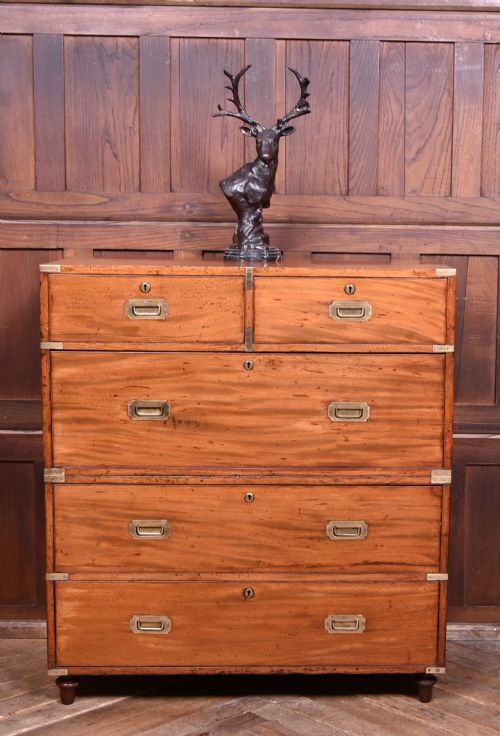
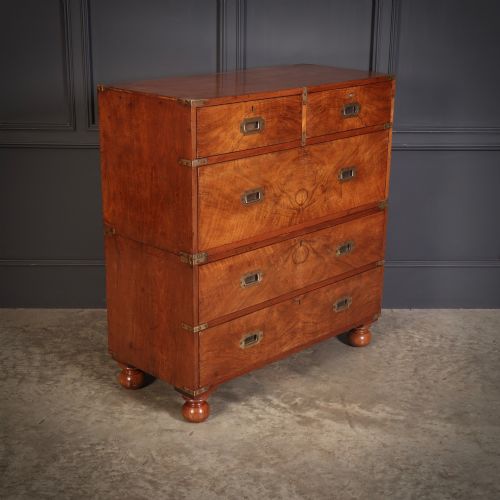


Split Military Tallboy
A split military tallboy offers robust modular storage forged for travel, prized for rich timbers and brass corners.
Split Military Tallboy
A split military tallboy provides a sturdy chest of drawers built in sections to move easily on campaign. These pieces appear in forms such as chests of drawers and campaign chests, designed with two distinct parts.
The versions met on this page belong mainly to the Victorian period, spanning the nineteenth century from eighteen fifty to eighteen ninety. Makers constructed these utilitarian items in woods like mahogany, teak, walnut, padouk, and oak.
Originating for military life, these sturdy chests combine practical handles with recessed brass fittings to withstand rough journeys. Collectors prize the modular design that separates into distinct upper and lower sections for transport.
How they were made
Cabinet makers built these pieces using dense hardwoods such as mahogany, teak, walnut, padouk, and oak to endure harsh climates and heavy transport. These timbers provide the structural strength required for modular campaign furniture.
Workshops reinforced every edge and corner with brass binding to protect the wood from splitting during transit. Recessed brass handles and flush drawer pulls allowed multiple sections to stack tightly without projecting hardware.
The documented examples span the Victorian era, including dated items from eighteen fifty and eighteen ninety.
What varies in quality
The choice of timber creates a distinct hierarchy, with highly figured walnut and rich padouk sitting above standard utility oak. Grain selection and timber density dictate the visual weight and tactile appeal of each section.
The precision of the brass work and the integration of flush hardware distinguish finer examples from simpler field furniture. Superior construction ensures that the two stacking sections align seamlessly with secure internal locking mechanisms.
Army & Navy
The Split Military Tallboy Glossary
- Split military tallboy
- A chest of drawers built in two stacking sections for transport during the nineteenth century. This modular construction allowed officers to pack and move their belongings efficiently.
- Campaign chest
- A modular set of drawers designed for military use with recessed brass fittings. These pieces dismantled into separate parts to facilitate travel.
- Padouk
- A dense tropical hardwood with a reddish brown tone utilised in nineteenth century cabinet making. It offers exceptional durability and resistance to warping.
- Brass binding
- Protective metal strips fitted around the edges of campaign furniture to prevent impact damage. This reinforcement is characteristic of military pieces.
Split Military Tallboy: Frequently Asked Questions
Why do these chests split in two?
The two-part construction allowed officers to pack and transport heavy storage easily across rough terrain.
Each section fitted with side carrying handles for loading onto wagons or ships during campaigns.
What woods were used for campaign chests?
Cabinet makers utilised durable hardwoods such as mahogany, teak, walnut, padouk, and oak.
These timbers resisted warping and endured the humid climates encountered by the military.
How do you identify a Victorian military piece?
Key indicators include flush brass drawer pulls, corner brackets, and a sectional carcass built for travel.
These functional details protected the wood from knocks during nineteenth-century transit.
Where should a tallboy be placed?
The modular proportions suit bedrooms or studies where substantial storage is required.
The flat top and sturdy brass corners anchor the piece visually within a room.