



Small Glass Clock
A small glass clock sits quietly on a desk or mantelpiece, catching the daylight through its bevelled panels while keeping exact time.
Small Glass Clock
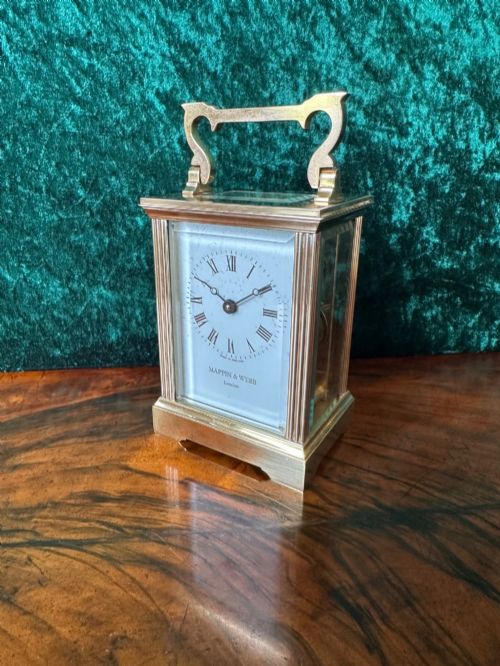
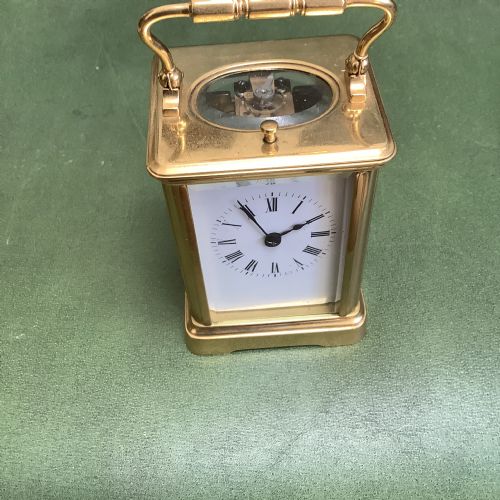
A small glass clock brings together the precision of a mechanical movement with transparent panels that reveal the inner cogs and escapements at work. When you search for a small glass clock, you encounter carriage clocks, four-glass mantel designs, and miniature timepieces spanning the nineteenth and twentieth centuries.
The selections on this page range from compact Victorian brass-framed carriage clocks to Edwardian four-glass designs and French library pieces. These domestic timepieces were made to sit in studies, parlours, and bedrooms where their clear panels allowed light to pass straight through the case.
Most examples rely on bevelled glass to catch the room's illumination, set within frames of brass, gilt brass, or polished hardwoods like mahogany and rosewood. Their proportions remain modest, designed to occupy a modest corner of a mantelpiece or a writing table without dominating the surface.
Materials and construction
Glass forms the primary visual element of these clocks, frequently cut with bevelled edges to refract light and housed within brass or wooden frames. Makers utilised brass and gilt brass for carriage and four-glass cases, whilst others employed mahogany and rosewood for wall and bracket clock surrounds.
Enamel provides the surface for many of the painted dials, carrying Roman or Arabic numerals behind protective convex or flat glass covers. The internal mechanisms rely on brass wheels, steel pinions, and fusee or platform escapements assembled by hand to ensure regular timekeeping.
Small Glass Clock Retail Price Guide 2026
Typical asking prices for small glass clock among the pieces listed under this phrase on Sellingantiques today, from the lower quarter to the upper quarter. They describe what is for sale here now, not the wider market.
Some miniature carriage clocks were small enough to fit inside a pocket, allowing Victorian travellers to carry home comforts on rough coaching roads.
Quality and craftsmanship
The distinction between standard production and the finest work lies in the crispness of the brass casting, the depth of bevelling on the glass panels, and the refinement of the dial engraving. Finer makers applied delicate floral or geometric engraving directly onto the gilt brass framing and movement backplates.
Proportion and balance dictate the architectural success of a piece, particularly in four-glass and skeleton designs where every angle remains visible to the eye. The integration of signed movements by established makers elevates the standing of an individual clock within its period.
Mappin and Webb·Richard Winter of Chieveley·Tiffany·WH and Sch·Drocourt·J C Vickery London
The Small Glass Clock Glossary
- Bevelled glass
- Glass with an edge ground and polished to an acute angle. This technique adds decorative reflection and refracts light into the interior of the case.
- Carriage clock
- A small, spring-driven timekeeper with a handle, originally designed for travel. They frequently feature glass panels on all sides to protect the delicate escapement.
- Fusee
- A conical pulley used in mechanical clocks to maintain an even pull on the gear train as the mainspring unwinds. It ensures consistent timekeeping power.
- Four-glass clock
- A mantel timepiece enclosed by glass panels on the front, back, and both sides. This construction showcases the entire movement and pendulum.
- Skeleton clock
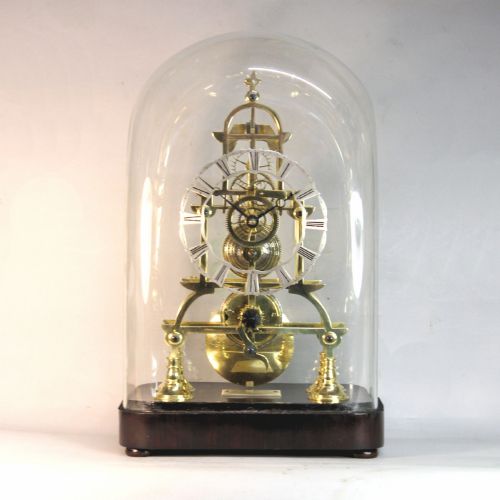
- A timepiece with an open framework designed to expose the gear train and escapement. It allows light to pass entirely through the mechanism.
Small Glass Clock: Frequently Asked Questions
Where should I place a small glass clock?
These clocks suit mantelpieces, desks, or bookcases where ambient light can pass through the transparent panels. Positioning them away from direct heat sources and constant vibrations helps protect the mechanical movement.
Because many examples feature glass on multiple sides, placing them where light reaches them from the side or behind highlights the internal gears and escapement.
How do I wind a mechanical carriage clock?
Most portable timepieces use a small key inserted into the backplate to tension the mainspring. Turning the key gently until resistance is felt ensures the clock is fully wound without straining the internal components.
Checking the winding arbor directions prevents overwinding, which can damage the delicate springs inside nineteenth and twentieth-century movements.
What distinguishes a four-glass clock from a carriage clock?
A four-glass clock sits on a stationary base, usually on a mantel or table, and relies on a traditional pendulum or platform balance to regulate time. It lacks the folding carrying handle found on standard carriage clocks.
Carriage clocks are built for portability with an upper handle and heavy protective brass framing, whereas four-glass designs prioritise transparent display over travel.
How do I identify the period of a glass timepiece?
Examining the dial style, framing materials, and engraving provides clear clues to the decade of manufacture. Victorian and Edwardian examples often display distinct brass patination and specific dial typography.
Signature marks on the movement backplate or dial frequently point to the maker and operational era, linking the piece to documented production dates.