

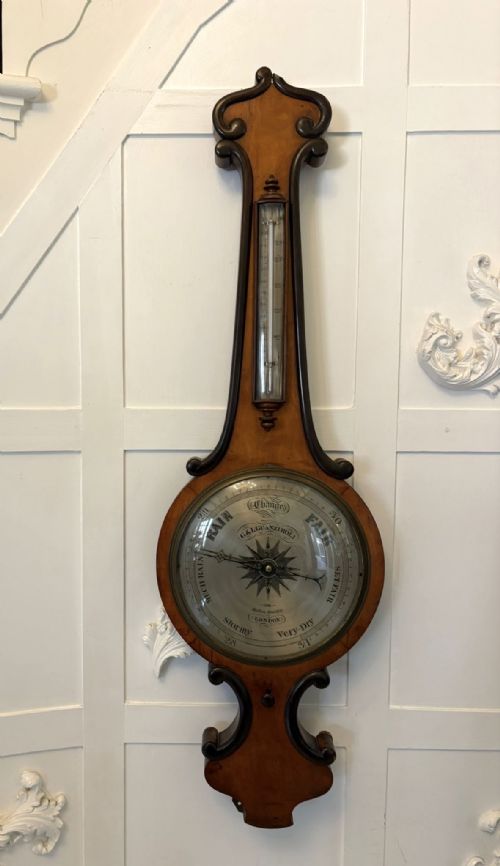





Silver Weather Glass
Silver weather glass instruments combine domestic utility with precision mercury mechanics, offering a glimpse into nineteenth-century forecasting.
Silver Weather Glass
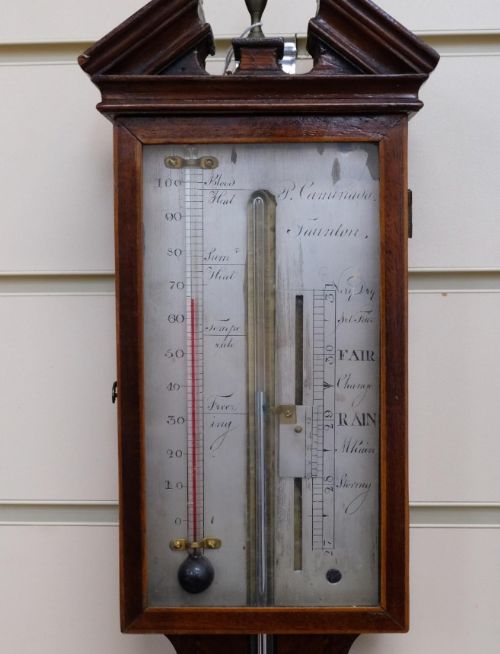
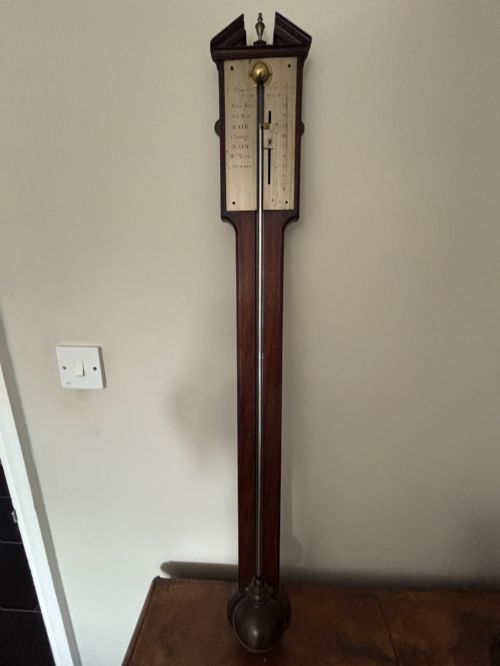
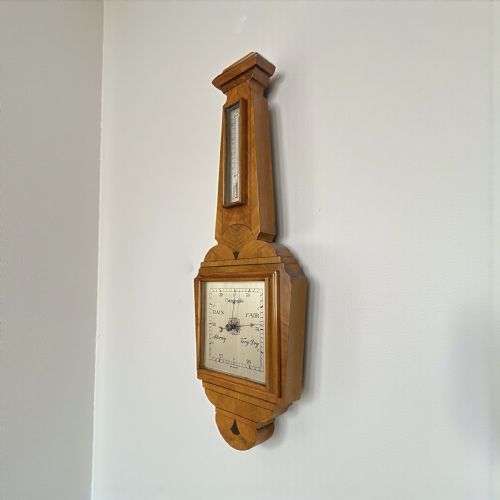
A silver weather glass typically appears as a mercurial barometer housed in a rich timber case, designed to track atmospheric pressure through a silvered metal scale. When searching for a silver weather glass, buyers encounter both tall stick barometers and broader wheel or banjo instruments.
The pieces on this page span the Georgian, Regency, and Victorian eras, alongside select later examples. Makers from London, provincial towns, and Dublin signed their metal dials, leaving records of regional trade across the British Isles.
Most items rely on mercury columns or dials with silvered brass plates, merging cabinetmaking with practical science. Walnut, mahogany, and rosewood dominate the housings, providing sturdy support for the delicate glass tubes within.
Materials and construction methods
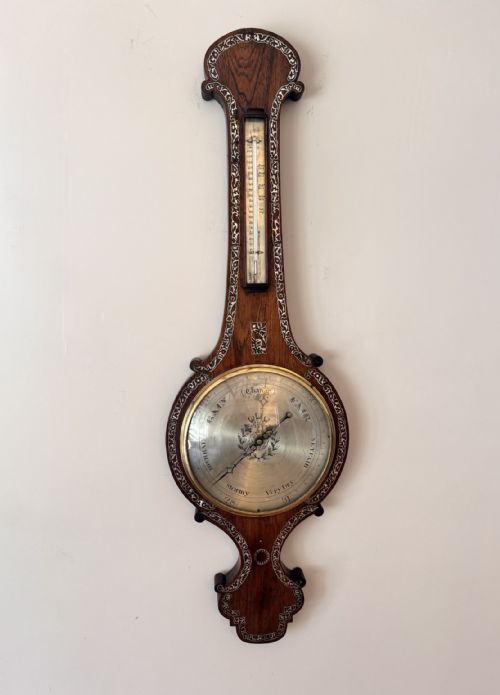
Cabinetmakers built the cases using dense hardwoods such as mahogany, rosewood, walnut, and oak, occasionally adding mother-of-pearl inlay or bird's-eye maple veneers. These timbers were shaped into slender sticks or sweeping banjo curves to protect the fragile glass reservoirs.
The forecasting scales consist of silvered brass or metal plates, engraved with weather descriptions and barometric measurements. Makers mounted these metal dials alongside mercury-filled glass tubes to register changes in atmospheric pressure accurately.
Silver Weather Glass Retail Price Guide 2026
Typical asking prices for silver weather glass among the pieces listed under this phrase on Sellingantiques today, from the lower quarter to the upper quarter. They describe what is for sale here now, not the wider market.
Instruments span stick barometers, wheel barometers, and desk barometers from Georgian to Victorian periods.
Assessing quality in barometers
Quality rests in the crispness of the engraved silvered metal scale and the fidelity of the cabinetwork. Finer pieces display architectural pediments, finely carved mouldings, and documented signatures from established instrument makers.
The integrity of the timber case and the preservation of the original mercury tube separate standard production items from workshop pieces. Master makers integrated brass bezels and dampers with precise mechanical alignment.
P. Caminada·George Adams London·G & L Guanziroli·Ganthony of London·JB Bergna·Molton of Norwich·Fagioli of Clerkenwell·Sandrino of Liverpool·Hayward of Ashford·Pillischer London·Bianchi·A. Rivolta·Bassi·Tarone Gally Co·Malacrida of Dublin·L. Malacrida·George Dollond
The Silver Weather Glass Glossary
- Barometer
- An instrument used to measure atmospheric pressure in order to forecast weather changes. These devices use enclosed columns of mercury or aneroid chambers.
- Silvered brass
- A metal alloy treated with silver powder to create a bright, reflective surface for engraving calibrations. This material forms the readable face of the instrument.
- Stick barometer
- A tall, narrow instrument housing a straight mercury tube without a dial face. This form originated earlier and offers direct observation of the mercurial column.
- Wheel barometer
- A banjo-shaped instrument that translates vertical mercury movement into circular pointer rotation via a pulley and float. These units often incorporate auxiliary hygroscopes or thermometers.
- Mercury
- A dense liquid metal used inside sealed glass tubes to respond to barometric pressure shifts. It forms the functional core of traditional weather instruments.
Silver Weather Glass: Frequently Asked Questions
What is a silver weather glass?
A silver weather glass refers to a traditional barometric instrument featuring a silvered metal scale for reading atmospheric pressure. These pieces measure changes in weather using sealed mercury columns housed in timber cases.
Craftsmen produced these instruments across the Georgian, Regency, and Victorian periods as both scientific tools and decorative furnishings for the home.
How do stick and wheel barometers differ?
Stick barometers display a straight, exposed mercury tube alongside a long vertical scale, showing direct shifts in the column. Wheel barometers use a pulley system to translate mercury movement into a dial pointer.
Wheel versions often take a banjo or bow-fronted shape and frequently include secondary dials like thermometers.
Where were these instruments made?
Instrument makers and cabinetmakers worked in London workshops as well as provincial hubs like Norwich, Liverpool, Dublin, and Newcastle. Many Italian immigrant craftsmen also settled in British cities to produce barometers.
Signatures engraved on the silvered brass scales often record the maker and town of origin.
How do I care for a mercury barometer?
Keep the instrument away from direct heat sources and strong vibrations to protect the wooden case and the internal glass components. Wall mounting requires a secure fixing to support the weight of the hardwood and glass.
Moving the barometer requires tilting it carefully to secure the mercury column against the stop.