




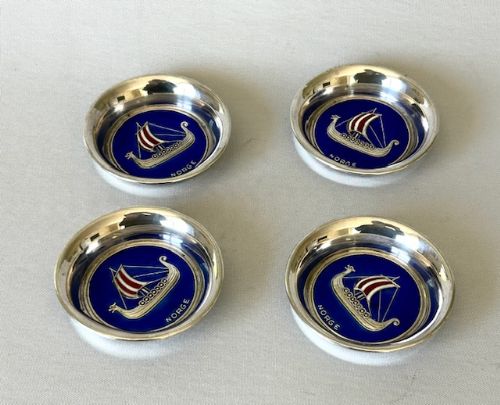


Silver Enamel Bowl
A silver enamel bowl brings together bright vitreous colour and precious metal, offering a decorative vessel for the dressing table or desk.
Silver Enamel Bowl
A silver enamel bowl typically takes the form of a lidded powder jar, a small trinket dish, or a heavier cut glass vessel fitted with an enamelled sterling silver top. These pieces emerge across the nineteenth century, the Edwardian era, and the art deco decades of the nineteen twenties and thirties, extending into mid-century Scandinavian and modern designs.
The domestic dressing table supplies the most common examples, where matching glass or silver bodies hold cosmetics and pins beneath colourful lids. Alongside these vanity jars appear small open dishes, lidded kovsh cups, and heavier crystal bowls designed for display.
Materials and construction
Silversmiths pair sterling silver or silver-gilt with vitreous enamel, frequently laying the glass paste over engine-turned guilloche patterns that catch the light beneath translucent colour. Cut crystal and cranberry glass form the bodies of many lidded jars, secured with hallmarked silver collars and matching enamelled lids.
Techniques range from cloisonné work with wire cells to hand-painted scenes and solid cast silver mounts stamped with assay office marks for cities such as Birmingham and London.
Silver Enamel Bowl Retail Price Guide 2026
Typical asking prices for silver enamel bowl among the pieces listed under this phrase on Sellingantiques today, from the lower quarter to the upper quarter. They describe what is for sale here now, not the wider market.
Origins represented in the surviving archive and current selections include English, Norwegian, Russian, Austrian, and Chinese workshops.
Assessing the craftsmanship
Quality rests on the crispness of the guilloche engraving beneath the enamel and the uniformity of the vitreous glass layer, which should remain free from heavy scratching or restoration. Thicker silver mountings and crisply cut crystal bodies indicate superior production values.
Makers known for distinct artistic output, such as those working in Norwegian, English, or Austro-Hungarian workshops, demonstrate superior precision in their enamel work and metal finishing.
A E Jones·Bernard Instone·Magnus Aase
The Silver Enamel Bowl Glossary
- Guilloche
- An ornamental technique where a mechanical lathe engraves a precise geometric pattern into a metal surface beneath translucent enamel.
- Vitreous enamel
- A material made by fusing powdered glass to a substrate by firing, resulting in a smooth, durable, and brightly coloured surface.
- Sterling silver
- An alloy of silver containing ninety-two point five percent silver by mass, standard for quality British tableware and vanity items.
- Kovsh
- A traditional boat-shaped Russian vessel with a single flat handle, often executed in silver-gilt and enamel.
- Cloisonné
- A method of decorating metalwork objects with coloured glass paste separated by thin strips of metal welded to the base.
Silver Enamel Bowl: Frequently Asked Questions
How do I clean a silver enamel bowl?
Use a soft dry cloth to remove dust from the enamel surface and polish the sterling silver mountings with a dedicated silver cloth. Avoid soaking the piece in water, particularly if glass and metal are joined with historical adhesives or fitted with crystal bases.
Keep the item away from harsh chemical dips and abrasive cleaners that can scratch the soft vitreous enamel or dull the polished metal finish.
Were these bowls used for cosmetics?
Many examples function as powder bowls and dressing table jars intended to hold loose face powder, hairpins, and small trinkets. The heavy glass bases and fitted lids kept vanity powders contained and dry in domestic dressing rooms.
Open dishes and smaller vessels served to hold pins, rings, or small personal accessories on side tables and desks.
How can I date an unmarked piece?
Examine the style of the metalwork and the colour palette, as art deco pieces from the nineteen twenties favour geometric guilloche patterns, while Edwardian examples often feature softer floral motifs. Hallmarks on the silver collar or rim provide exact assay office symbols and date letters for British items.
Scandinavian and continental European pieces often rely on maker marks and purity stamps rather than full date letter sequences.
Why do some bowls have glass bodies?
Makers combined cut crystal and cranberry glass with silver and enamel lids to provide weight and visual contrast on the dressing table. The transparent or coloured glass allowed light to pass through the lower vessel while the enamelled lid provided a decorative focal point.