



Silver Christening Cutlery
Silver christening cutlery brings together small spoons and forks in fitted presentation boxes, marked by the distinct hand of Victorian silversmiths.
Silver Christening Cutlery
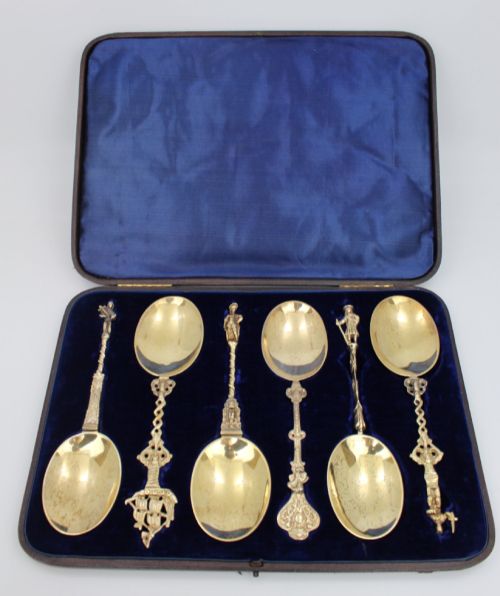
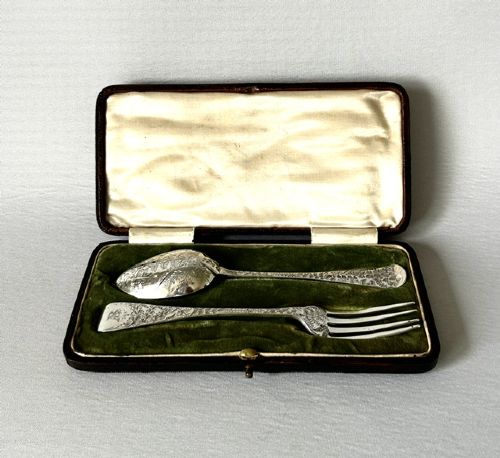
Silver christening cutlery consists of small eating implements designed specifically for children, often appearing as boxed sets containing a fork and spoon or apostle spoons. These objects survive primarily from the Victorian era, spanning dates from the mid nineteenth century into the early twentieth century.
The form is defined by smaller proportions suited to a child's hand, accompanied by fitted cases lined with silk, velvet, or leatherette. Most examples encountered here belong to the Victorian period, though George V pieces also appear alongside silver plate alternatives.
How they were made
Makers shaped these items from sterling silver or silver plate, occasionally applying silver-gilt finishes to the metal surface for a rich golden tone. Workshops utilised traditional smithing techniques to fashion forks and spoons, which were then housed in protective cases.
The presentation boxes themselves combine wooden or rigid frames covered in leather, silk, velvet, or leatherette to safely cradle the cutlery.
Silver Christening Cutlery Retail Price Guide 2026
Typical asking prices for silver christening cutlery among the pieces listed under this phrase on Sellingantiques today, from the lower quarter to the upper quarter. They describe what is for sale here now, not the wider market.
Apostle spoons bring small metallic saints to the nursery table, watching over porridge with solemn grace.
What varies in quality
Quality rests upon the weight of the silver and the precision of the ornamentation applied to the handles, separating standard production from works by notable makers. Art Nouveau period styling and detailed workmanship elevate certain sets above simpler utilitarian designs.
The condition and completeness of the original fitted case, whether lined in velvet, silk, or leather, plays a part in distinguishing finer survivals from more basic items.
Deakin and Francis·Walter and John Barnard·Thomas Harwood and Co·John Round
The Silver Christening Cutlery Glossary
- Sterling silver
- A standard alloy of silver containing ninety-two point five percent pure silver by mass, used for solid cutlery sets.
- Silver-gilt
- Silver that has been coated with a thin layer of gold on its surface, giving the metal a yellow golden appearance.
- Apostle spoons
- Spoons featuring figures of the apostles cast or engraved on the handle terminals, often found in cased sets.
- Leatherette
- An imitation leather material utilised to cover the exterior of presentation boxes for these small cutlery sets.
- Cutlery set
- A matched group of eating utensils housed together in a fitted box.
Silver Christening Cutlery: Frequently Asked Questions
What is silver christening cutlery?
Silver christening cutlery comprises small forks and spoons presented as gifts for a child's naming ceremony or baptism. These pieces are typically housed in fitted cases lined with silk or velvet.
They reflect the domestic silver production of the Victorian era, utilising sterling silver or silver plate to create durable keepsakes.
How were these sets used?
These utensils were intended for a child's daily use during nursery meals or kept as ceremonial mementoes of a significant family milestone. The smaller scale accommodated a child's grip.
Because they were often stored safely in their presentation boxes, many survive today with minimal wear.
How do I identify a Victorian set?
Victorian sets often feature hallmarks corresponding to assay offices in cities like Birmingham or Sheffield, alongside dates spanning the mid to late nineteenth century. Stylistic markers such as Art Nouveau influences also point to this period.
The inclusion of original leatherette or velvet lined boxes helps place the items firmly within the Victorian and Edwardian eras.
Are all sets made of solid silver?
Not all pieces are solid sterling silver, as manufacturing methods included both solid silver and silver plate alternatives. Makers utilised different grades of metal depending on the intended cost of the gift.
Hallmarks on the metal help determine whether a specific set is solid silver or plated.