




Sheraton Weather Glass
A Sheraton weather glass is a mercury or aneroid barometer mounted in a refined timber case, offering precise atmospheric readings and classic Georgian elegance.
Sheraton Weather Glass
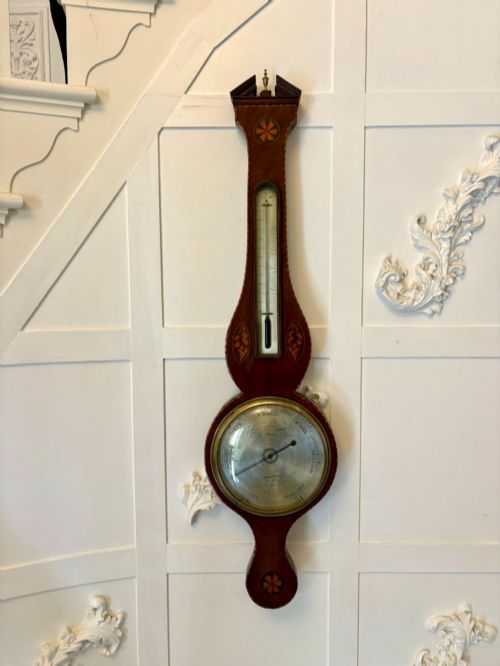
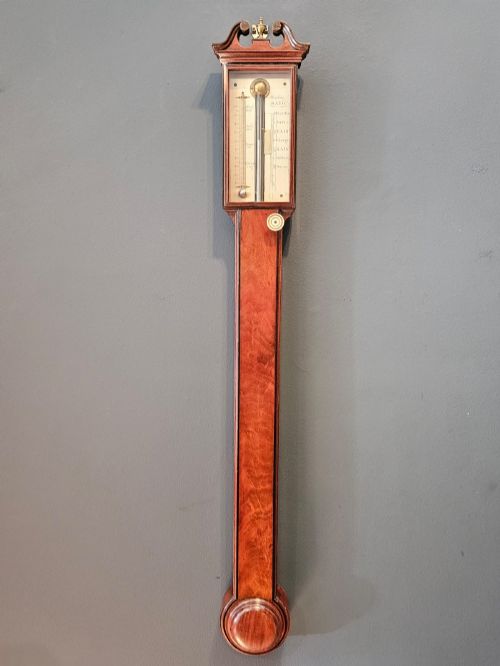
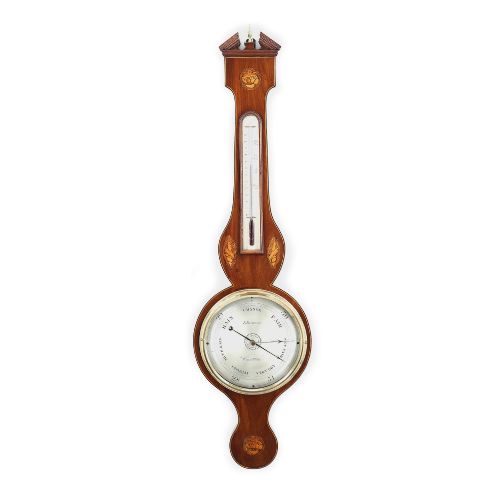
A Sheraton weather glass typically takes the form of a banjo barometer or stick barometer, housed within a slender timber case. These instruments were designed both to record changes in atmospheric pressure and to adorn the principal rooms of fine houses.
The pieces on this page span the Georgian, Victorian, and Edwardian eras, with a strong representation of George III examples. Alongside standard wall barometers, one encounters occasional combinations such as a mantel clock and barometer, or instruments paired with thermometers.
Makers of these weather glasses utilised distinctive case layouts, often featuring a damp-and-fair dial at the top, a spirit thermometer in the stem, and a larger cistern cover at the base. The proportions remain slender, balanced, and upright.
Materials and construction
Makers built the cases primarily from dense hardwoods such as mahogany, rosewood, and satinwood, often selecting veneers for the main body. Boxwood inlay and marquetry inlay provide crisp geometric lines and floral motifs along the borders.
The dials feature silvered metal engraved with weather descriptions, registers, and maker signatures. Brass is common for bezels, damp-and-fair indicators, and the small decorative finials crowning the apex of the case.
Sheraton Weather Glass Retail Price Guide 2026
Typical asking prices for sheraton weather glass among the pieces listed under this phrase on Sellingantiques today, from the lower quarter to the upper quarter. They describe what is for sale here now, not the wider market.
Cabinetmakers worked in mahogany, rosewood, and satinwood, applying boxwood inlay and marquetry to enhance the vertical lines of the barometer cases.
Quality and craftsmanship
Quality rests in the crispness of the cabinetwork and the subtlety of the timber grain. Finer examples display meticulous stringing, deliberate choice of figured veneers, and intact crestings at the top of the banjo frame.
The legibility and preservation of the silvered dial distinguish better pieces from ordinary production. Original brass fittings, hand-engraved dial lettering, and well-preserved maker signatures elevate the standing of an instrument.
B Besozzi of Weymouth·Prada of High Wycombe·Giana Shrewsbury·Vecchio and Co of Shaftsbury·A Rivolta·J Groce York·Luisetti of London·J C Moretti of King's Lynn
The Sheraton Weather Glass Glossary
- Banjo barometer
- A domestic weather glass shaped broadly like a banjo, featuring a circular dial at the top and a bulging cistern cover at the bottom. This form became dominant during the Georgian period.
- Stick barometer
- A vertical wall barometer with a long, narrow trunk enclosing the glass tube of mercury. It offers a direct reading against a fixed scale without mechanical multiplier linkages.
- Aneroid barometer
- A weather glass that measures pressure through the expansion and contraction of a sealed corrugated metal box rather than liquid mercury. This mechanism gained popularity in the Victorian era.
- Silvered metal
- A brass or copper plate treated with a silver solution to create a bright, matte metallic surface for engraving dial scales. The resulting contrast makes the graduations easy to read in domestic interiors.
- Stringing
- A narrow strip of contrasting wood inlaid into a channel in the primary timber. Makers used boxwood or ebony to outline panels on the barometer case.
Sheraton Weather Glass: Frequently Asked Questions
What is a Sheraton weather glass?
A Sheraton weather glass is a barometer housed in a mahogany or veneered timber case influenced by the neoclassical designs of Thomas Sheraton. They combine functional meteorological instruments with decorative cabinetmaking.
These pieces typically present as wall-hung banjo or stick barometers. They served both a practical purpose in predicting local weather and a social purpose in displaying household refinement.
How do you read a wheel barometer?
The wheel barometer employs a mechanical pulley system connected to a float inside the lower cistern. As air pressure moves the mercury up or down, a silk thread turns the central needle around a circular silvered dial.
Readings are taken by observing the primary pointer against weather inscriptions such as rain, change, or fair. A secondary manual pointer, adjusted by a small knob on the glass bezel, allows you to track whether the pressure is rising or falling since the last check.
Where were these barometers placed?
In period homes, barometers hung in prominent communal spaces such as the hall, library, or drawing room. Easy access allowed family members and guests to consult the instrument before venturing outside.
Because fluctuations in temperature can affect mercury and mechanical joints, these pieces were kept away from direct heat sources like open fireplaces and out of damp exterior corridors.
How do I date a barometer?
Dating relies on stylistic clues in the woodwork, the shape of the pediment, and the construction of the dial. Georgian pieces often feature swan-neck pediments and delicate string inlay, whereas Victorian and Edwardian examples may incorporate aneroid movements and heavier mouldings.
The inclusion of a maker's name engraved on the dial or recorded on a trade label inside the case often provides a reliable window into the working period of the instrument's creator.