




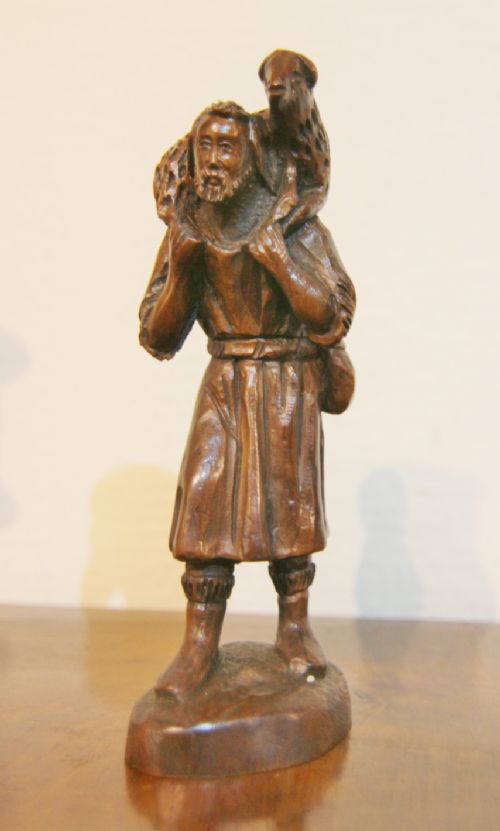

Shepherd Pastoral Art
Shepherd pastoral art brings the quietude of the countryside into the room through paintings and carved figures depicting herdsmen and flocks.
Shepherd Pastoral Art
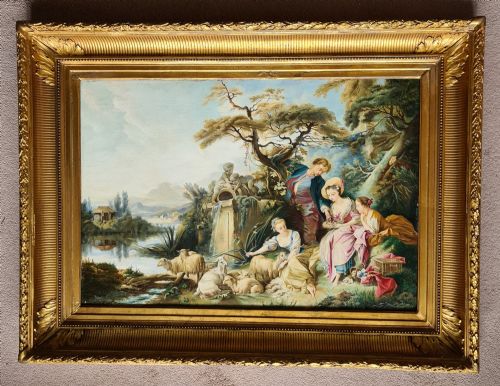
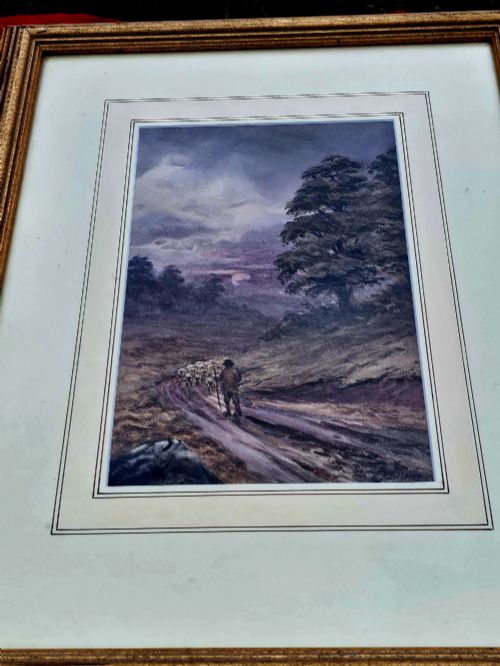
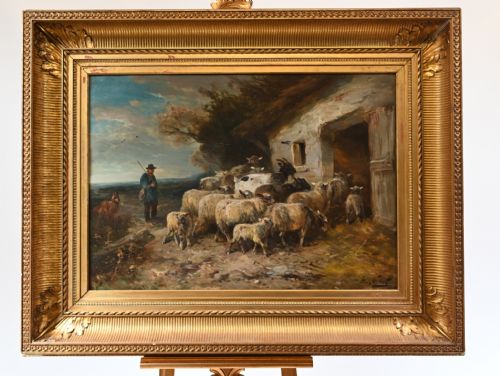
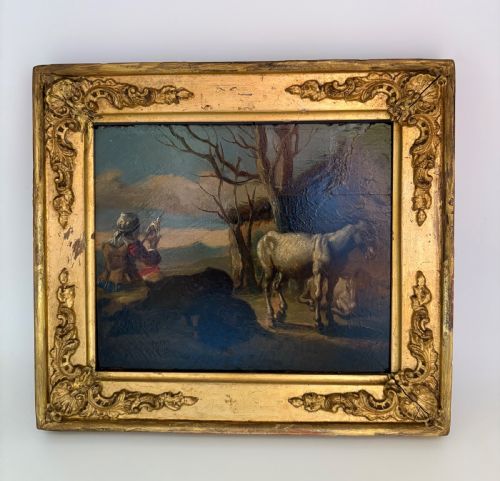
Shepherd pastoral art encompasses oil paintings, watercolours, mixed-media works, wood carvings and porcelain statuettes dedicated to rural life. The most frequent encounters on this page are nineteenth-century and early twentieth-century oil paintings and watercolours on canvas or paper, portraying shepherds tending sheep in landscapes.
The imagery draws upon British Impressionism, Victorian pastoral and nineteenth-century romanticism, capturing figures driving flocks along country lanes or resting beside animals. Alongside flat art, the selection includes decorative objects such as carved wooden figures, bellows with shepherd boy decoration and Royal Dux porcelain statuettes.
Materials and technique
Painters utilised oil paint on canvas and oak panel, or watercolour on paper, often framing the finished works in giltwood and gesso frames. These mediums allowed artists to render atmospheric skies, verdant pastures and the texture of wool with fine brushwork.
Sculptural pieces take form through wood carving or moulded ceramic, finished with hand-painted details. Makers combined traditional painting methods with careful framing to preserve these rural scenes.
Listings feature works spanning the eighteenth to the mid-twentieth century, executed in oil, watercolour, wood and porcelain.
Distinctions in quality
Quality rests upon the artist's command of light, composition and anatomical accuracy in rendering both human figures and livestock. Finer works display confident brushwork and balanced tonal harmony that draw the eye deep into the landscape.
In sculptural objects and decorative items like bellows or porcelain figures, quality shows in the crispness of the carving, the preservation of original polychrome surfaces and the subtlety of expression.
Eugène Verboeckhoven·Francois Boucher·Henry Schouten·Henry Charles Fox·Philipp Peter Roos·George Turner·Owen Bowen·Anthonij Anton Mauve·Royal Dux
The Shepherd Pastoral Art Glossary
- Giltwood
- Wood that has been coated with a thin layer of gold leaf. It frequently appears on nineteenth-century picture frames.
- Gesso
- A plaster-like mixture applied to wood or canvas as a base for painting or for moulded frame ornamentation. It provides a smooth surface for gilding.
- Oil paint
- Pigment suspended in a drying oil, typically linseed oil. This medium allows for rich colour depth and slow blending.
- Watercolour
- Paint consisting of colourants suspended in a water-soluble vehicle, usually applied to paper. It creates luminous, transparent washes.
- Oak panel
- A rigid board of oak timber used as a painting support before canvas became dominant. It offers a stable, durable surface.
Shepherd Pastoral Art: Frequently Asked Questions
What periods do these pieces date from?
The selections span from the eighteenth century through to the mid-twentieth century, with a strong concentration of nineteenth-century and Edwardian works.
Dates are determined through stylistic analysis, artist signatures and framing techniques characteristic of each era.
How do I care for framed watercolours?
Watercolours on paper are sensitive to direct sunlight and high humidity, which can cause fading and discolouration over time.
Display them away from direct sunlight and utilise UV-filtering glass where possible to protect the pigment.
What subjects appear alongside shepherds?
Compositions frequently include flocks of sheep, sheepdogs, rural cottages, country lanes, mountains and lakes.
Some pieces also incorporate figures playing flutes or resting near ponds, emphasising an idyllic rural atmosphere.
Are all the artworks original?
The listings include original paintings, watercolours and mixed-media works alongside historical studies after earlier masters like Boucher.
Descriptions specify the medium and whether a work is an original composition or an interpretive piece.