

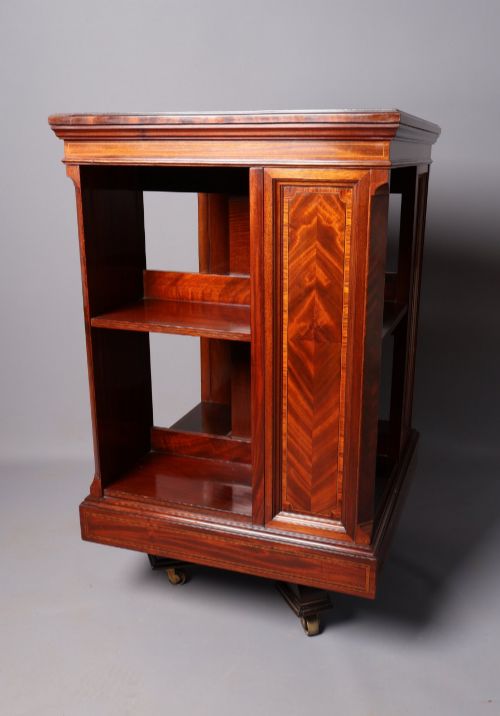


Satinwood Revolving Bookcase
A satinwood revolving bookcase brings both fluid rotation and pale timber warmth to a corner, offering books within arm's reach.
Satinwood Revolving Bookcase
A satinwood revolving bookcase is a compact piece of furniture designed to hold volumes upright while sitting on a table or standing directly on the floor. Most examples on this page date from the Edwardian period or the late nineteenth century, reflecting a popular Victorian and Edwardian form.
How they were made
Craftsmen utilised mahogany and satinwood timbers, often incorporating contrasting boxwood inlay or delicate painted decoration onto the wood surfaces. Metal, brass and iron components formed the internal revolving mechanisms that allow the tiers to spin smoothly.
Carpenters constructed these items with attention to stability, ensuring the rotating base supports the weight of heavy books without tipping. Inlaid details were meticulously fitted into the primary timber before finishing.
Satinwood Revolving Bookcase Retail Price Guide 2026
Typical asking prices for satinwood revolving bookcase among the pieces listed under this phrase on Sellingantiques today, from the lower quarter to the upper quarter. They describe what is for sale here now, not the wider market.
Listings feature Edwardian, late nineteenth century, and nineteen ten periods, predominantly utilising satinwood, mahogany, and brass revolving mechanisms.
What varies in quality
Quality rests upon the choice of timber and the precision of the underlying turning mechanism. Solid or heavily figured flame mahogany paired with crisp satinwood inlay distinguishes superior pieces from simpler utilitarian ones.
The smoothness of the rotation and the intricacy of any painted decoration or banded borders separate standard examples from finer workshop productions.
James Shoolbred
The Satinwood Revolving Bookcase Glossary
- Satinwood
- A pale, lustrous timber native to Ceylon and India, prized for its golden sheen and smooth texture. Cabinet makers utilised it extensively for banding and decorative veneers during the Sheraton Revival.
- Revolving bookcase
- A tiered bookstand mounted on a concealed rotating platform, permitting access to multiple sides of volumes from a stationary seat. Mechanisms typically rely on hidden ball bearings or iron pivots.
- Sheraton Revival
- A late nineteenth and early twentieth century design movement that drew inspiration from the lighter neoclassical furniture of Thomas Sheraton. Pieces in this style frequently display classical symmetry and fine inlay.
- Inlay
- The technique of embedding contrasting strips or shapes of wood into a recess flush with the surrounding surface. Boxwood and ebony frequently complement satinwood and mahogany grounds.
Satinwood Revolving Bookcase: Frequently Asked Questions
How do I care for satinwood furniture?
Keep wooden surfaces away from direct sunlight to prevent the pale satinwood timbers from darkening unevenly over the decades. Apply natural beeswax sparingly and buff gently with a soft cloth to maintain the lustre.
Avoid placing damp items directly onto the top tier to protect the delicate polish and underlying inlay work from water rings.
Are these bookcases sturdy enough for heavy books?
The internal rotating mechanism distributes weight evenly across the base, supporting standard octavo volumes and reference books without difficulty. Heavier folios sit best on the lower tiers to maintain a low centre of gravity.
Check that the central pivot turns freely before loading volumes to prevent undue strain on the wooden platform.
Where should I place a revolving bookcase?
Position the piece beside an armchair or near a desk where the spinning action allows easy selection of titles from any angle. Free-standing floor models suit corners or empty wall spaces where all four sides remain accessible.
Table top variants sit securely on larger desks or side tables without requiring dedicated floor space.
How do I identify an Edwardian piece?
Edwardian items dating from around nineteen hundred typically display lighter construction, Sheraton Revival influences, and bright satinwood or mahogany veneers. Inlay patterns from this era often feature delicate floral swags or geometric stringing.
Late Victorian examples from the eighteen nineties share similar decorative traits but generally employ slightly heavier timber proportions.