
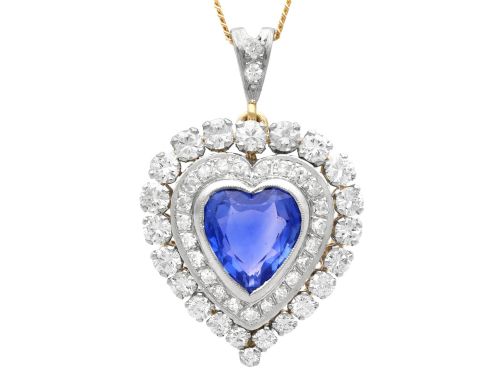


Sapphire Cluster Pendant
A sapphire cluster pendant brings together central stones and surrounding gems in a classic pendant form designed to sit at the collarbone.
Sapphire Cluster Pendant
A sapphire cluster pendant typically centres on a sapphire surrounded by a border of smaller stones, most frequently diamonds, arranged to catch the light from multiple angles. These pieces span several distinct eras, with examples appearing from the Victorian and Edwardian periods through the mid-twentieth century and into the late twentieth century.
The materials utilised in these pendants vary widely across the periods, incorporating 9ct gold, 18ct gold, white gold, platinum, and silver alongside the sapphires. While many pieces feature standard blue sapphires, the evidence also records variations including padparadscha, green, and white sapphires paired with seed pearls, rubies, yellow quartz, opals, and white zircons.
The form itself appears both as dedicated necklace pendants and as convertible brooches designed to be worn on a chain. Buyers searching for a sapphire cluster pendant will encounter traditional daisy cluster designs alongside fan shapes, cross motifs, and specialised settings from various twentieth-century decades.
Materials and construction
Metals such as 9ct gold, 18ct gold, and platinum provide the structural foundation for setting the principal sapphire and its attendant stones. Silvers and white golds frequently appear in Victorian and Edwardian settings to complement the icy brilliance of surrounding diamonds.
Gemstone selection relies on grouping a prominent central sapphire with accent stones like old-cut diamonds, rose-cut diamonds, or seed pearls. These stones are secured in traditional claw, bezel, or flush settings that define the geometric outline of the cluster.
Elephants and witches feature in the metalwork.
Evaluating craftsmanship and materials
Quality in these pieces rests upon the saturation and clarity of the central sapphire, alongside the matching and brilliance of any surrounding diamonds or accent gems. Superior examples display harmonious proportions where the central stone commands attention without the cluster frame appearing crowded or misaligned.
The integrity of the metalwork, whether executed in yellow gold, white gold, platinum, or silver, dictates the longevity of the setting. Skilled workmanship is evident in the precision of the stone placement and the clean finishing of the reverse side of the pendant.
The Sapphire Cluster Pendant Glossary
- Cluster pendant
- A jewellery piece featuring a central gemstone encircled by a ring of smaller stones. This traditional arrangement maximises the overall visual impact of the piece.
- Old-cut diamond
- A vintage diamond facet style characterised by a smaller table and a higher crown. These stones are typical of Edwardian and Victorian clusters.
- Seed pearl
- A very small, naturally occurring pearl often used in Edwardian cluster designs. They provide a soft, luminous contrast to darker sapphires.
- Rose-cut diamond
- A historic diamond cut featuring a flat base and a domed crown with triangular facets. This cut predates modern brilliant cutting and appears in earlier pieces.
Sapphire Cluster Pendant: Frequently Asked Questions
What periods do these pendants come from?
The available selection spans the Victorian and Edwardian eras, progressing through the nineteen-fifties and sixties into the late twentieth century. Each period brings distinct metal colours and gemstone combinations to the cluster design.
Victorian and Edwardian pieces often utilise silver-topped gold or yellow gold with delicate details, while later mid-century examples lean towards heavier gold settings and diverse sapphire tones.
Are all the sapphires traditional blue?
While traditional blue sapphires form the majority of the pieces, the record includes notable exceptions. Sapphires in padparadscha, green, and white varieties appear across different decades.
Additionally, many clusters incorporate secondary accent stones such as rubies, opals, and yellow quartz alongside the primary sapphire.
How were convertible pieces worn?
Certain historic pendants incorporate hidden loops or hinged pins that allow the piece to function as both a brooch and a necklace pendant. This versatility was common in the nineteenth and early twentieth centuries.
Owners could pin the cluster to a garment during formal occasions or suspend it from a chain for everyday wear.
What gold purities are used?
The pieces utilise both nine-carat and eighteen-carat gold, alongside white gold and platinum variants. The choice of metal often reflects the prevailing fashion of the pendant's specific era.
Earlier pieces frequently pair yellow gold backs with silver settings on the face, while mid-century creations rely on uniform white or yellow gold structures.