

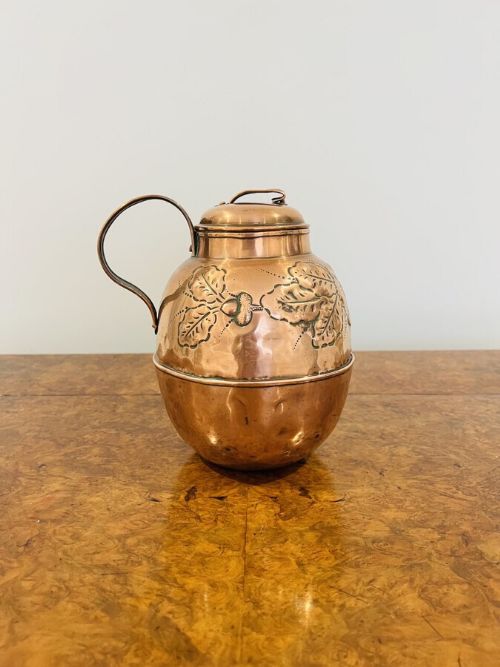


Rustic Copper Jug
These rustic copper jugs bring warmth and honest heft to a kitchen, prized for their rich metal tones and enduring utility.
Rustic Copper Jug
A rustic copper jug serves as a sturdy vessel with roots in Georgian and Victorian farmhouses, workshops, and taverns. When searching for a rustic copper jug, buyers encounter domestic liquid measures, large flagons, and Jersey cans designed for daily work. Most examples on this page span the eighteenth and nineteenth centuries, showing the generous proportions of working vessels.
The forms range from two-pint pouring jugs to colossal lidded pitchers and gallon-sized brass haystack measures. These pieces carry the marks of heavy use, offering a tactile connection to historical domestic routines. Collectors value them for their honest proportions and the deep patination gathered over generations of service.
How they were made
Coppersmiths shaped these vessels using sheet metal, hammering the copper over stakes to create seamless or dovetailed bodies. Handles and rims often incorporate brass for added strength during heavy lifting and pouring.
Internal tin linings appear in surviving vessels intended to hold liquids safely for consumption. Surface textures reflect hand-beating techniques, leaving subtle hammer marks across the body and base.
Rustic Copper Jug Retail Price Guide 2026
Typical asking prices for rustic copper jug among the pieces listed under this phrase on Sellingantiques today, from the lower quarter to the upper quarter. They describe what is for sale here now, not the wider market.
The listings on this page span the Georgian and Victorian eras, alongside specific nineteenth-century production years like 1850 and 1880.
What varies in quality
The distinction between ordinary utility items and finer pieces lies in the crispness of the hand-beating and the structural integrity of the seams. Heavier gauge metal retains its shape better under pressure, creating a more substantial feel in the hand.
Maker marks and capacity stamps add distinction to utilitarian forms, particularly when stamped clearly into the metal. The depth and warmth of the natural copper patina also separate honest, untouched surfaces from over-polished metal.
J Bower·S Hancock
The Rustic Copper Jug Glossary
- Jersey can
- A distinctive tall copper jug with a narrow neck and heavy handle, originally utilised in the Channel Islands for measuring and transporting milk. These vessels often feature refined brass fittings and sturdy bases.
- Haystack measure
- A traditional British liquid measure characterised by its bulbous lower body tapering towards the rim, resembling the shape of a hayrick. These are frequently cast in brass rather than copper.
- Flagon
- A large vessel with a handle and often a lid, designed for holding and pouring liquids in domestic or institutional settings. Eighteenth-century examples display particularly generous capacities.
- Patina
- The surface sheen and colour acquired by copper and brass through age, handling, and oxidation over many decades. A rich patina shows undisturbed oxidation rather than chemical treatment.
Rustic Copper Jug: Frequently Asked Questions
How were these copper jugs used?
These vessels functioned as working liquid measures, dairy cans, and flagons in domestic and commercial settings. They transported milk, ale, and water across farmhouses and taverns.
Over time, many transitioned from active utility into decorative display pieces within country interiors. Their robust construction suited the heavy demands of daily rural life.
What materials make up these jugs?
The primary material is hand-beaten copper, valued for its malleability and warmth of colour. Brass frequently appears on handles, rims, and capacity measures for added structural strength.
Tin linings often coat the interior surfaces to prevent the copper from reacting with liquids. This combination of metals ensured both durability and safety in daily use.
How do I date a copper jug?
Dating relies on stylistic clues, construction methods, and capacity stamps or maker marks. Georgian pieces often display simpler, heavier forms, while Victorian examples introduce ornate flourishes like shaped Jersey cans.
Hand-beated seams and dovetailed joints point towards earlier manufacturing techniques. Comparing proportions with documented measures helps narrow the period of origin.
How should I live with copper?
Display these vessels in spaces where their natural metal tones can catch the light, such as kitchens or dining rooms. They pair well with natural wood surfaces and traditional earthenware.
Minimal maintenance preserves the historic surface. Allowing the dark, rich patina to remain intact honours the age and history of each piece.