


Rural Agricultural Oil Artwork
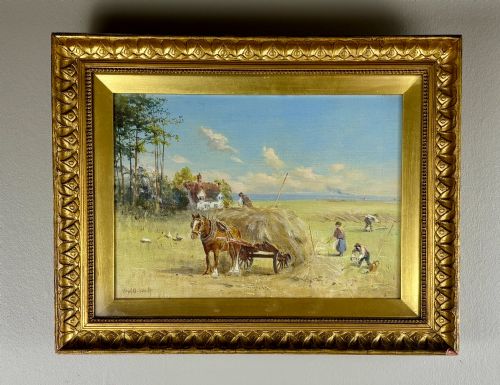
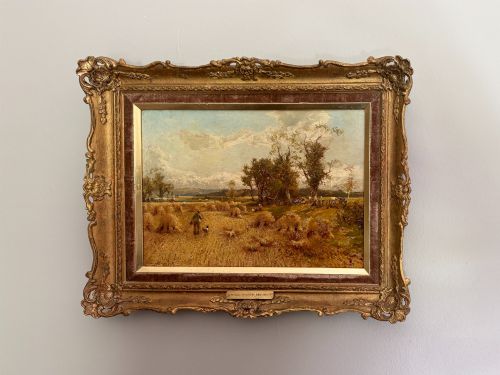
Rural agricultural oil artwork captures the heavy horses, harvest fields and farmyards of the nineteenth and twentieth centuries.
Rural Agricultural Oil Artwork
Rural agricultural oil artwork brings together canvas paintings recording farm life, working horses and country landscapes from the Victorian era onward. When you search for rural agricultural oil artwork, you encounter depictions of ploughing, haymaking and livestock painted in British Impressionism, Victorian Realism and traditional country styles.
The pieces on this page span from the nineteenth century into the mid-twentieth century, capturing changing rural communities through oil on canvas. Common subjects include shire horses at work, wagon teams in harvest fields and quiet farmyard corners rendered by named artists and regional painters alike.
Materials and techniques
Artists apply oil paint directly to stretched canvas, building up textures with brushwork and pigment to capture light across fields and farm buildings. Canvases are frequently housed in wooden frames, sometimes accented with gesso mouldings or finished in ebonised or gilt treatments.
The handling of oil paint varies from smooth Victorian Realism to the looser brush marks associated with British Impressionism and mid-century provincial scenes. Painters layer tone and colour to evoke the atmosphere of harvest time, dusty tracks and overcast skies.
Materials recorded across the selection include oil paint, canvas, wood, gesso and gilt framing.
Judging quality in rural paintings
Quality rests in the anatomical accuracy of the working horses, the handling of perspective across the landscape and the sureness of the brushwork. Stronger works convey movement and weight in draft animals rather than stiff or generic representations.
The depth of the artist's palette and the subtlety of light distinguish superior compositions from simpler decorative pieces. Original framing and clear attribution to a listed artist add further distinction to an oil painting.
Raimond Louis Lecourt·James Kyd·Herbert Royle·James William Booth·Arthur Winter Shaw·Arthur Charles Dodd·Vernon Stokes·Frederick William Jackson·John Percy Cooke·W E Millner·Ernest Higgins Rigg·George Cole·Frederick J Haycock·B J Burrows
The Rural Agricultural Oil Artwork Glossary
- Oil on Canvas
- Pigment mixed with drying oil applied to a woven fabric support stretched over a wooden frame. This medium allows for rich blending of colour and varied surface textures.
- Gesso
- A plaster-like mixture applied to wooden frames as a base for gilding or paint. It provides a smooth surface for ornamental mouldings.
- British Impressionism
- A painting style focusing on light, everyday subjects and loose brushwork adapted by British artists from French movements. It appears in outdoor harvest and pastoral scenes.
- Victorian Realism
- An artistic approach depicting everyday life and rural labour with precise detail and accuracy. Works in this style record farm workers and heavy horses without romantic idealisation.
- Genre Painting
- The pictorial representation of scenes from ordinary life, including agricultural labour and village activities. These works focus on human and animal activity within a landscape.
Rural Agricultural Oil Artwork: Frequently Asked Questions
What periods do these paintings date from?
The works span from the nineteenth century through the Victorian period and into the mid-twentieth century. Artists recorded changing rural practices across these decades using traditional oil techniques.
Dates often reflect the active period of the painter or the stylistic conventions of the decade in which the canvas was produced.
How should I care for an oil painting?
Keep canvases away from direct sunlight, high humidity and sudden temperature fluctuations to protect the oil paint and canvas support. Dust gently with a soft, dry brush without applying pressure to the painted surface.
Avoid using water or chemical cleaners on the canvas or the wooden frame.
How do I identify a Victorian agricultural painting?
Victorian works often display meticulous attention to period costume, harness details and traditional farming implements. The palettes tend towards natural earth tones reflecting the realism of the era.
Signatures, framing styles and canvas stamps can help narrow down the date and origin of the piece.
What subjects are most common?
Heavy shire horses feature prominently, shown ploughing fields, hauling hay wagons or resting at water troughs. Farm landscapes, harvest scenes and rural labourers make up the majority of the compositions.
Animals, particularly horses and working dogs, form the central focus of many equestrian and pastoral portraits.