



Round Cut Earrings
These round cut earrings bring timeless sparkle to the earlobe, spanning decades of design from Edwardian solitaires to mid-century clusters.
Round Cut Earrings
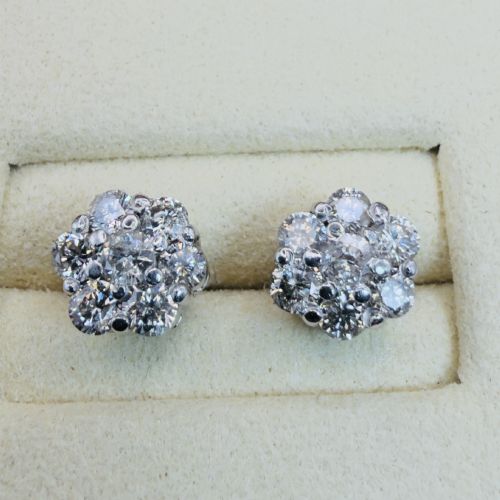
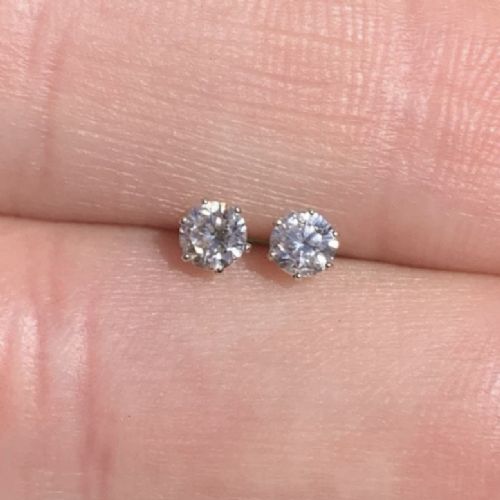
When you search for round cut earrings, you encounter classic stud and twirl configurations designed to sit closely and securely against the ear. The selection ranges from delicate solitaire designs carrying a fraction of a carat to substantial multi-stone diamond clusters exceeding six carats.
The pieces on this page draw from several distinct eras, notably the 1910s, 1930s, 1940s, 1950s, and 1960s. You will frequently meet mid-century white gold studs alongside earlier Edwardian and Art Deco platinum mountings.
Beyond traditional diamond configurations, the inventory occasionally incorporates coloured stones such as deep red garnet, blue sapphire, and amethyst. These variations provide alternatives to the standard white diamond solitaire while maintaining the traditional round cut profile.
Materials and construction
The mountings rely heavily on durable precious metals, with platinum and 18ct white gold dominating the selections alongside 14ct gold, 14k white gold, and standard 18ct gold. These metals provide the necessary structural strength to hold secure settings while complementing the brilliant white sparkle of the stones.
Master jewellers utilised traditional claw and cluster settings to secure the round cut stones, ensuring maximum light entry through the pavilions. Fastening mechanisms include standard screw backs designed for security during everyday wear.
Round Cut Earrings Retail Price Guide 2026
Typical asking prices for round cut earrings among the pieces listed under this phrase on Sellingantiques today, from the lower quarter to the upper quarter. They describe what is for sale here now, not the wider market.
Listings span five distinct decades from the 1910s to the 1960s, incorporating platinum, gold, and white gold.
Evaluating quality and execution
The distinction between tiers rests upon the overall carat weight, stone purity, and the precision of the metalwork. Heavier diamond configurations set in solid platinum occupy the upper echelon of the range.
The integration of supportive coloured gemstones like sapphires or garnets alongside the primary diamonds alters the character and balance of the piece. Superior examples demonstrate harmonious proportion between the central round cut stones and their surrounding gallery work.
The Round Cut Earrings Glossary
- Solitaire
- A single gemstone set on its own in a mounting. This term usually describes a single diamond stud earring.
- Cluster
- An arrangement of smaller gemstones gathered tightly around a central stone. This layout maximises visual impact on the ear.
- Twirl
- A curved or swirling metal design element incorporated into the earring silhouette. This style gained popularity during the mid-century period.
- Screw back
- A threaded post and backing mechanism that twists into place for added security. This closure prevents accidental loss of valuable studs.
Round Cut Earrings: Frequently Asked Questions
Are these earrings comfortable for daily wear?
Most pairs utilise standard post or screw back fastenings designed to sit flush against the earlobe.
The compact nature of stud and cluster configurations ensures they do not snag easily on clothing during routine activities.
How do I identify an Art Deco pair?
Art Deco pieces typically feature geometric platinum settings that emphasise clean lines and symmetrical arrangements around the round cut stones.
These designs often date from the 1930s and display precise, angular metalwork contrasting with softer mid-century curves.
What metal types are most common?
White metals predominate, with platinum and various grades of white gold appearing frequently across the inventory.
Yellow 14ct and 18ct gold options also surface, particularly in mid-century and garnet variations.
Can I find coloured gemstone earrings?
While diamonds form the majority of the selection, sapphire, garnet, and amethyst examples occasionally appear.
These coloured stones are typically paired with accent diamonds in cluster or twirl formations.