

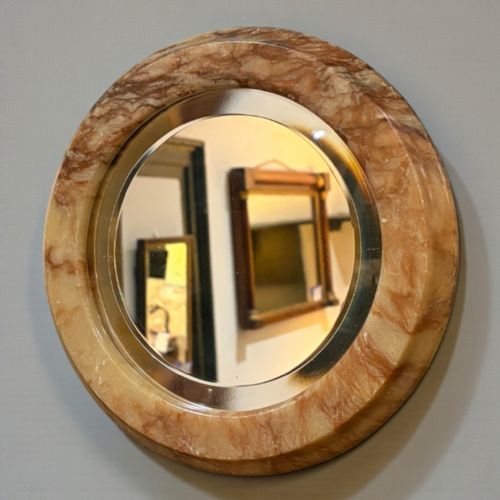
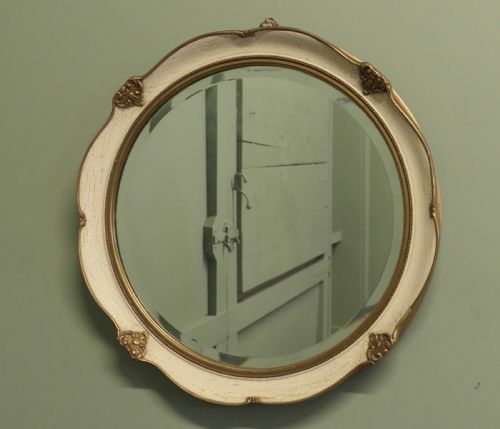


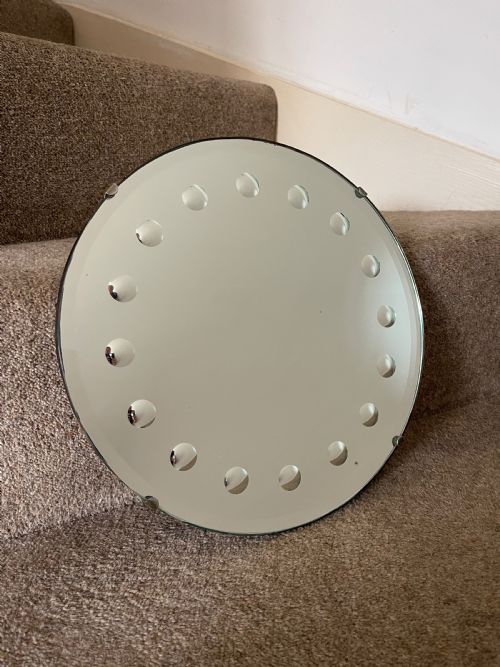


Round Bevelled Wall Mirror
A round bevelled wall mirror brings focus and reflected light to a room, drawing the eye with its curved frame and angled edge.
Round Bevelled Wall Mirror
When you search for a round bevelled wall mirror, you are looking at circular looking glasses framed in wood, metal, or gesso, designed to hang securely on a wall. The pieces listed here span the Georgian, Victorian, Edwardian, and Art Deco periods, offering a range of decorative aesthetics from plain circular forms to ornate French designs.
You are most likely to meet Art Deco examples from the 1920s and 1930s on this page, often featuring geometric lines, etched details, or contrasting gilt and cream finishes. These twentieth-century creations sit alongside earlier nineteenth-century brass frames and occasional wall clocks incorporating circular mirrors.
How they were made
Maker construction relies on heavy glass plate with edges hand-ground and polished at an angle to create the characteristic bevel. Frames are fashioned from turned mahogany, cast brass, copper, or carved giltwood, holding the mirror glass firmly in place.
Surface decoration involves traditional techniques such as gilding with gesso, chemical silvering of glass, and surface etching to produce decorative motifs. Alabaster and bronze also appear in the material record, shaped into solid circular surrounds.
Round Bevelled Wall Mirror Retail Price Guide 2026
Typical asking prices for round bevelled wall mirror among the pieces listed under this phrase on Sellingantiques today, from the lower quarter to the upper quarter. They describe what is for sale here now, not the wider market.
Listings feature periods spanning from the nineteenth century through the Edwardian era to the 1920s and 1930s Art Deco movement.
What varies in quality
Quality rests upon the depth and clarity of the silvered glass and the precision of the bevel cut around the perimeter. Superior pieces display crisp framing without distortion in the reflection.
The sophistication of the frame construction distinguishes finer examples, whether through finely cast brass work, careful carving on giltwood, or the clean geometry of an Art Deco Jazz design.
The Round Bevelled Wall Mirror Glossary
- Bevel
- An angled edge ground along the perimeter of the mirror glass. This process catches and refracts light differently than a flat edge.
- Giltwood
- Wood that has been coated with a thin layer of gold leaf or gilt paint. It appears frequently on decorative frames from the Georgian and Edwardian eras.
- Gesso
- A plaster-like mixture applied to wood frames as a base for gilding. It allows for intricate moulded decoration.
- Silvered glass
- Glass treated with a reflective metallic coating on the rear surface. Antique pieces often show characteristic ageing and speckling in this layer.
Round Bevelled Wall Mirror: Frequently Asked Questions
What is a sorcerer mirror?
A sorcerer mirror refers to a convex circular looking glass that provides a wide-angle, fish-eye reflection of the entire room. These pieces were historically designed to monitor activity across a space.
In domestic settings, they create striking optical effects and double as decorative wall art rather than functional dressing glasses.
How do I clean antique mirror glass?
Wipe the glass gently with a soft microfibre cloth slightly dampened with distilled water or a mild vinegar solution. Avoid spraying liquid directly onto the glass edge where moisture can seep behind the silvering.
Keep cleaning solutions away from gilt and wooden frames to protect the historic surface finishes from staining or lifting.
How do I date an Art Deco mirror?
Art Deco mirrors from the 1920s and 1930s typically feature geometric shapes, symmetrical etching, and combinations of materials like chrome, brass, and coloured glass. Look for streamlined profiles and modernist motifs.
Documented construction methods and stylistic markers help distinguish these interwar pieces from earlier Victorian or Edwardian revivals.