

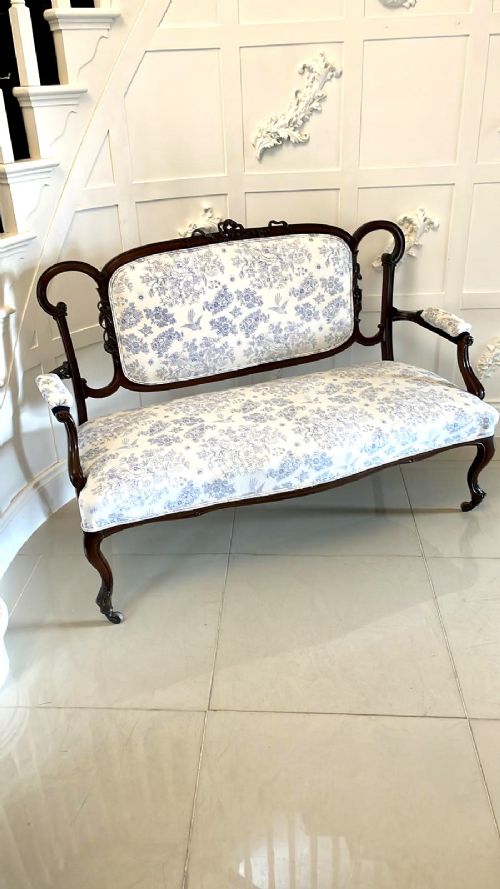


Rococo Style Couch
These rococo style couches bring fluid carved lines and graceful seating to a room, spanning revival periods from the nineteenth century onward.
Rococo Style Couch
When you search for a rococo style couch, you encounter nineteenth-century revival seating that adapts eighteenth-century French and English curves into settees, sofas, and chaise longues. These pieces emerge from periods spanning the Victorian era, eighteen-sixty, and nineteen-ten, taking the form of two-seater settees, larger three-seater sofas, and intimate love seats.
The prevalent variations on this page include walnut and giltwood frames dressed in fabric, velvet, silk, or cane. You meet British, French, German, Irish, and Swedish interpretations, each channelling the exuberant carving and serpentine outlines characteristic of Louis the Fifteenth and Queen Anne revivals.
How they were made
Cabinetmakers shaped the structural frames from solid timbers including walnut, mahogany, rosewood, and bleached walnut, applying gold paint or deep gilding to selected giltwood and gold painted examples. Skilled carvers rendered organic motifs and asymmetric cartouches directly into the wood.
Upholsterers integrated springs, webbing, and stuffing beneath top layers of velvet, silk, and woven textile, while other frames incorporated woven cane panels into the backrests and seats.
Rococo Style Couch Retail Price Guide 2026
Typical asking prices for rococo style couch among the pieces listed under this phrase on Sellingantiques today, from the lower quarter to the upper quarter. They describe what is for sale here now, not the wider market.
Listings feature nineteenth-century and early twentieth-century pieces, spanning walnut, mahogany, rosewood, and giltwood materials.
What varies in quality
The distinction between ordinary and exceptional seating lies in the crispness and depth of the timber carving, where hand-tooled execution surpasses mechanical shaping. Frames constructed from dense walnut or fire-gilt giltwood maintain structural integrity and display superior grain movement over time.
The refinement of the silhouette dictates overall success, separating balanced proportions from heavy-handed proportions. Original upholstery methods and surviving textile choices further elevate the integrity of a piece.
The Rococo Style Couch Glossary
- Rococo Revival
- A nineteenth-century design movement that reinterprets eighteenth-century asymmetry, scrolling foliage, and C-scroll motifs. This aesthetic defines the curved frames and ornamental carvings found on nineteenth-century settees.
- Giltwood
- Timber coated with gold leaf or gold powder over a prepared gesso ground. This luxurious finish catches the light on formal nineteenth-century salon seating.
- Canapé
- A French term for an upholstered sofa or settee with an exposed decorative wooden frame. These pieces often feature carved crest rails and cabriole legs.
- Bergère
- An enclosed upholstered armchair or sofa featuring wooden sides filled with cane or upholstery. This seating style provides structured comfort.
- Chaise Longue
- An elongated seating form designed for reclining, combining a chair with an extended footrest. Victorian examples utilise carved walnut or rosewood frames.
Rococo Style Couch: Frequently Asked Questions
Where did rococo style couches originate?
The aesthetic draws inspiration from mid-eighteenth-century French design under Louis the Fifteenth, which favoured asymmetry and natural curves. Nineteenth-century cabinetmakers across Britain, France, Germany, and Sweden subsequently revived these flamboyant forms.
Craftsmen adapted the fluid lines for domestic parlours and salons, producing diverse regional interpretations of the historic style.
How do I distinguish a settee from a sofa?
Historically, settees denoted lighter, often double-seated wooden or upholstered frames designed for refined spaces. Sofas typically referenced larger, heavier seating arrangements built to accommodate three or more occupants.
In practice, nineteenth-century makers and modern cataloguers frequently use both terms interchangeably for these revival pieces.
What woods were used for these couches?
Walnut serves as the predominant timber across these listings, appearing alongside mahogany, rosewood, and bleached walnut. Giltwood and gold painted finishes transform underlying softwoods or hardwoods into gilded showpieces.
Each timber dictates the weight and carving potential of the finished frame.
How do I care for antique upholstery?
Preserving delicate textiles such as silk, velvet, and patterned fabric requires gentle vacuuming with a soft brush attachment. Keep antique seating away from direct sunlight to prevent fabric degradation and fading.
Professional conservation cleaning protects fragile underlying stuffing and nineteenth-century textile integrity.