

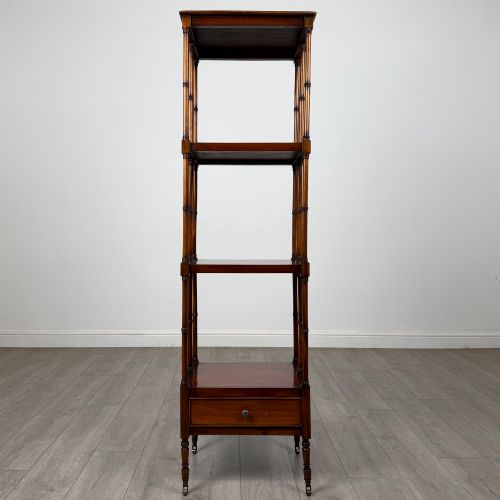
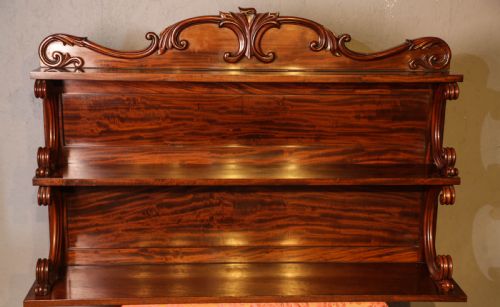


Rich Mahogany Etagere
A rich mahogany etagere brings tiered display space and deep timber grain to a room.
Rich Mahogany Etagere
A rich mahogany etagere is an open tiered shelving piece designed for display and utility, frequently taking the form of a whatnot, wall shelf, or occasional table. Buyers seeking this phrase encounter multi-tiered furniture items that serve as bookcases, display shelves, and compact storage units.
The pieces listed on this page span several distinct periods, including Georgian, Victorian, and Edwardian eras, alongside specific dates such as eighteen sixty and eighteen seventy. Forms range from tall wall hanging shelves and open bookcases to two-tier and three-tier whatnots with turned legs and castors.
Origins and styles represented in the current selection include Sheraton Revival and Regency Revival designs, constructed as shelving units and occasional tables. These items utilise mahogany as the primary timber, often enhanced by satinwood and brass details.
Materials and construction
Construction relies heavily on solid mahogany and flame mahogany veneer, providing the deep reddish-brown tone characteristic of these items. Workshops frequently paired the primary timber with contrasting satinwood inlay to define shelves and surfaces.
Structural hardware includes brass elements, whilst support systems often incorporate turned wooden legs fitted with castors for mobility. Joinery techniques secure multiple tiers together to hold books, display items, and small objects.
Rich Mahogany Etagere Retail Price Guide 2026
Typical asking prices for rich mahogany etagere among the pieces listed under this phrase on Sellingantiques today, from the lower quarter to the upper quarter. They describe what is for sale here now, not the wider market.
Listings span Georgian, Victorian, and Edwardian periods, featuring materials such as mahogany, flame mahogany veneer, satinwood, and brass.
Assessing quality
Quality separates ordinary utility pieces from finer examples through the selection of timber figures, such as flame mahogany veneer. The crispness of turned legs and the careful integration of satinwood contrast distinguish finer workshop production.
Proportion and scale dictate the visual success of the piece, with compact George III examples and multi-tier Victorian whatnots demonstrating different standards of design refinement. The presence of original brass castors and harmonious timber matching elevate an item above standard production.
The Rich Mahogany Etagere Glossary
- Etagere
- An open piece of furniture with multiple shelves for displaying small objects, ornaments, or books. This form became popular during the eighteenth and nineteenth centuries.
- Whatnot
- A tiered shelving unit designed for the display of ornaments and knick-knacks. Victorian and Georgian examples often feature three or four tiers supported by turned columns.
- Flame mahogany veneer
- A thin slice of mahogany timber cut from the point where a branch joins the trunk, creating a distinctive flickering flame pattern. Cabinetmakers applied this to prominent surfaces for visual impact.
- Satinwood
- A durable, yellowish timber native to Ceylon and India used for stringing and inlay work. It provides a bright contrast against darker mahogany surfaces.
Rich Mahogany Etagere: Frequently Asked Questions
What is an etagere used for?
An etagere provides open tiered shelving designed for displaying books, ceramics, and ornamental objects. These multi-level units allow collectors to exhibit small pieces while keeping them accessible within a living space.
In period interiors, these stands functioned as versatile surfaces for everyday items and decorative collections. Their open construction makes them suitable for placing against walls or within corners.
What is the difference between an etagere and a whatnot?
An etagere generally describes an open shelving unit intended for display, often featuring decorative framing and refined woodwork. A whatnot is a specific type of tiered stand that developed in the eighteenth and nineteenth centuries for general display purposes.
In practice, antique dealers and makers often used these terms interchangeably for multi-tiered shelving furniture. Both forms rely on open tiers to showcase objects rather than enclosed cabinet space.
How do I care for mahogany furniture?
Mahogany furniture benefits from placement away from direct sunlight and strong heat sources to prevent the timber from drying out. Regular dusting with a soft, dry cloth maintains the surface sheen without building up residue.
Applying a traditional beeswax polish occasionally helps nourish the wood and preserve the grain. Avoiding excessive moisture ensures the timber and any applied veneer remain stable.