



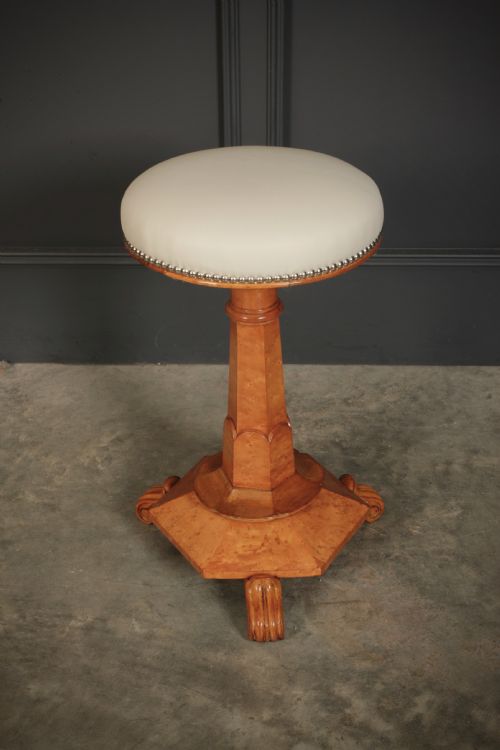
Revolving Wood Stool
A revolving wood stool brings practical mechanical movement and rich timber character to domestic and workspace settings alike.
Revolving Wood Stool
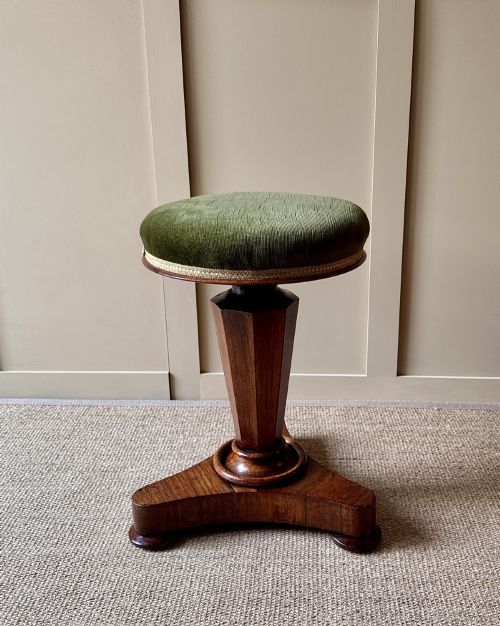
A revolving wood stool combines a swivelling or height-adjustable mechanism with timber construction, appearing in forms such as piano stools, music chairs, and industrial workshop seating. Buyers searching for a revolving wood stool encounter pieces spanning the Georgian, Regency, and Victorian periods, alongside later industrial designs from the twentieth century.
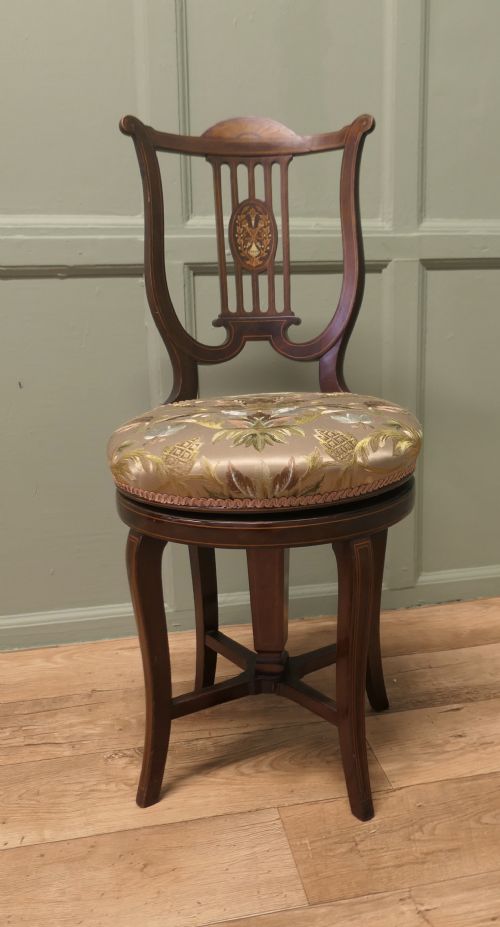
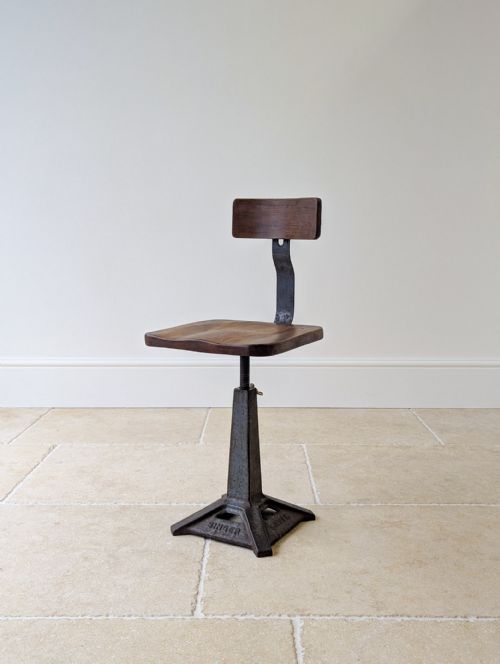
The domestic versions on this page predominantly take the form of piano stools or music chairs in mahogany, rosewood, and walnut, often featuring carved details or upholstered seats. Industrial variants bring together cast iron elements and wooden tops, reflecting the functional demands of workshops and factories from around nineteen thirty.
Makers such as Gillows, James Shoolbred, and H Brooks and Co. represent the higher tier of domestic production, while unbranded workshop and machinist chairs demonstrate purely utilitarian design. These items originate primarily from nineteenth and early twentieth century workshops, offering both adjustable height mechanisms and fixed revolving tops.
How they were made
Makers utilised dense hardwoods such as mahogany, rosewood, and walnut for the frames and seats, often employing carving, ebonising, or gilt painting to finish the timber. Domestic pieces frequently incorporate upholstered elements in fabric or velvet, sometimes paired with brass details.
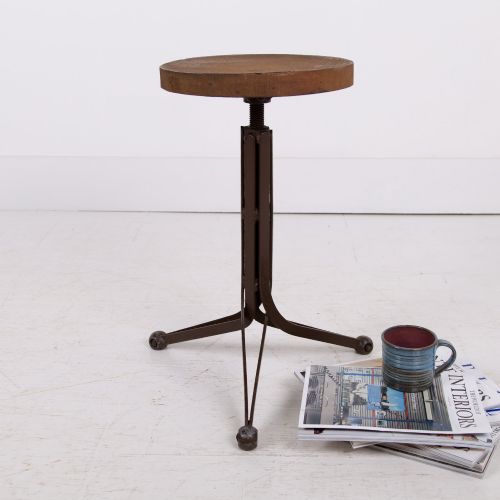
Industrial variants rely on robust combinations of cast iron and wood, welding or bolting metal screw mechanisms to elm or hardwood tops. The height adjustment relies on threaded screw shafts or rise and fall mechanisms that allow the seat to rotate smoothly.
Revolving Wood Stool Retail Price Guide 2026
Typical asking prices for revolving wood stool among the pieces listed under this phrase on Sellingantiques today, from the lower quarter to the upper quarter. They describe what is for sale here now, not the wider market.
Listings feature mahogany, rosewood, walnut, and cast iron across periods from the Georgian era to nineteen thirty.
What varies in quality
Quality rests in the precision of the turning mechanism and the choice of timber, where figured rosewood, burr walnut, and rich mahogany elevate a piece far above utilitarian pine or basic workshop stock. The complexity of the carving, from lyre backs to carved grotto details, distinguishes standard domestic seating from high-end cabinet maker production.
The integrity of the screw thread and the smoothness of the swivel movement determine the mechanical success of each example. Robust industrial cast iron combined with sound timber creates durability, while finer domestic pieces depend on tight joinery and well-preserved upholstery.
Gillows·James Shoolbred·H Brooks and Co.·Rubery Owen·Singer
The Revolving Wood Stool Glossary
- Revolving top
- A seat mechanism that rotates completely around its central axis without changing height. This allows the sitter to turn freely during musical performance or work.
- Rise and fall
- An adjustable height mechanism operated by turning the seat itself to raise or lower via a central wooden or metal screw. This system appears frequently on nineteenth century piano stools.
- Ebonised
- Timber treated with a finish to imitate expensive ebony. Makers utilised this technique on nineteenth century fruitwood and mahogany frames.
- Lyre back
- A chair back shaped in the form of an ancient Greek lyre. This decorative motif appears on musical seating from the Regency and Victorian eras.
- Padouk
- A heavy tropical hardwood with distinct reddish tones. It appears in nineteenth century overseas furniture production.
Revolving Wood Stool: Frequently Asked Questions
How do I adjust the height?
Many examples feature a central screw mechanism operated by rotating the wooden seat clockwise or anticlockwise to raise or lower the level.
Other variants utilise a rise and fall system secured by a side lever or thumb screw beneath the seat frame.
Were these made for pianos?
A large proportion of nineteenth century examples served specifically as piano stools or music chairs to accommodate the player's posture.
Others originated in workshops, drawing offices, and factories as heavy duty machinist or drafting seating.
What timbers were used?
Cabinet makers predominantly selected rich hardwoods including mahogany, rosewood, walnut, and birds eye maple for domestic music seating.
Industrial workshop stools typically paired sturdy elm or hardwood seats with robust cast iron bases.
How do I date these pieces?
Stylistic indicators such as Regency scrollwork, Victorian Arts and Crafts carving, or Art Deco geometry help establish the period of domestic items.
Industrial designs with cast iron components frequently date towards the early twentieth century around nineteen thirty.