

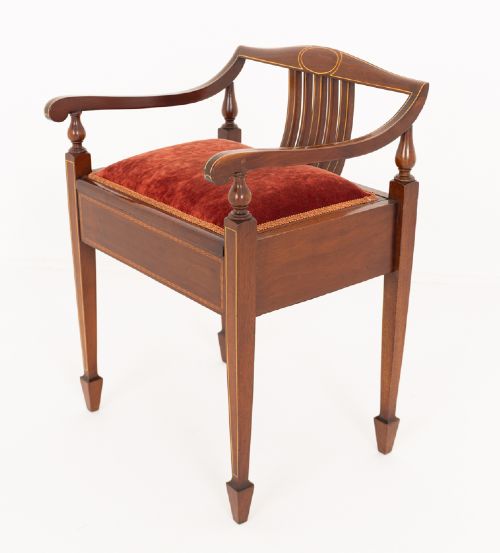


Revival Piano Bench
A revival piano bench brings refined period design to the music room, offering upholstered comfort alongside classic woodwork.
Revival Piano Bench
A revival piano bench encompasses pieces designed to support musicians during performance while echoing earlier historical aesthetics. When searching for a revival piano bench, buyers encounter forms ranging from single seats to duet configurations created across several distinct eras.
The pieces listed on this page span the Victorian and Edwardian periods, stretching back through the nineteenth century. Common manifestations include mahogany and walnut frames, frequently ornamented with intricate inlays or ebonised finishes.
Makers drew heavily on established historical idioms, producing items in Sheraton Revival, Georgian Revival, and Victorian Rococo Revival styles. Stools, benches, and adjustable variants dominate the available selections, often featuring upholstered pads in fabric or velvet.
Materials and construction methods
Craftsmen utilised robust hardwoods such as mahogany and walnut to form the structural framework of each bench. Satinwood inlay provided delicate surface contrast, while ebonised wood offered a dark, polished alternative to natural timber tones.
Upholstery formed an integral part of the manufacturing process, employing tactile textiles like velvet and standard fabric over padded seats. Metal components occasionally facilitated mechanical adjustments on specialised duet and single music stools.
Revival Piano Bench Retail Price Guide 2026
Typical asking prices for revival piano bench among the pieces listed under this phrase on Sellingantiques today, from the lower quarter to the upper quarter. They describe what is for sale here now, not the wider market.
Current listings demonstrate a strong representation of Edwardian and nineteenth century pieces, heavily featuring mahogany and walnut timbers alongside satinwood inlay.
Distinctions in craftsmanship and design
The refinement of the woodwork largely dictates the standing of an individual bench, separating standard utility pieces from ambitious revival works. Finer examples display meticulous satinwood inlay and deeply carved cabriole legs that reflect careful hand labour.
The integrity of the original upholstery and the smoothness of any mechanical adjustment mechanisms further distinguish superior items. Material selection, from dense walnut to plain ebonised timber, plays a defining role in the visual impact of the piece.
The Revival Piano Bench Glossary
- Sheraton Revival
- A late nineteenth and early twentieth century design movement that reinterpreted the light, neoclassical furniture forms of the eighteenth century. It frequently incorporates satinwood inlay and tapered legs.
- Ebonised wood
- Timber treated with a chemical stain or pigment to simulate the deep, dark appearance of ebony. This finish gained significant popularity during the nineteenth century.
- Duet stool
- An extended music bench designed to accommodate two players simultaneously. These wider seats often feature adjustable mechanisms or long upholstered pads.
- Cabriole leg
- A furniture leg that curves outward in a convex arc before tapering inward in a concave sweep, finishing at a pad or claw foot. This form is common in revival pieces referencing earlier Georgian and Victorian aesthetics.
Revival Piano Bench: Frequently Asked Questions
What is a revival piano bench?
A revival piano bench is a seat created during the nineteenth or early twentieth century that imitates historical furniture styles. These pieces were designed to provide comfortable seating for pianists while complementing period home interiors.
They combine functional seating with decorative woodwork, drawing inspiration from Georgian, Victorian, and Sheraton design principles.
How do I date a piano bench?
Dating involves examining the wood types, construction methods, and stylistic revival cues present in the piece. Pieces originating in the Edwardian era often display lighter satinwood inlays, whereas mid nineteenth century items lean toward heavier carved forms.
Matching the stylistic markers, such as Victorian Rococo Revival curves or Sheraton Revival proportions, helps narrow down the period of manufacture.
Were these benches used only for pianos?
While primarily built to accommodate musicians at keyboard instruments, many of these versatile seats served secondary purposes in drawing rooms and window alcoves. Duet variants provided extra seating capacity for multiple performers or casual parlour use.
Their decorative upholstered tops and polished wood frames made them suitable for placement throughout period reception rooms.
What materials are typical for these benches?
Primary construction relies on solid hardwoods, predominantly mahogany and walnut, chosen for their durability and attractive grain patterns. Decorative details often include satinwood inlay and ebonised wood surfaces.
Seats are typically finished with traditional upholstery materials, incorporating soft fabrics or rich velvet over internal padding.