
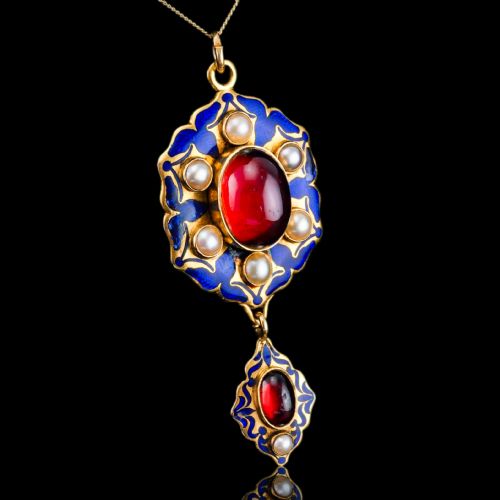


Renaissance Revival Jewellery
Renaissance revival jewellery combines historical motifs with nineteenth-century craftsmanship, offering collectors intricate gold, enamel, and gemstone pieces to wear.
Renaissance Revival Jewellery
Renaissance revival jewellery draws on historical design motifs from the sixteenth and seventeenth centuries, reinterpreted by nineteenth-century makers working in gold, silver gilt, and steel. When exploring renaissance revival jewellery, buyers encounter pendants, brooches, necklaces, and belt buckles that emulate earlier European aesthetics.
The objects appearing on this page span the Victorian era, the wider nineteenth century, and specific regional interpretations such as French, German, and Austro-Hungarian work. These pieces frequently incorporate pearls, enamel, and multi-gem settings alongside structural metalwork.
Beyond wearable ornaments, the selection includes decorative boxes, caskets, and table boxes sharing the same stylistic vocabulary of enamelling and appliques. Collectors find that these items bridge the gap between personal adornment and miniature sculptural art.
Materials and Techniques
Makers utilised high-karat gold, silver gilt, and steel as the structural base for these ornaments, often applying damascene techniques or intricate metal appliques. Iron and steel components appear in specific European caskets and belt buckles from the period.
Enamelling provides the vivid colour characteristic of these designs, complemented by baroque pearls, garnets, and various gemstones. Wood elements such as walnut, fruitwood, and ebony support bone-inlaid table caskets within the broader stylistic category.
St. George occasionally slays the dragon inside nineteenth-century enamel pendants.
Quality Variations
The refinement of the enamelling and the precision of the metal appliques separate standard production from superior examples. Master workshops executed finer details in stone settings and goldwork that remain crisp and secure.
The integration of diverse materials, such as combining bone inlay with hardwoods or balancing multiple gemstones with pearls, determines the visual harmony of each piece. Superior execution lies in the balance between the historicist design and the structural integrity of the mount.
Tissot
The Renaissance Revival Jewellery Glossary
- Silver gilt
- Silver that has been coated with a thin layer of gold on its surface. This technique provided the rich appearance of solid gold while utilising a different core metal.
- Damascene
- The art of inlaying different metals into a dark oxidized steel background to produce intricate patterns. French makers utilised this technique for decorative belt buckles and small metalware.
- Holbeinesque
- A nineteenth-century revival style inspired by the jewellery designs attributed to Hans Holbein the Younger. These pieces typically feature symmetrical arrangements of enamel, pearls, and pendant drops.
- Baroque pearl
- A pearl with an irregular, non-spherical shape. Makers incorporated these organic forms into pendants and brooches to add texture and natural asymmetry to formal historicist designs.
Renaissance Revival Jewellery: Frequently Asked Questions
What is renaissance revival jewellery?
Renaissance revival jewellery comprises nineteenth-century ornaments and decorative objects designed in imitation of sixteenth and seventeenth-century European styles. These pieces draw heavily on historical motifs, incorporating dense ornament, figural subjects, and rich colour.
Makers across France, Germany, and Austro-Hungary produced these items using gold, silver gilt, enamel, and precious stones. The category encompasses wearable items like pendants and necklaces alongside small caskets and boxes.
How do I date these pieces?
Dating relies on stylistic markers, hallmarking traditions, and the specific material combinations characteristic of the nineteenth century. Most examples date from the Victorian period through to the end of the nineteenth century.
Makers integrated historical revival styles with contemporary nineteenth-century manufacturing techniques. Examining the construction of the metal mounts and the style of the enamel work helps establish the precise era.
How were caskets decorated?
Caskets and table boxes from this period utilised techniques like bone inlay, metal appliques, and carved wood. Materials such as walnut, fruitwood, and ebony formed the structural body of the boxes.
Makers applied silver, enamel, and cameos to the exterior surfaces to match the aesthetic of contemporary jewellery. These decorative containers served both practical storage functions and display purposes.
What gemstones are typical?
Garnets, pearls, and multi-gem settings dominate the stone selection in these historical revival pieces. Baroque pearls are particularly common as pendant drops or central accents in brooches and necklaces.
Coloured gemstones were chosen to contrast against enamelled backgrounds and gold or silver gilt mounts. The combination created the rich, polychromatic effect desired by nineteenth-century collectors.