

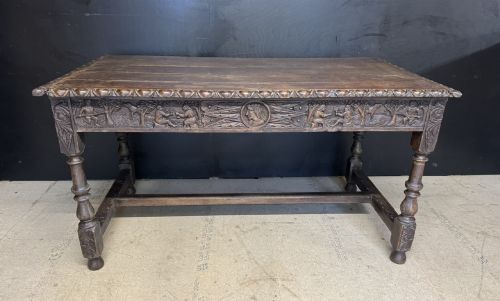


Renaissance Revival Console
A renaissance revival console brings nineteenth-century grandeur into a room, offering heavy carved timber and historic detail.
Renaissance Revival Console
When buyers search for a renaissance revival console, they are looking at nineteenth-century tables, sideboards, and wall brackets that borrow heavily from sixteenth-century European design. These pieces often manifest as console tables, centre tables, and hall tables created during the Victorian era.
The versions most commonly met on this page are constructed from walnut, oak, and golden oak, carrying the characteristic heavy carving of the nineteenth century. Examples span French and Italian interpretations of the style, occasionally incorporating bone inlay or majolica glaze.
Makers and craftsmen of this period utilised classical motifs, scrollwork, and figurative elements such as the Green Man. The resulting furniture serves both as functional surface space and as a striking architectural feature within an interior.
Materials and Construction
The construction relies heavily on durable hardwoods like walnut and oak, selected for their stability and capacity to hold deep, sculptural carving. Master carvers shaped these timbers to create elaborate friezes, legs, and surface supports.
Surface ornamentation frequently includes bone inlay, mother of pearl accents, and inset marble tops. Certain iterations integrate earthenware elements with a majolica glaze, reflecting the eclectic material palette of Victorian workshops.
Renaissance Revival Console Retail Price Guide 2026
Typical asking prices for renaissance revival console among the pieces listed under this phrase on Sellingantiques today, from the lower quarter to the upper quarter. They describe what is for sale here now, not the wider market.
Object forms span centre tables, console tables, wall brackets, cabinets, and buffets.
Assessing Quality and Craftsmanship
Quality in these pieces is determined by the depth, crispness, and ambition of the carving rather than mere age alone. Work by named master carvers displays an anatomical precision and fluidity in figures and foliage that separates standard production from exceptional artistry.
The selection of timber grain and the integration of secondary materials, such as bone inlay or marble, dictate the upper tier of the range. Finer examples maintain structural integrity in their joints while exhibiting intricate scrollwork that remains sharp and well-defined.
Luigi Frullini·Minton
The Renaissance Revival Console Glossary
- Console table
- A table designed to be fixed against a wall, frequently supported by ornate brackets or legs at the front. These pieces traditionally stood in hallways and formal reception rooms.
- Renaissance Revival
- A nineteenth-century design movement that drew inspiration from the art and architecture of the fifteenth and sixteenth centuries. It is characterised by classical symmetry and heavy relief carving.
- Majolica glaze
- A colourful, opaque tin-glazed earthenware technique popular during the Victorian period. It provides a glossy, vibrant surface often seen on decorative brackets and architectural elements.
- Green Man
- A sculptural motif depicting a face made of or entwined with leaves, vines, and branches. This symbol of rebirth appears frequently in nineteenth-century oak furniture.
- Pier lamp table
- A small table designed to fit against the wall between windows, often beneath a mirror. These surfaces held lighting fixtures in Victorian interiors.
Renaissance Revival Console: Frequently Asked Questions
What is a renaissance revival console?
A renaissance revival console is a nineteenth-century table built with heavy timber and historic motifs inspired by the sixteenth century.
These pieces were designed for grand hallways and reception rooms, functioning as both display surfaces and architectural statements.
How do I style a console table?
These tables suit traditional or eclectic interiors where their dark wood and heavy carvings can anchor a room.
Pinned against a wall or beneath a mirror, they provide a strong focal point without requiring additional decoration.
What woods were used?
Furniture from this period relies primarily on walnut and oak, including golden oak variants.
These dense timbers allowed carvers to execute deep, durable relief work that has survived well into the modern era.
How do I identify the period?
The nineteenth-century date is often revealed through the combination of Renaissance motifs with Victorian manufacturing methods and timber selection.
Details like bone inlay, majolica elements, and specific regional styles help narrow down the origin.