


Regency Style Curule Seat
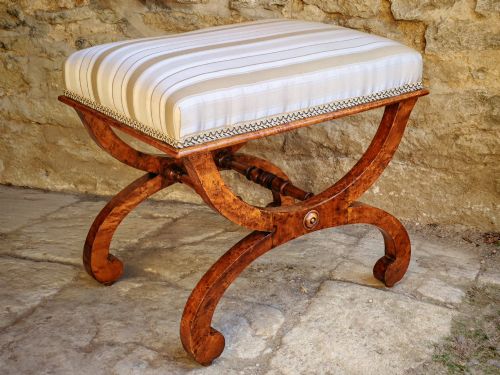
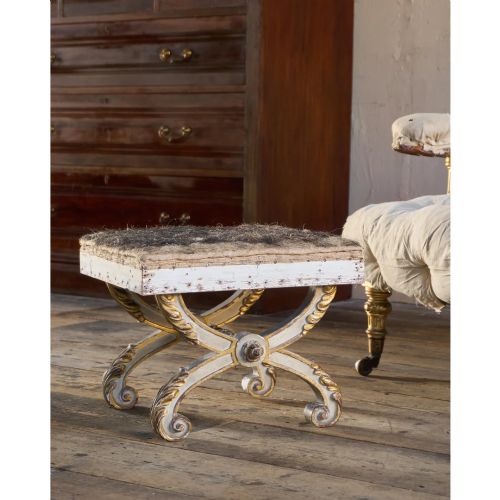
These regency style curule seat pieces offer a classical X-frame form derived from ancient Rome, bringing stately architectural proportion to any interior.
Regency Style Curule Seat
A regency style curule seat embodies the neoclassical revival of the nineteenth century, drawing direct inspiration from Roman magistrates' folding chairs. The form typically manifests as a stool, footstool, or window seat where the supporting legs cross in an elegant X-shape.
Most examples found in this selection date across the nineteenth century, with specific pieces linked to Georgian, Regency, and French or Italian Empire idioms. Buyers frequently encounter variants ranging from simple mahogany footstools to large window seats framed in giltwood and gesso.
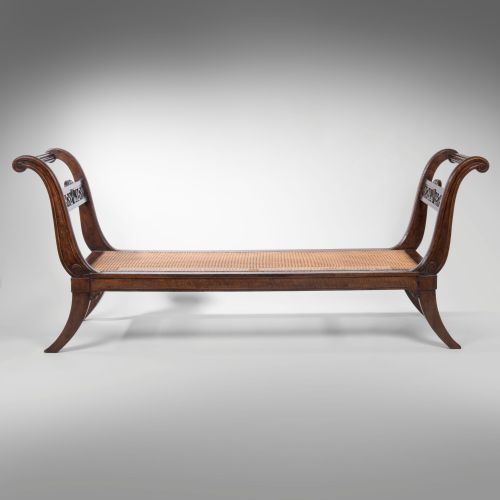
Seating arrangements of this type serve both utilitarian and decorative functions within a room. They appear as armchairs, ottomans, and benches, often upholstered in rich velvet or fitted with cane seats.
Construction and materials
Makers constructed these frames using dense timbers such as mahogany and burr maple, alongside carved giltwood. Selected woods provided the structural integrity required to support the intersecting X-frame tension.
Surface ornamentation relied on applied gesso and gilt finishes to achieve the opulent neoclassical aesthetic. Artisans incorporated brass mounts and intricate upholstery in silk or velvet to complete the design.
Judging quality in curule seating
Superior execution is evident in the sharpness of the carved details along the X-frame and the fluidity of the neoclassical motifs. Lesser examples display softer lines and simpler, unadorned wooden junctions.
The choice of primary timber and the sophistication of the gilding dictate the overall standing of an individual piece. Finer items utilise burr maple or intricate giltwood, whilst simpler domestic versions rely on plain mahogany or basic wood.
Miles & Edwards
The Regency Style Curule Seat Glossary
- Curule
- An ancient Roman chair shape characterised by crossing legs that form an X. This classical silhouette was heavily revived during the Regency and Empire periods.
- Giltwood
- Timber that has been coated with gold leaf or a gold-coloured substance. This finish was favoured in neoclassical and Empire furniture to catch the light.
- Gesso
- A plaster-like mixture applied to wood surfaces as a base for gilding or painting. It allows craftsmen to carve intricate relief ornamentation before applying gold leaf.
- Neoclassical
- A style spanning the eighteenth and nineteenth centuries that revived the architectural and decorative motifs of classical antiquity. It emphasises symmetry, straight lines, and classical proportions.
- X-frame
- A furniture base formed by two intersecting structural members. This geometry provides both stability and a distinctive visual rhythm.
Regency Style Curule Seat: Frequently Asked Questions
What is a curule seat?
A curule seat is a piece of furniture featuring intersecting X-shaped legs inspired by ancient Roman magistrate chairs. These seats span stools, benches, and window seats.
They gained immense popularity during the neoclassical revival, becoming a staple of Regency and Empire interior decoration.
Where should I place a window seat?
Window seats fit naturally beneath low windowsills or at the foot of a bed. Their low profile ensures they do not obstruct outside views.
They also function effectively in hallways or living spaces as occasional perches that introduce classical geometry to the room.
How do I identify a Regency period piece?
Regency items often display restrained classical lines, dark timbers like mahogany, and architectural restraint. They frequently incorporate brass details and sabre legs.
Comparing the construction methods and decorative motifs against known nineteenth-century examples helps confirm the era.
What is the difference between Empire and Regency styles?
Empire style originates from Napoleonic France and tends to be heavier, with abundant gilt bronze mounts and overt imperial symbols. Regency style developed concurrently in Britain and often favours lighter woods and more understated classical references.
Both styles, however, draw heavily from Roman and Greek antiquity.