



Regency Rosewood Music Rack
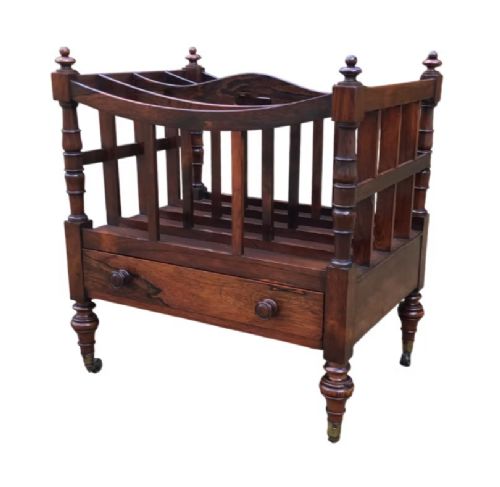
A regency rosewood music rack is a refined piece of early nineteenth-century furniture designed to hold sheets, folios and journals with elegance.
Regency Rosewood Music Rack
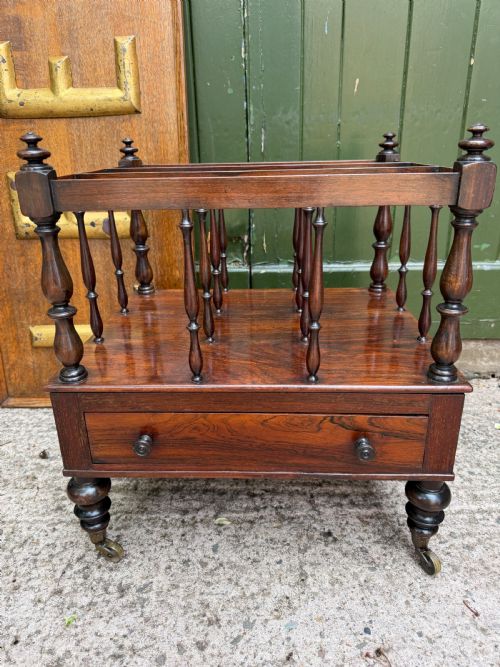
A regency rosewood music rack most commonly takes the form of a canterbury, featuring upright dividers and a low compartment for storing scores, newspapers or magazines. These pieces originate primarily from the Regency, George IV and William IV periods of the nineteenth century.
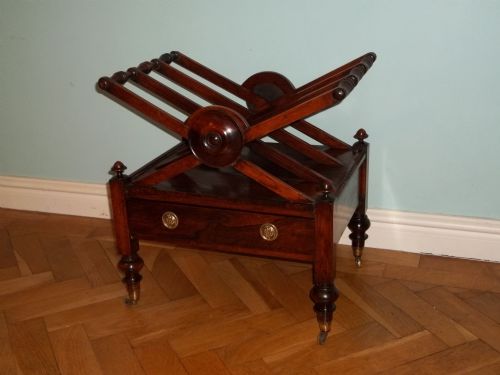
The form appears in various configurations, including boat-shaped designs, double-size proportions, folio stands and music stands with carrying handles. Many examples stem from English country house traditions and reflect specific cabinet-making influences such as the designs of J. C. Loudon or Gillows.
How they were made
Cabinet-makers constructed these pieces predominantly from dense rosewood, often paired with secondary timbers for internal structures, complemented by contrasting brass details and intricate inlay. Carved elements such as Prince of Wales feathers frequently adorned the upright supports.
Joinery techniques focused on creating stable divisions and sturdy carrying handles capable of supporting heavy folios and bound music sheets without compromising the decorative frame.
Regency Rosewood Music Rack Retail Price Guide 2026
Typical asking prices for regency rosewood music rack among the pieces listed under this phrase on Sellingantiques today, from the lower quarter to the upper quarter. They describe what is for sale here now, not the wider market.
Current listings span the Regency, George IV, and William IV periods, executed in rosewood and mahogany with brass and inlay.
What varies in quality
Quality rests in the crispness of the carved ornamentation, the grain pattern of the rosewood timber and the proportion of the divisions. Pieces bearing maker attributions or specific design influences command higher regard among collectors.
Structural refinement in the turning of the legs, the integration of brass castors and the precision of the inlay work distinguish standard workshop production from superior cabinet-making.
Gillows
The Regency Rosewood Music Rack Glossary
- Canterbury
- A low stand with upright divisions used for holding music, newspapers and folios. It typically incorporates a carrying handle and a small drawer or compartment at the base.
- Rosewood
- A heavy, durable timber featuring rich dark grain patterns favoured during the nineteenth century for high-status cabinet work. It takes a high polish.
- Folio Stand
- A larger standing rack designed specifically for loose sheets of music, maps or large books. These often feature adjustable or rigid frames.
- Prince of Wales Feathers
- A carved decorative motif consisting of three ostrich feathers encircled by a coronet. It appears frequently on carved wooden mounts of the period.
Regency Rosewood Music Rack: Frequently Asked Questions
What is a music canterbury?
A music canterbury is a compartmentalised stand designed to hold sheet music, folios and periodicals within easy reach of an instrument.
These pieces typically feature slatted vertical divisions and a carrying handle so they could be moved around a drawing room.
How were these racks used historically?
They served in country house drawing rooms and music rooms to keep scores and daily newspapers organised and accessible.
The inclusion of a carrying handle allowed servants or family members to transport the reading material to different seating areas.
What is the difference between a canterbury and a folio stand?
A canterbury is generally a compact piece with divided compartments for folded or bound music and a low drawer, often fitted with castors.
A folio stand is typically larger and built to hold oversized sheets flat or upright without folding.